Bermuda Grass
Bermuda grass (Cynodon dactylon) is a perennial turfgrass belonging to the Poaceae family. Native to the Mediterranean region, this plant is widely utilized…
What is Bermuda grass?
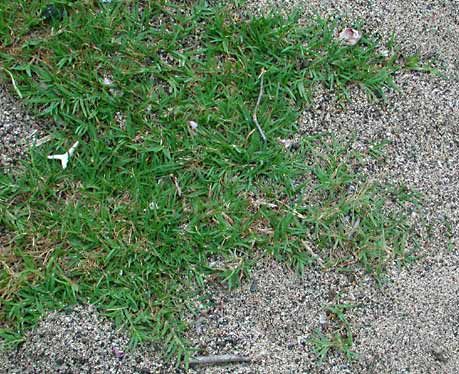
Bermuda grass (Cynodon dactylon) is a perennial turfgrass belonging to the Poaceae family. Native to the Mediterranean region, this plant is widely utilized in warm climates for lawns, pastures, and golf greens1.1
The plant typically reaches heights of 10 to 40 cm (4 to 16 inches) and features short, flat leaves. Its ability to form a dense turf is driven by its extensively creeping stolons and rhizomes, which are horizontal stems that grow above and below the ground, respectively. While valued for its utility, it is classified as an invasive species in Bermuda and several other regions outside of its native range.2
What are stolons and rhizomes?
Stolons and rhizomes are specialized plant stems that facilitate vegetative reproduction, allowing plants to propagate asexually and spread across an area.34
Stolons
Also known as runners, stolons are slender, horizontal stems that grow above the soil surface. They feature nodes from which roots and new aerial branches can develop, effectively creating new plantlets when they make contact with moist soil. A common example of a plant that uses stolons for propagation is the strawberry.534
Rhizomes
Rhizomes are horizontal, usually subterranean stems that serve as both storage organs and a means of reproduction. Unlike roots, they possess nodes with reduced leaves and internodes. They store starches and proteins, which help the plant survive unfavorable seasons like drought or winter. Many plants, including bamboo, ginger, and most grasses, rely on rhizomes to send up new shoots and expand their colonies.634
Why is Bermuda grass considered an invasive species in some areas?
Bermuda grass is considered an invasive species in many regions outside its native Mediterranean range primarily due to its aggressive growth habit. Its extensive system of creeping stolons and rhizomes allows it to spread rapidly and establish a dense, persistent turf that can outcompete native vegetation for resources like space, water, and nutrients.1
Because these horizontal stems grow both above and below the ground, the plant is highly resilient and difficult to eradicate once it has colonized an area. This ability to form thick, expansive mats makes it a significant ecological disruptor in non-native environments, such as Bermuda, where it can displace local plant species and alter natural habitats.1
What are the main differences between warm-season and cool-season grasses?
The primary difference between warm-season and cool-season grasses lies in their photosynthetic pathways, which dictate their optimal environmental conditions and growth patterns.
Photosynthetic Pathways
- Warm-Season Grasses (C4 Plants): These grasses utilize the C4 carbon-fixation pathway. They initially fix carbon dioxide into a four-carbon acid, which allows them to suppress photorespiration and function efficiently in high-light, warm, and dry environments. Because their primary enzyme is saturated at lower CO2 concentrations, they can keep their stomata less open, conserving water.91
- Cool-Season Grasses (C3 Plants): These grasses use the C3 pathway, where the first stable product is a three-carbon acid. They are generally more efficient in colder, wetter climates with lower light intensity. In hot conditions, their efficiency drops because the enzyme Rubisco begins to act as an oxygenase, leading to significant carbon loss through photorespiration.71
Growth and Adaptation
Warm-season grasses, such as Bermuda grass and Zoysia, thrive during the heat of summer. Conversely, cool-season grasses, such as bluegrass and fescue, are better adapted to temperate regions where they can avoid the high-temperature stress that penalizes C3 photosynthesis.81
Sources
- Bermuda grass — Encyclopædia Britannica
- Bermuda grass — Merriam-Webster
- stolon — Encyclopædia Britannica
- rhizome — Encyclopædia Britannica
- angiosperm - Shoot system modifications — Encyclopædia Britannica
- vegetative reproduction — Encyclopædia Britannica
- list of plants in the family Poaceae — Encyclopædia Britannica
- list of economically important members of the family Poaceae — Encyclopædia Britannica
- photosynthesis - Differences in carbon fixation pathways — Encyclopædia Britannica
- Grassland - Environment — Encyclopædia Britannica
- plant - Specific variations in photosynthesis — Encyclopædia Britannica
Published on · 3 min read