Bess Beetle
Bess beetles, members of the family Passalidae, are primarily found in tropical regions, though a small number of species inhabit North America.
Where are bess beetles typically found, and what is their preferred habitat?
Bess beetles, members of the family Passalidae, are primarily found in tropical regions, though a small number of species inhabit North America.1
Their preferred habitat consists of decaying logs, where they live in social aggregations beneath the bark. These beetles are uniquely adapted to this environment, as both males and females process the decaying wood to feed their larvae, a form of social cooperation rarely seen outside of termite societies. Because they are gregarious, they are frequently found in groups rather than as solitary individuals.123
What are the distinctive physical characteristics of bess beetles?
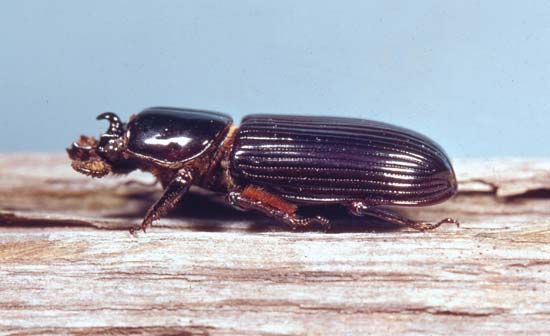
Bess beetles (family Passalidae) possess several distinctive physical characteristics that make them easily identifiable:
- Size: They are relatively large insects, typically measuring between 30 and 40 mm (1.2 to 1.6 inches) in length.1
- Color and Texture: They are known for their shiny black wing covers, or elytra, which have earned them the nickname “patent-leather beetles”.1
- Body Shape: Their bodies are notably flat and squarish in appearance.14
- Head Features: A defining trait is the presence of a horn on the top of the head that points forward.1
- Sound-Producing Structures: Adults possess specialized rough patches on the abdomen that they rub their wings against to create sound.1
How do bess beetles communicate with each other?
Bess beetles communicate primarily through sound, a behavior known as stridulation. This method of communication is unique because it is utilized by both adults and larvae, and the sounds produced are audible to humans.1
The mechanisms for creating these sounds differ by life stage:
- Adults: They produce sound by rubbing their wings against rough, file-like patches located on their abdomen.1
- Larvae: They generate sound by rubbing their vestigial (degenerate) hind pair of legs against their middle pair of legs.1
This acoustic communication is essential for their primitive social organization, allowing individuals living together in decaying logs to interact within their colony. While many other beetle species also use stridulation—often for mutual sex calling—the specific use of these sounds in bess beetles facilitates their unique social cooperation, such as the sharing of food between adults and larvae.16
Are there any predators that commonly prey on bess beetles?
Sorry, the Britannica knowledge base does not contain specific information regarding predators that commonly prey on bess beetles. While it is noted that beetles in general are often well-armored and protected against enemies, and that they may be consumed by birds, bats, reptiles, frogs, and other insects, the provided text does not identify specific predators for the family Passalidae.1
Sources
- bess beetle — Encyclopædia Britannica
- Coleoptera - Distribution and abundance — Encyclopædia Britannica
- bess-bug — Merriam-Webster
- Passalidae — Merriam-Webster
- passalid — Merriam-Webster
- Coleoptera - Sound production — Encyclopædia Britannica
- Chemoreception - Pheromones — Encyclopædia Britannica
- Coleoptera - Feeding habits and habitats — Encyclopædia Britannica
- Coleoptera - Beetles as prey — Encyclopædia Britannica
Published on · 2 min read