Big Rock Candy Mountain
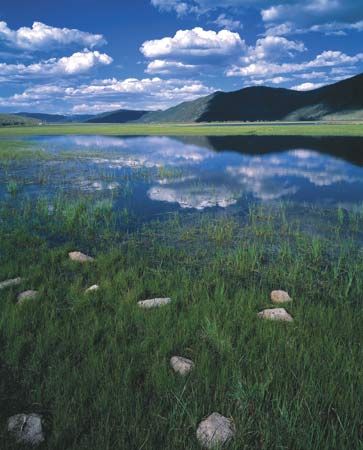
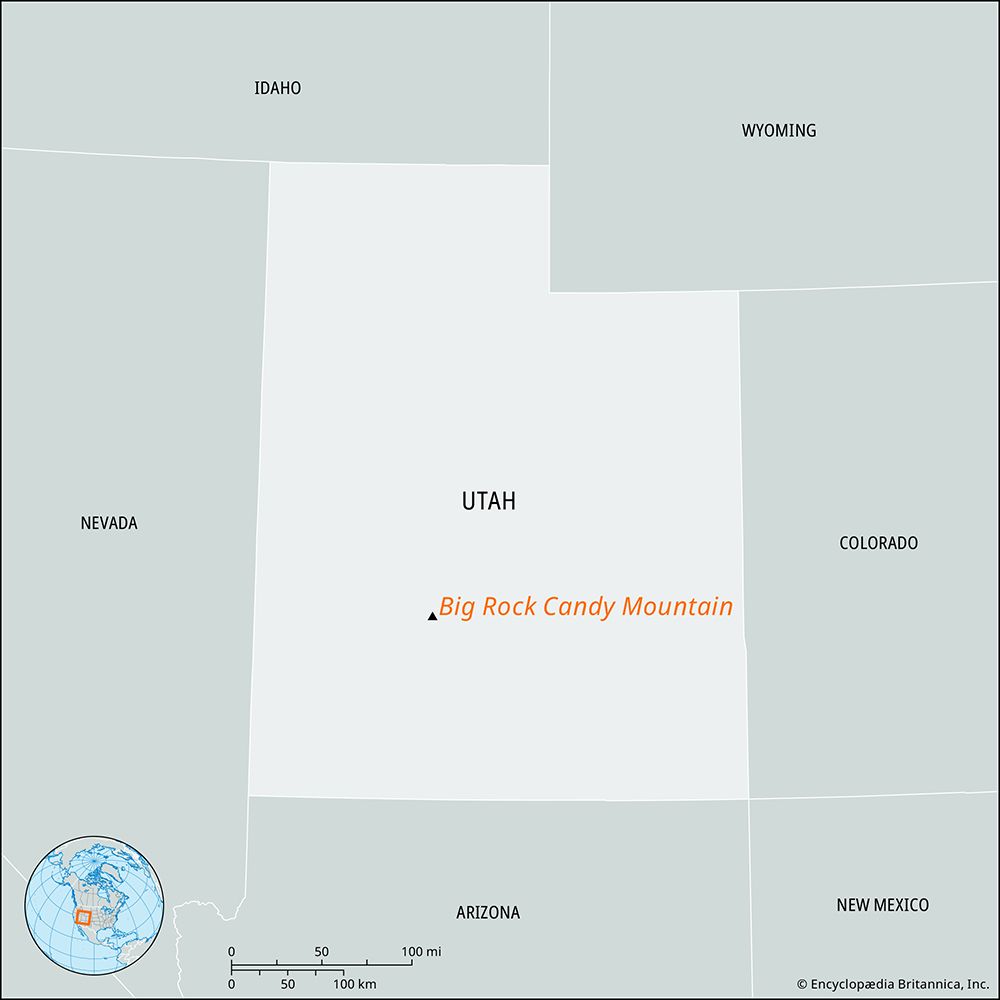
Big Rock Candy Mountain is a complex of carbonate hills located near Marysvale in south-central Utah, U.S. Standing approximately 5,500 feet tall, these…
What is Big Rock Candy Mountain?
Big Rock Candy Mountain is a complex of carbonate hills located near Marysvale in south-central Utah, U.S. Standing approximately 5,500 feet tall, these hills are noted for their distinctive striped dun and rose coloration.1
The site was named by workers on the Denver and Rio Grande Railroad. One of these workers, a brakeman named Harry McClintock, later wrote the famous song “Big Rock Candy Mountain,” which depicts a hobo’s whimsical vision of an ideal life. Following the song’s rise to popularity in the late 1920s, the area became a well-known tourist destination, featuring a resort situated along the Sevier River1.
Who was Harry McClintock and what was his life like?
Harry McClintock was a railroad brakeman who gained recognition for composing the song “Big Rock Candy Mountain.” While the provided search results confirm his role as a railroad worker and songwriter, they do not contain further biographical details regarding his life or personal history.2
What is the history of hobo culture in the United States?
A hobo is defined as a person without a permanent residence who travels from place to place, often by furtively hopping onto trains, to perform seasonal labor or odd jobs. While the term is sometimes used disparagingly, it has also been adopted as a neutral or positive self-descriptor, historically associated with an adventurous life free from traditional societal obligations.3
The term first appeared in the United States around 1885, and the practice of living or traveling in this manner is referred to as hoboism. Unlike other terms for homeless wanderers—such as tramps or bums, which may imply idleness—the hobo is distinguished by the willingness to work for a living while traveling.4536
Because the origin of the word remains unknown, historical documentation of the culture relies largely on linguistic records and cultural accounts, such as those by Jack London, who described the hobo’s life as one defined by the present moment and the freedom to drift with chance.3
How did the railroad industry influence American folk music?
The railroad industry significantly influenced American folk and country music by providing a rich source of imagery and archetypes that resonated with listeners during periods of major social upheaval. As the United States underwent large-scale population shifts during the Great Depression and World War II, the railroad worker emerged as a central, mythical figure in the American consciousness.9
Early country music frequently utilized these figures—alongside cowboys, miners, and farmers—to anchor the genre in rural traditions and themes of loneliness and displacement. This association helped musicians connect with audiences who were often far from home and struggling with the challenges of industrialization and economic hardship. While some performers adopted these identities as a stylistic image, others drew from genuine personal experiences, grounding the music in a sense of authenticity that defined the genre’s evolution through the mid-20th century.9
Sources
- Big Rock Candy Mountain — Encyclopædia Britannica
- Jimmy McHugh — Encyclopædia Britannica
- hobo — Merriam-Webster
- bum — Merriam-Webster
- Hoodoo - Origins and history — Encyclopædia Britannica
- hobo — Merriam-Webster
- hoboism — Merriam-Webster
- hobo — Merriam-Webster
- country music - Singing cowboys, Western swing, and honky-tonk — Encyclopædia Britannica
Published on · 2 min read