Bindweed
Bindweed refers to plants within the genera Convolvulus and Calystegia, which belong to the morning glory family, Convolvulaceae.
What are the defining characteristics of bindweed plants?
Bindweed refers to plants within the genera Convolvulus and Calystegia, which belong to the morning glory family, Convolvulaceae.1
These plants are generally characterized by the following traits:
- Growth Habit: Most are twining or trailing perennial plants that often grow from creeping underground stems or rhizomes.1
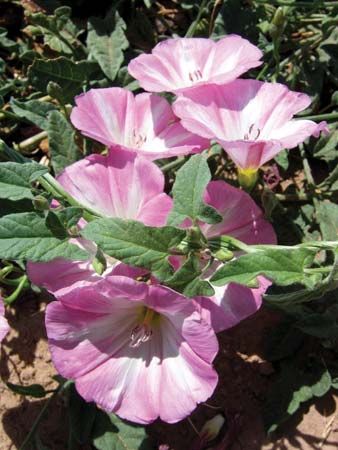
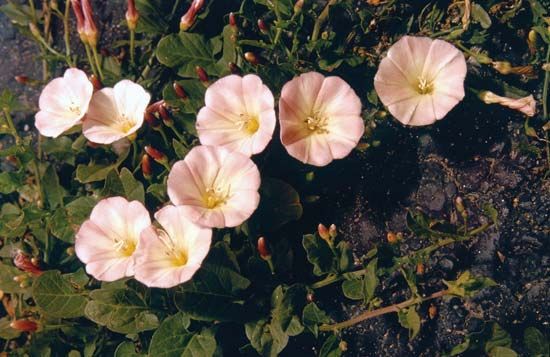
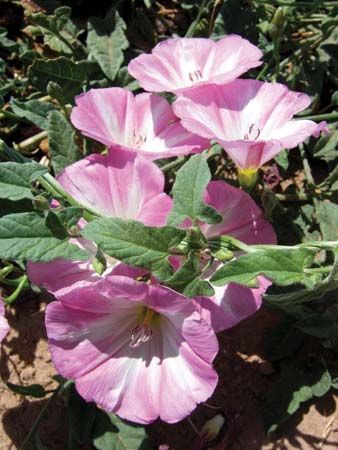
- Flowers: They produce distinct, funnel-shaped flowers that appear in shades of white, pink, or blue.1
- Leaves: Many species, such as the common field bindweed (C. arvensis) and hedge bindweed, feature arrow-shaped leaves, though others like the seashore false bindweed have fleshy, kidney-shaped foliage.1
- Ecological Impact: While some are ornamental, many are considered aggressive weeds that twine around other plants, often becoming problematic in agricultural settings or along roadsides.21
What are the different species of bindweed found around the world?
Bindweed refers to various twining plants within the genera Convolvulus and Calystegia of the morning glory family (Convolvulaceae). Several notable species are found across different regions:23
- Hedge Bindweed (Calystegia sepium): Also known as bellbine, this perennial is native to Eurasia and North America. It is characterized by arrow-shaped leaves and white to pink flowers, commonly found in hedges, woods, and along roadsides.2
- Field Bindweed (Convolvulus arvensis): Native to Europe but widely naturalized in North America, this aggressive, weedy perennial is known for twining around crops. It produces fragrant, long-stalked flowers in shades of pink, white, or striped.2
- Seashore False Bindweed (Calystegia soldanella): This species features fleshy, kidney-shaped leaves and deep pink blooms. It is typically found creeping along sand and gravel in European coastal areas.2
- Scammony (Convolvulus scammonia): A trailing perennial native to western Asia, this plant is historically significant for its rhizomes, which are used to derive a purgative.2
What is the scientific classification of bindweed plants?
Bindweed plants are classified within the morning glory family, known as Convolvulaceae, which falls under the order Solanales.26
The term “bindweed” refers to plants belonging to two closely related genera:
- Convolvulus: A genus comprising approximately 100 species of erect, trailing, or twining herbs and shrubs.36
- Calystegia: A smaller genus of twining or prostrate perennial herbs. While sometimes included within Convolvulus, this genus is distinguished by the presence of large bracts located beneath the calyx.7
These plants are characterized by their funnel-shaped flowers and, in many cases, a twining growth habit.26
What are some common nicknames for bindweed, and why are they used?
Bindweed plants are frequently referred to by several common nicknames, which often reflect their physical characteristics or their reputation as invasive weeds.
- Wild Morning Glory: This is a common name for both field bindweed (Convolvulus arvensis) and hedge bindweed (Calystegia sepium). The name is used because these plants belong to the morning glory family (Convolvulaceae) and share the characteristic funnel-shaped flowers associated with that group.129
- Bellbine: This name is specifically applied to hedge bindweed (Calystegia sepium). It is used to describe the plant’s bell-shaped flowers and its tendency to grow in or over hedges.9
- Creeping Jenny: This term is sometimes used to refer to field bindweed. The name highlights the plant’s growth habit, as it spreads via creeping underground stems and often mats or interlaces with other vegetation.4910
These names are generally used to describe the plants’ twining nature, as they often “bind” or mat together with the plants they grow among.10
Sources
- field bindweed — Merriam-Webster
- Bindweed — Encyclopædia Britannica
- Calystegia — Merriam-Webster
- bindweed — Merriam-Webster
- hedge bindweed — Merriam-Webster
- convolvulus — Merriam-Webster
- Convolvulaceae — Merriam-Webster
- Convolvulaceae — Encyclopædia Britannica
- wild morning glory — Merriam-Webster
- creeping Jenny — Merriam-Webster
Published on · 3 min read