Cypress Vine
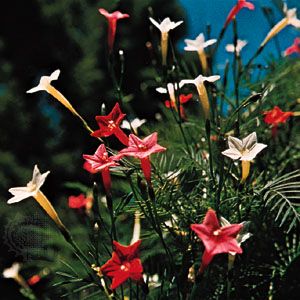
The cypress vine (Ipomoea quamoclit) is a tropical American twining climber that has become naturalized in southern North America.
What is Cypress vine?
The cypress vine (Ipomoea quamoclit) is a tropical American twining climber that has become naturalized in southern North America.1
As a member of the morning glory family (Convolvulaceae), this annual plant is characterized by its finely dissected, deeply lobed leaves and star-shaped tubular flowers, which typically appear in shades of scarlet, pink, or white. It is often compared to the closely related star ipomoea (I. coccinea), which features similar crimson blooms but possesses heart-shaped leaves.12
What other plants belong to the morning glory family?
The Convolvulaceae family, commonly known as the morning glory family, comprises approximately 1,600 species across 59 genera. While many members are recognized as twining vines, the family also includes various herbs, shrubs, and trees.34
Notable plants within this family include:
- Food Crops: The sweet potato (Ipomoea batatas) is the most economically significant member, valued for its edible tuberous roots.354
- Ornamentals: Various species of morning glories (Ipomoea), such as the common morning glory, heavenly blue morning glory, and the fragrant, night-blooming moonflower, are widely cultivated for their showy, funnel-shaped flowers.364
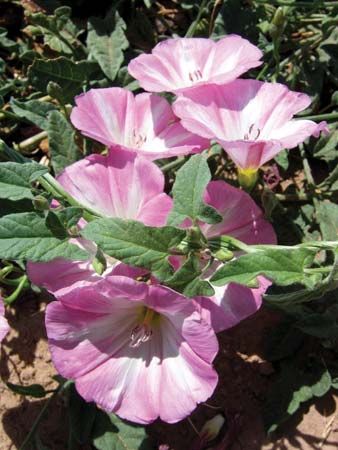
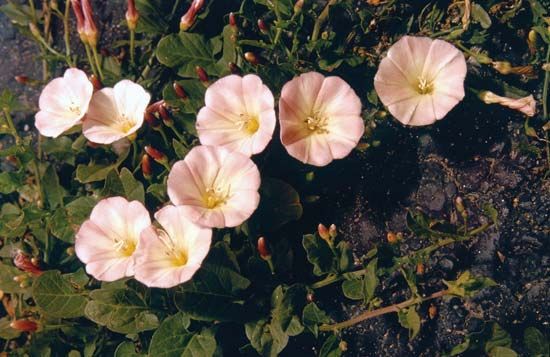
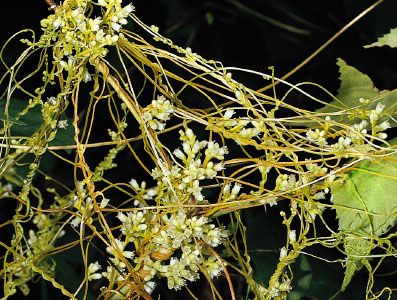
- Weeds and Parasites: Bindweeds (Convolvulus and Calystegia) are often considered agricultural pests. Additionally, the genus Cuscuta, known as dodder, consists of leafless parasitic plants that derive nourishment from host plants.34
- Other Notable Genera: The family includes Evolvulus and Merremia (wood rose).34
Some species, such as Ipomoea violacea and Turbina corymbosa, are historically significant for containing alkaloids similar to LSD.364
How do annual plants differ from perennials?
The primary difference between annual and perennial plants lies in the duration of their life cycles and their ability to survive from one growing season to the next.
Annual Plants
An annual is a plant that completes its entire life cycle—germination, growth, flowering, and seed production—within a single growing season. Once the plant has produced seeds, it undergoes a programmed senescence and dies. The survival of the species from one year to the next depends entirely on the dormant seeds left behind in the soil. Common examples include corn, beans, and marigolds.8910
Perennial Plants
A perennial is a plant that persists for several years. While the aboveground portions of herbaceous perennials may die back at the end of each growing season, the plant survives through specialized underground structures such as bulbs, rhizomes, tubers, or corms. These structures allow the plant to produce new growth when favorable conditions return. All trees and shrubs are perennials, as are many garden favorites like chrysanthemums and peonies.119
What types of pollinators are attracted to Cypress vines?
The Cypress vine (Ipomoea quamoclit) is a member of the morning glory family known for its star-shaped, scarlet-colored blooms. While the provided search results do not explicitly list the specific pollinators for this plant, its floral characteristics—specifically its bright red color, tubular shape, and lack of a landing platform—align with the “ornithophilous” (bird-loving) pollination syndrome.131
In the Americas, where the Cypress vine is naturalized, these traits are highly attractive to hummingbirds. Bird-pollinated flowers typically rely on the visual acuity of birds, who are particularly sensitive to the red end of the light spectrum, and provide copious amounts of nectar to sustain the high metabolism of these visitors. Additionally, because the flowers are tubular and lack a landing platform, they are well-suited for pollinators that hover while feeding, such as hummingbirds or certain species of hawk moths, which are also known to visit red, tubular flowers.11415
Sources
- Cypress vine — Encyclopædia Britannica
- cypress vine — Merriam-Webster
- Convolvulaceae — Encyclopædia Britannica
- Morning glory — Encyclopædia Britannica
- Convolvulaceae — Merriam-Webster
- Sweet potato — Encyclopædia Britannica
- Solanales - Convolvulaceae — Encyclopædia Britannica
- Is That Plant 'Perennial' or 'Annual'? — Merriam-Webster
- Annual — Encyclopædia Britannica
- Perennial — Encyclopædia Britannica
- Angiosperm - General features — Encyclopædia Britannica
- Plant development - Senescence in plants — Encyclopædia Britannica
- Asparagales - Pollination — Encyclopædia Britannica
- Major types of pollinators - Butterflies and moths — Encyclopædia Britannica
- Pollination - Butterflies and moths — Encyclopædia Britannica
- Pollination - Birds — Encyclopædia Britannica
Published on · 3 min read