Binturong
The binturong (Arctictis binturong) is a catlike omnivore belonging to the civet family (Viverridae). Native to the dense forests of Southeast Asia, this…
What is binturong?
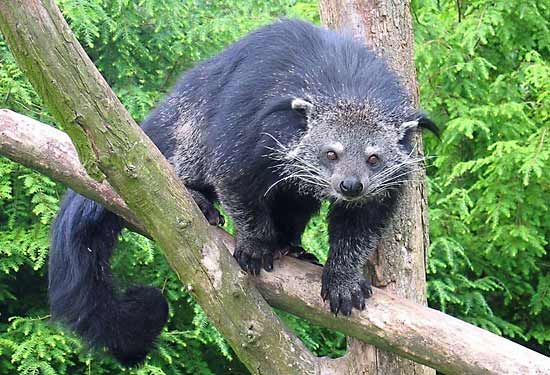
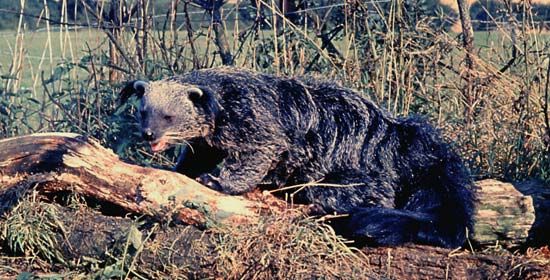
The binturong (Arctictis binturong) is a catlike omnivore belonging to the civet family (Viverridae). Native to the dense forests of Southeast Asia, this animal is characterized by its long, shaggy black hair, tufted ears, and a long, bushy, prehensile tail used to assist in climbing trees.1
Primarily nocturnal and crepuscular, the binturong feeds largely on fruit, such as figs, though it also consumes eggs and small animals. While they are sometimes kept as affectionate pets, the species is currently classified as vulnerable. Populations have been in decline since the 1980s due to deforestation, habitat loss, and hunting pressure.1
What does it mean for an animal to have a prehensile tail?
A prehensile tail is a specialized adaptation found in certain arboreal animals that functions as a “fifth limb,” providing increased mobility, stability, and support while navigating through trees.2
Essentially, a tail is considered prehensile if it is capable of grasping or habitually used to cling to aerial supports. In many species, these tails are strong enough to support most of the animal’s body weight, allowing them to anchor themselves securely to branches or bridge gaps between supports.3
This evolutionary trait is particularly advantageous for animals living in complex forest environments, such as spider monkeys, chameleons, and various snakes, as it helps them maintain balance and maneuver safely at the periphery of tree crowns where branches are slender and flexible. By acting as a grasping appendage, the prehensile tail enhances an animal’s ability to move effectively through the canopy, reducing the risk of falling.234
Why do binturongs smell like buttered popcorn?
The premise that binturongs smell like buttered popcorn is a widely cited observation, but it is important to clarify that this specific chemical characteristic is not mentioned in the provided Britannica entry for the species.
While the binturong is a fascinating omnivore native to the forests of Southeast Asia, the available scientific documentation focuses on its physical traits—such as its shaggy hair, tufted ears, and prehensile tail—as well as its ecological status as a vulnerable species. The provided information does not contain data regarding the specific scent profile of the animal or the chemical compounds that might produce such an aroma.
What are some other animals in the civet family?
The family Viverridae consists of 35 species of small, slender-bodied mammals native to Asia, Africa, and Europe. While they are often misidentified as cats due to their appearance, they are distinct from the Feliformia suborder.678
Beyond the binturong, other notable members of the viverrid family include:
- Genets: Slender, nocturnal animals primarily found in Africa. Unlike civets, they are smaller and are the only viverrids known to stand on their hind legs.78
- Linsangs: A group that includes the spotted linsang, which is the smallest member of the family, weighing only 0.6 kg.68
- Fossa: A large, tree-dwelling predator native to Madagascar that can reach up to 20 kg.68
- Palm Civets: Species such as the masked palm civet and golden palm civet, which are largely frugivorous and spend much of their lives in trees.8
- Semiaquatic Species: These include the otter civet and the aquatic genet, which are adapted for swimming.8
Sources
- binturong — Encyclopædia Britannica
- Tail — Encyclopædia Britannica
- reptile - Clinging and climbing — Encyclopædia Britannica
- Why Do Animals Have Tails? — Encyclopædia Britannica
- primate - Size in evolutionary perspective — Encyclopædia Britannica
- list of viverrids — Encyclopædia Britannica
- Are civet cats and genet cats the same animals? — Encyclopædia Britannica
- viverrid — Encyclopædia Britannica
Published on · 2 min read