Black Panther
The term "black panther" does not refer to a distinct biological species. Instead, it is an informal, vernacular label used primarily to describe melanistic…
What species of big cats are commonly referred to as black panthers?
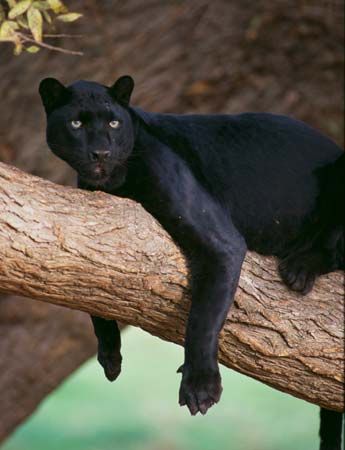
The term “black panther” does not refer to a distinct biological species. Instead, it is an informal, vernacular label used primarily to describe melanistic leopards (Panthera pardus) and jaguars (P. onca).12
These animals possess a coat of black fur caused by increased production of the pigment melanin, which results from specific genetic variations—recessive alleles in the ASIP gene for leopards and a dominant allele in the MC1R gene for jaguars. While the term is most frequently associated with these two species, it is sometimes applied loosely to other dark-colored felines, including bobcats, lynx, jaguarundis, tigers, and pumas. It is important to note, however, that reports of black-colored individuals for some of these other species have not been scientifically confirmed.12
In which habitats are black panthers typically found, and how does their coloration benefit them?
“Black panther” is an informal term for melanistic leopards and jaguars, rather than a distinct species. These animals are found in the same diverse habitats as their non-melanistic counterparts.21
Habitats
- Leopards: These cats are found across Africa and Asia. Melanistic individuals are particularly notable in the wet forests of Southeast Asia, where they occur at a much higher frequency than elsewhere.21
- Jaguars: Native to the Western Hemisphere, jaguars inhabit regions ranging from Mexico to Argentina. Their preferred environments include swamps, wooded regions, scrublands, and deserts, with the largest population residing in the Amazon rainforest.4
Coloration and Benefits
The black coat is caused by an overproduction of the pigment melanin, specifically eumelanin. While the dark coloration may provide camouflage in dense, shaded environments like deep forests, it is not a specialized adaptation for a unique habitat; rather, it is a genetic variation that persists within the broader population. Interestingly, even in black-coated individuals, the animal’s characteristic spotted pattern—often called “ghost rosettes”—remains visible under direct sunlight.214
How rare are black panthers in the wild compared to their non-melanistic counterparts?
Globally, melanistic leopards and jaguars—commonly referred to as black panthers—are considered uncommon compared to their non-melanistic counterparts.21
On average, approximately 11 percent of leopards exhibit this dark coloration. However, the frequency of this trait varies significantly by region; in the wet forests of Southeast Asia, the prevalence of melanistic leopards can be as high as 55 percent.21
Despite these regional variations, confirmed sightings of black leopards remain rare, particularly in Africa. For instance, a 2019 camera-trap photograph of a melanistic leopard in Kenya garnered international attention precisely because such individuals are exceptionally rare on the African continent. While melanistic individuals are documented, they represent a minority within the broader populations of both species.21
How has the image of the black panther been used in popular culture and media?
The term “Black Panther” holds two distinct and significant places in popular culture and media, often leading to historical confusion.
The Comic Book Superhero
Created by Stan Lee and Jack Kirby for Marvel Comics, the Black Panther first appeared in 1966 as one of the first Black superheroes in mainstream American comics. T’Challa, the king of the fictional, technologically advanced nation of Wakanda, became a cultural icon, particularly through the Marvel Cinematic Universe film franchise. These films, notably the 2018 production directed by Ryan Coogler, are celebrated for exploring themes of Afrofuturism, power, and identity. Notably, Marvel briefly renamed the character “Black Leopard” in the late 1960s to avoid association with the political organization of the same name.56
The Political Organization
The Black Panther Party, founded in October 1966, was a revolutionary political organization that left a lasting legacy in the public imagination. Its influence extended globally, inspiring various social movements and activist groups in countries like India and the Bahamas. The party’s rhetoric and imagery have been frequently referenced in rap music and memoirs. Later groups, such as the New Black Panther Party, have attempted to appropriate this legacy, though they have been widely denounced by original members and organizations like the Southern Poverty Law Center for their divergent ideologies.57
Sources
- black panther: Top Questions — Encyclopædia Britannica
- black panther — Encyclopædia Britannica
- white tiger — Encyclopædia Britannica
- jaguar — Encyclopædia Britannica
- Black Panther: Top Questions — Encyclopædia Britannica
- Black Panther — Encyclopædia Britannica
- Black Panther Party - Legacy — Encyclopædia Britannica
Published on · 3 min read