Bearded Seal
The bearded seal (Erignathus barbatus) is a nonmigratory seal belonging to the family Phocidae, found in coastal Arctic waters. It is easily identified by…
What is bearded seal?
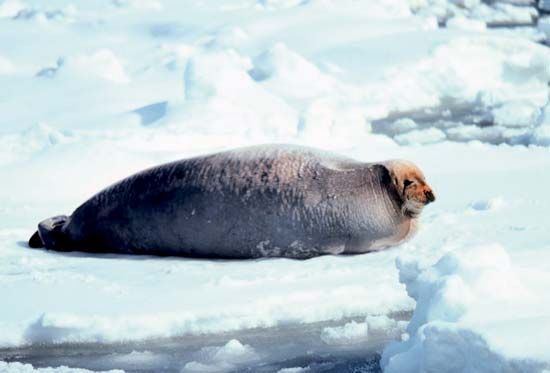
The bearded seal (Erignathus barbatus) is a nonmigratory seal belonging to the family Phocidae, found in coastal Arctic waters. It is easily identified by the long, bushy, and bristly whiskers on its muzzle, as well as its foreflippers, which have a distinct rectangular shape—earning the animal the nickname “squareflipper”.12
Typically grayish or yellow-brown in color, these seals live solitary lives or gather in small groups. They are significant in size, reaching lengths of 2.4–3.7 meters (8–12 feet) and weighing between 225–454 kilograms (500–1,000 pounds), with females generally being smaller than males. As adept divers, they primarily feed on clams and other bottom-dwelling organisms, likely utilizing their sensitive whiskers to locate prey. The species has long been highly valued by Indigenous Arctic peoples for its meat, blubber, and hide. Females typically breed every other year, giving birth to a single pup following an 11-month gestation period1.1
How do bearded seals survive in the freezing Arctic waters?
Bearded seals survive the extreme cold of the Arctic primarily through the presence of blubber, a thick layer of fat that provides essential insulation against freezing temperatures.13
While the provided search results do not detail specific physiological mechanisms beyond the reliance on blubber, this layer is a characteristic adaptation for large marine mammals, serving as an energy reserve and a critical thermal barrier in frigid environments. By maintaining this layer, the seals are able to inhabit coastal Arctic waters throughout the year.13
What other types of seals live in the Arctic?
In addition to the bearded seal, several other species of earless seals (family Phocidae) inhabit the Arctic region:
- Ringed seal: A common, nonmigratory species named for the pale rings on its coat. It is a vital resource for the Inuit and is closely related to the Caspian and Baikal seals.56
- Harp seal: A migratory, medium-sized seal recognized by the black, harp-shaped marking on its back. They are among the most abundant seal species and are well-known for their white-coated pups.76
- Hooded seal: A large, migratory species found in the North Atlantic and Arctic. Adult males are distinguished by a unique nasal appendage that can be inflated into a hood or a reddish balloon to attract mates and display strength.86
- Ribbon seal: Found in the North Pacific and Bering Sea, these seals are characterized by the striking ribbon-like bands of yellowish-white fur on the dark bodies of adult males.910
How does climate change affect the habitat of Arctic seals?
Climate change significantly threatens the habitat of Arctic seals by reducing the extent, thickness, and duration of sea ice. Because many Arctic seals, such as the ringed seal, rely on pack ice for essential life activities, these environmental shifts pose severe risks to their survival.12513
The primary impacts include:
- Loss of Breeding Grounds: Species like the ringed seal depend on stable ice to create dens for their pups. As ice cover decreases and thins, these critical breeding habitats are compromised.51314
- Disruption of Feeding Habits: Arctic seals rely on the ice as a platform for resting and accessing prey. Changes in ice dynamics, such as the widening of gaps or the premature melting of ice floes, make it more difficult for seals to forage and for their predators, such as polar bears, to hunt them effectively.1315
- Ecosystem Shifts: The warming of the Arctic Ocean and the recession of ice farther north are altering the distribution of marine life, forcing species to migrate and disrupting established food webs.13
Sources
- bearded seal — Encyclopædia Britannica
- bearded seal — Merriam-Webster
- Why are polar bears white? — Encyclopædia Britannica
- blubber — Merriam-Webster
- ringed seal — Encyclopædia Britannica
- hooded seal — Encyclopædia Britannica
- harp seal — Encyclopædia Britannica
- ribbon seal — Encyclopædia Britannica
- ribbon seal — Merriam-Webster
- Arctic - Marine fauna — Encyclopædia Britannica
- seal — Encyclopædia Britannica
- sea ice - The emerging impacts of recent changes to sea ice — Encyclopædia Britannica
- Alaska - Climate of Alaska — Encyclopædia Britannica
- Baikal seal: Top Questions — Encyclopædia Britannica
- Global warming: Top Questions — Encyclopædia Britannica
Published on · 3 min read