Biogenic Gas
Biogenic gases, which are produced by living organisms or through the biological breakdown of organic matter, have significant industrial utility. The most…
What are some industrial applications of biogenic gases?
Biogenic gases, which are produced by living organisms or through the biological breakdown of organic matter, have significant industrial utility. The most prominent examples include biogas and carbon dioxide.
Industrial Applications of Biogenic Gases
- Energy Production: Biogas, primarily composed of methane and carbon dioxide, is generated via anaerobic digestion of organic waste. It is burned to generate heat or used in combustion engines and turbines to produce electricity.12
- Carbon Dioxide Utilization: Recovered carbon dioxide is used in various sectors, including:
- Enhanced Oil Recovery: Injected into oil wells to increase crude oil extraction.3
- Manufacturing: Used in the production of urea for fertilizers and plastics, as well as in the creation of certain types of concrete.34
- Commercial Applications: Employed as a refrigerant, in fire extinguishers, for foaming rubber and plastics, and in carbonated beverages.4
- Agriculture: Injected into greenhouses to promote plant growth.34
How do plants and animals contribute to biogenic gas production?
Plants and animals contribute to the production of biogenic gases primarily through metabolic processes and the subsequent decomposition of their organic matter by microorganisms.
Metabolic Contributions
- Photosynthesis: Green plants and cyanobacteria consume carbon dioxide and release oxygen into the atmosphere.3
- Respiration: Animals and other organisms perform aerobic respiration, consuming oxygen and releasing carbon dioxide as a byproduct.3
- Enteric Fermentation: Ruminant animals, such as cattle, produce methane through specialized digestive processes in their rumen, where bacteria break down cellulose.78
Decomposition and Microbial Activity
When plants and animals die, or when they produce waste, microorganisms convert their organic remains into gases:
- Anaerobic Digestion: In low-oxygen environments like wetlands, landfills, or digestive tracts, methanogenic archaea and bacteria break down organic matter into methane and carbon dioxide.17
- Nutrient Cycling: Bacteria in soil and water transform organic waste into various gases, including ammonia, nitrous oxide, and nitrogen gas, through processes like nitrogen fixation and denitrification.73
What role do biogenic gases play in the global carbon cycle?
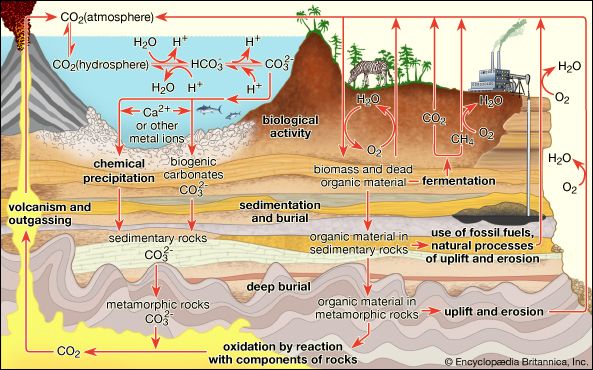
Biogenic gases play a fundamental role in the global carbon cycle by mediating the exchange of carbon between the atmosphere, hydrosphere, and biosphere. This cycle is essentially driven by the conversion of inorganic carbon (carbon dioxide) into organic carbon (biomass) and back again.1011
Key Biological Processes
- Photosynthesis and Respiration: Green plants, cyanobacteria, and other organisms use sunlight to fix carbon dioxide into organic molecules, releasing oxygen as a byproduct](https://www.britannica.com/science/carbon-dioxide) into organic molecules, releasing oxygen as a byproduct. Conversely, animals and other organisms perform aerobic respiration, which consumes oxygen and oxidizes organic carbon to produce inorganic carbon dioxide.91011
- Microbial Degradation: In environments where oxygen is limited, such as wetlands or sediments, microorganisms perform fermentation and anaerobic processes. These activities are critical sources of atmospheric methane, a potent greenhouse gas.1011
Regulation and Feedback
The biosphere acts as a vital carbon sink, though its capacity is sensitive to environmental changes. Global warming can alter these dynamics; for instance, rising temperatures may decrease the efficiency of the biological pump in oceans and shift terrestrial ecosystems from carbon sinks to carbon sources as decomposition rates outpace photosynthesis. Furthermore, the continuous generation of these gases by the biosphere is necessary to maintain their relatively constant proportions in the atmosphere; without this biological activity, these compounds would disappear over time.911
What are the main types of biogenic gases and their sources in nature?
Biogenic gases are substances produced by or essential to living organisms, playing a critical role in Earth’s atmospheric composition and radiation budget.27
Main Types of Biogenic Gases
The contemporary atmosphere contains a wide array of these gases, most of which function as greenhouse gases. They include:
- Primary gases: Oxygen and nitrogen (the only non-greenhouse gases in this category).27
- Greenhouse gases: Carbon dioxide, methane, water vapour, ozone, nitrous oxide, ammonia, carbon monoxide, sulfur dioxide, and hydrogen sulfide.27
- Other compounds: Nitrogen dioxide, nitric acid, carbonyl sulfide, dimethyl sulfide, and various non-methane hydrocarbons.27
Natural Sources
These gases are generated through diverse biological and biochemical processes:
- Metabolism and Respiration: Living organisms continuously exchange gases with the atmosphere. Plants and cyanobacteria perform photosynthesis, while animals and other heterotrophs release carbon dioxide through respiration.78
- Microbial Decomposition: Microorganisms, particularly bacteria and archaea, break down organic matter in environments like soil, wetlands, and landfills. In anaerobic conditions, this process produces significant amounts of methane.1148
- Enteric Fermentation: Ruminant animals, such as cattle, produce methane as a byproduct of digesting cellulose in their digestive tracts.114
- Nutrient Cycling: Bacteria facilitate the nitrogen cycle and other elemental transformations, converting inorganic compounds into usable forms and releasing gases like nitrogen and ammonia back into the environment.1
Sources
- biogas — Encyclopædia Britannica
- Biogenic gas — Encyclopædia Britannica
- anaerobic digestion — Encyclopædia Britannica
- hydrogen - Production and applications of hydrogen — Encyclopædia Britannica
- decarbonization - Industrial carbon removal — Encyclopædia Britannica
- carbon dioxide — Encyclopædia Britannica
- Climate - Climate and life — Encyclopædia Britannica
- Bacteria - Distribution in nature — Encyclopædia Britannica
- Climate - The cycling of biogenic atmospheric gases — Encyclopædia Britannica
- evolution of the atmosphere - Biological carbon cycle — Encyclopædia Britannica
- Global warming - Carbon cycle feedbacks — Encyclopædia Britannica
- evolution of the atmosphere - Interaction of biological and geologic cycles — Encyclopædia Britannica
- plant - Specific variations in photosynthesis — Encyclopædia Britannica
- Carbon cycle — Encyclopædia Britannica
Published on · 4 min read