Ecological Resilience
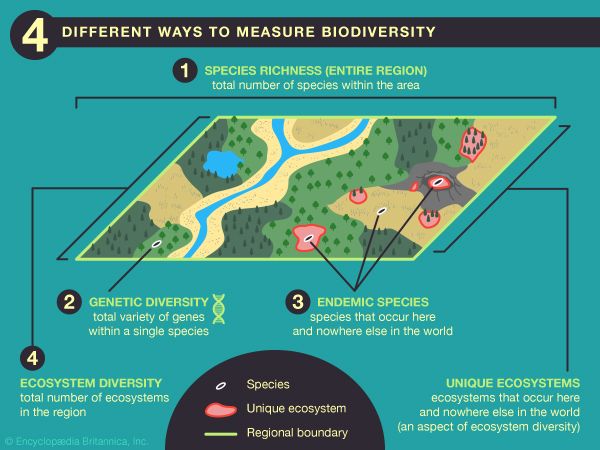
Biodiversity is essential for maintaining ecosystem health and enhancing ecological resilience—the ability of a system to recover from disturbances and…
What role does biodiversity play in enhancing ecological resilience?
Biodiversity is essential for maintaining ecosystem health and enhancing ecological resilience—the ability of a system to recover from disturbances and maintain its core functions, such as nutrient cycling and biomass production.12
High species diversity strengthens an ecosystem in several ways:
- Functional Redundancy: When multiple species perform similar roles, the loss of one does not necessarily lead to system collapse. For example, the decline of the American chestnut was partially compensated for by the expansion of oak and hickory species.12
- Stability and Recovery: Research shows that species-rich communities, such as grasslands, exhibit greater stability in biomass and productivity during environmental stresses like drought. They are also better equipped to recover after disturbances and resist the establishment of invasive species.3
- Complexity: A diverse, interconnected web of species provides a buffer against change. Conversely, as biodiversity decreases, ecosystems lose complexity, becoming more vulnerable to destabilization and potential collapse into a different state, such as a barren wasteland.12
How can understanding ecological resilience help in conservation and environmental management efforts?
Understanding ecological resilience is fundamental to modern conservation and environmental management, as it shifts the focus from preserving individual species to maintaining the overall structure, function, and productivity of ecosystems.3
By prioritizing resilience, managers can better protect the ecosystem services that humans rely on, such as clean water, food, and climate regulation. Key management strategies include:3
- Predictive Monitoring: Managers now use statistical indicators to identify early-warning signs of systemic collapse, such as eutrophication or desertification, allowing for intervention before an ecosystem shifts into an undesirable state.3
- Structural Enhancement: Efforts are made to bolster resilience by managing for diversity, heterogeneity, and modularity. For example, forest managers may create firebreaks to prevent the spread of wildfire and maintain ecosystem integrity.3
- Adaptive Management: This iterative approach allows managers to test hypotheses and adjust goals in real-time. It is particularly effective for navigating scientific uncertainty and shifting baselines caused by global warming.4
Ultimately, managing for resilience acknowledges that ecosystems are dynamic and that maintaining their ability to recover from disturbances is vital for long-term sustainability.3
What are some examples of ecosystems that demonstrate high ecological resilience?
Ecological resilience refers to an ecosystem’s capacity to maintain its core functions, such as nutrient cycling and biomass production, following a disturbance. While resilience is a complex property, certain ecosystems demonstrate this trait through high species diversity, functional redundancy, and structural complexity.32
Examples of ecosystems that exhibit high ecological resilience include:
- Species-Rich Grasslands: Research indicates that grasslands with high species diversity are more stable and recover faster from disturbances like drought or grazing. In regions such as the Serengeti or the Midwestern United States, diverse plant communities maintain more consistent biomass and productivity compared to species-poor areas.2
- Complex Forest Systems: Forests often demonstrate resilience through the ability of different species to fill functional gaps. For instance, when the American chestnut was lost to blight in North American forests, the expansion of oak and hickory species helped the ecosystem maintain its overall structure and function.3
- Dynamic Tropical Forests: These environments often feature high levels of heterogeneity. Small-scale disturbances, such as a tree falling, create patches that allow for rapid colonization and regeneration, contributing to the long-term persistence of the forest as a whole.2
How do human activities impact ecological resilience in various ecosystems?
Human activities significantly impact ecological resilience—the ability of an ecosystem to maintain its structure and function following a disturbance—by introducing chronic stressors that simplify biological communities and reduce their capacity to recover.310
Mechanisms of Impact
Human influence often manifests through the following processes:
- Habitat Alteration: Activities such as deforestation, agriculture, and urban development lead to habitat destruction, fragmentation, and degradation. Fragmentation, in particular, isolates populations, increasing the risk of local extinction and making ecosystems more vulnerable to edge effects, such as increased exposure to pests and extreme weather.1112
- Pollution and Chemical Changes: The introduction of industrial toxins, pesticides, and acid rain alters the chemical composition of environments. In aquatic systems, nutrient runoff leads to eutrophication, which depletes oxygen and can lock an ecosystem into an undesirable, degraded state.10311
- Anthropogenic Climate Change: Rapid shifts in climate are occurring faster than many species can adapt, leading to unforeseen declines and the disruption of natural cycles, such as snowmelt-fed river systems or the stability of peatlands.13
- Biological Simplification: Chronic disturbances consistently favor small-bodied, rapidly reproducing organisms over complex food webs. This loss of diversity and functional redundancy weakens the system’s “elasticity,” making it less capable of compensating for the loss of specific species.310
Ultimately, these cumulative pressures threaten the ecosystem services upon which human societies depend, such as clean water and food production.3
Sources
- biodiversity loss - Ecological effects — Encyclopædia Britannica
- community ecology - Community equilibrium and species diversity — Encyclopædia Britannica
- ecological resilience — Encyclopædia Britannica
- conservation - Putting a price on conservation — Encyclopædia Britannica
- adaptive management — Encyclopædia Britannica
- Wetland - Climate — Encyclopædia Britannica
- Marsh — Encyclopædia Britannica
- Coral Bleaching: A Threat to Our Reefs — Encyclopædia Britannica
- Tropical rainforest - Environment — Encyclopædia Britannica
- habitat loss — Encyclopædia Britannica
- plant - Changes in biosystems: pollution — Encyclopædia Britannica
- ecological restoration - Implementation — Encyclopædia Britannica
- Wetland - Effects of climate change — Encyclopædia Britannica
- Urban ecosystem - Urban ecology — Encyclopædia Britannica
Published on · 4 min read