Ark Shell
Sorry, the Britannica knowledge base does not contain information regarding historical human uses of ark shells beyond their role as a food source. The…
How have ark shells been used historically by humans, apart from food?
Sorry, the Britannica knowledge base does not contain information regarding historical human uses of ark shells beyond their role as a food source. The available records focus on their biological classification as bivalve mollusks, their physical characteristics, and their habitat preferences.1
How do ark shells reproduce and what is their life cycle like?
Ark shells, which belong to the family Arcidae, follow the general reproductive and developmental patterns characteristic of marine bivalve mollusks3.4
Reproduction
Most bivalve species are gonochoristic, meaning individuals are either male or female, and they typically maintain an equal sex ratio. Reproduction generally involves synchronized spawning, where both males and females discharge their gametes—sperm and eggs—directly into the water column. Fertilization occurs externally in the sea. While some bivalves exhibit hermaphroditism, the primary method for most marine species remains the release of gametes into the environment to facilitate external fertilization.4
Life Cycle
Following fertilization, the development of most marine bivalves proceeds through two distinct larval stages:4
- Trochophore Larva: The fertilized egg first develops into a free-swimming, ciliated trochophore larva.34
- Veliger Larva: The trochophore then metamorphoses into a veliger larva. This stage features a ciliated organ called a velum, which the larva uses for both swimming and trapping microscopic food particles.34
After a period spent in the plankton—which can last from hours to months—the veliger descends to the seafloor to undergo metamorphosis into an adult. During this transition, the velum is lost, the foot develops, and the animal typically secretes byssus threads to anchor itself to a substrate, such as rock or coral crevices, or it begins its life in the sand or silt.45
Are ark shells used for human consumption, and if so, how?
Ark shells are indeed used for human consumption and have served as a food source since prehistoric times.3
These bivalve mollusks are harvested from various regions, with specific species being particularly significant in culinary traditions. For example, the Anadara senilis, found in western Africa, and the Anadara granosa, native to Southeast Asia, are notable examples of ark shells that have been consumed by humans for millennia.3
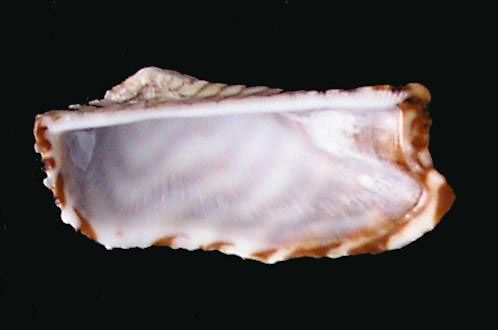
These clams are recognized by their distinct boat-shaped shells, which feature long, straight hinge lines and numerous small, interlocking teeth. While many species live attached to rocks or coral via byssus threads, those harvested for food, such as the Anadara genus, typically reside shallowly buried in sands and silts, making them accessible for collection.3
How do ark shells differ from other types of bivalve mollusks?
Ark shells, members of the family Arcidae, differ from many other bivalve mollusks in several distinct ways:
- Shell Morphology: Unlike many “true” clams that have rounded or oval shells, ark shells are characterized by a distinct boat-shaped shell with a long, straight hinge line. This hinge is lined with numerous small, interlocking teeth.37
- Surface Texture: The shells of ark species are frequently covered by a thick, sometimes hairy layer known as a periostracum.3
- Sensory Features: Many ark shell species possess rows of simple eyes along the margins of their mantle, a feature not found in all bivalve groups.3
- Lifestyle and Attachment: While many bivalves are active burrowers, ark shells are generally sedentary or slow-moving. Many species, such as those in the genera Arca and Barbatia, live attached to rock or coral crevices using a byssus—a tuft of horny threads secreted by a gland on the foot. Other species, like those in the genus Anadara, do burrow into sand or silt, but they remain distinct from the typical burrowing behavior of many other clam families.38
Sources
- ark shell — Merriam-Webster
- Noah's ark — Merriam-Webster
- ark shell — Encyclopædia Britannica
- mollusk - Reproduction and life cycles — Encyclopædia Britannica
- bivalve - Reproduction and life cycles — Encyclopædia Britannica
- acarid - Reproduction and life cycle — Encyclopædia Britannica
- Arcidae — Merriam-Webster
- clam — Encyclopædia Britannica
- Arctiidae — Merriam-Webster
Published on · 3 min read