Pridoli Series
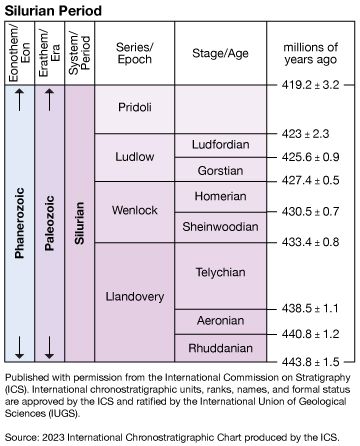
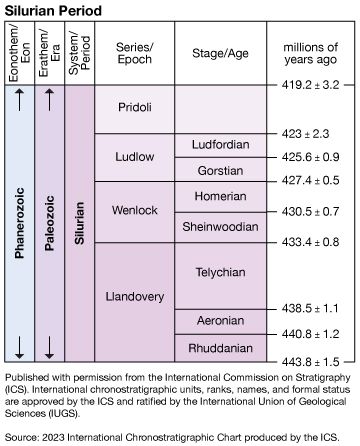
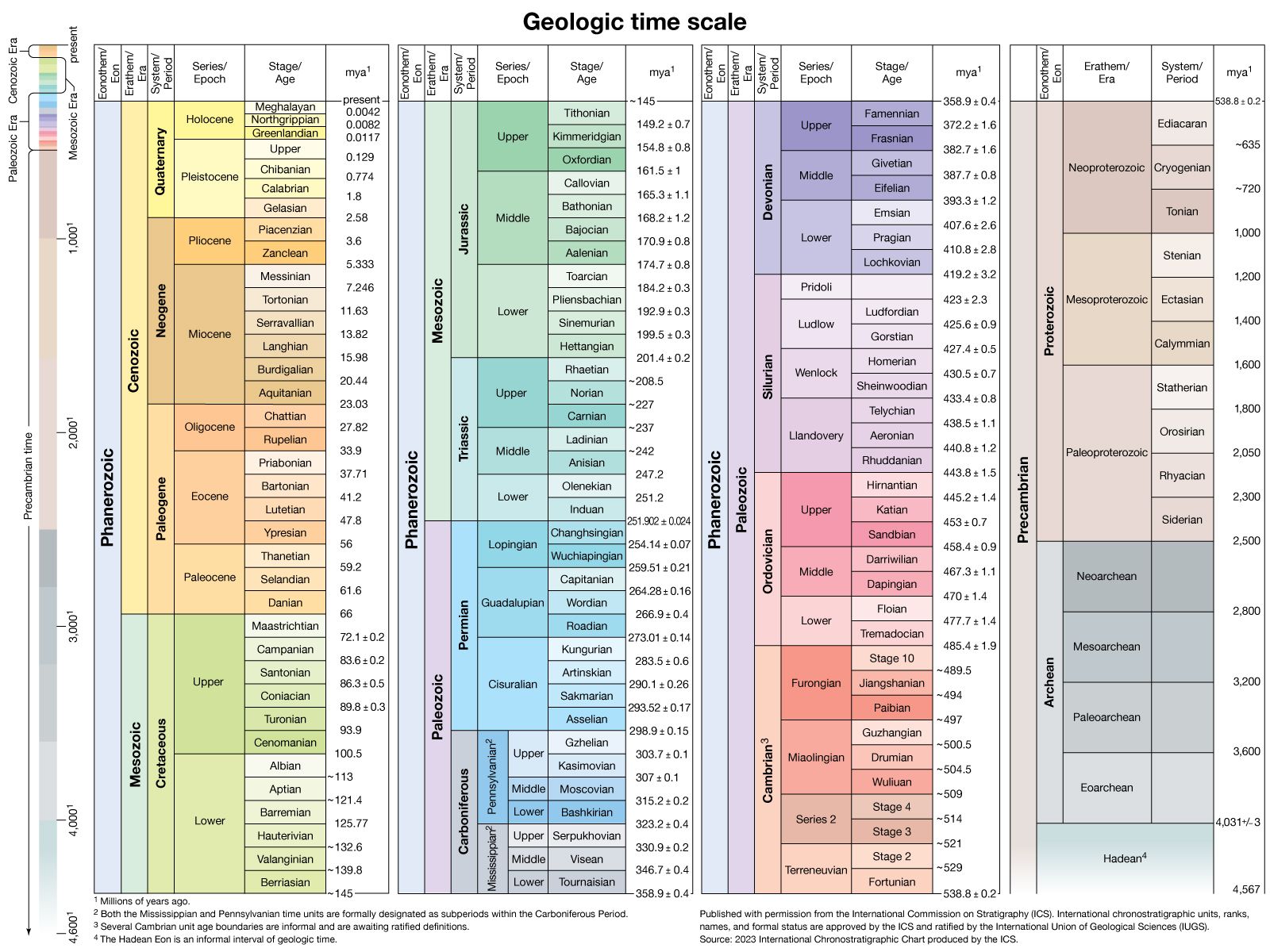
The Pridoli Series, the uppermost division of the Silurian System, represents rocks deposited between 423 million and 419.2 million years ago.
What are the key characteristics of the rocks and fossils found in the Pridoli Series?
The Pridoli Series, the uppermost division of the Silurian System, represents rocks deposited between 423 million and 419.2 million years ago.1
Rock Characteristics
In its type locality within the Daleje Valley of the Czech Republic, the series consists of approximately 20 to 50 meters of platy limestone strata. The base of the series is globally defined by the first occurrence of the graptolite species Monograptus parultimus at the Pozary Quarries.1
Fossil Assemblage
The rocks are notable for being rich in cephalopods and bivalves. Other significant biological markers include:1
- Marine Plankton: The first occurrences of the chitinozoans Urnochitina urna and Fungochitina kosovensis appear at or near the base of the series.1
- Early Land Plants: The lower portions of the series contain some of the earliest known simple vascular land plants, specifically those of the genus Cooksonia.1

What is the Pridoli Series and where does it fit in the geological time scale?
The Pridoli Series is the uppermost of the four primary divisions of the Silurian System. It represents the rocks deposited globally during the Pridoli Epoch, which spanned from 423 million to 419.2 million years ago.1
Geological Placement
In the geological time scale, the Pridoli Series occupies the final interval of the Silurian Period. Its stratigraphic position is defined as follows:
- Underlying: It is preceded by the Ludlow Series.1
- Overlying: It is capped by the Lochkovian Stage, which marks the beginning of the Devonian System. Consequently, the base of the Devonian System serves as the upper boundary for both the Pridoli Series and the Silurian System.1
The series is named after the Pridoli area in the Czech Republic, where it is characterized by platy limestone strata. By international agreement, its base is defined by the first appearance of the graptolite species Monograptus parultimus.1
What are some important locations around the world where Pridoli Series rocks are well-exposed or studied?
The Pridoli Series is most notably studied in the Czech Republic, which serves as the primary reference area for this geological interval. Key locations include:
- Daleje Valley (Prague): This area is the type locality for the series, where approximately 20 to 50 meters of platy limestone strata are well-developed and rich in cephalopods and bivalves.1
- Pozary Quarries (near Reporyje): Located about 1.5 km east of Reporyje, these quarries contain the global stratotype section and point (GSSP) for the base of the Pridoli Series. This site is defined by the first occurrence of the graptolite species Monograptus parultimus.1
- Klonk: While primarily recognized as the standard reference section for the Silurian-Devonian boundary, this cliff section is critical for understanding the upper limit of the Pridoli Series, as it marks the transition into the Lochkovian Stage and the Devonian System.ian-Stage) and the Devonian System.2
Beyond these specific sites, the Pridoli Series is studied globally, as the lower portions of these strata frequently contain the earliest known simple vascular land plants of the genus Cooksonia.1
What specific dating methods are used to determine the age of rocks from the Pridoli Series?
To determine the age and correlation of rocks within the Pridoli Series, geologists primarily utilize two distinct methods: biostratigraphy and geochronology.
Biostratigraphy (Relative Dating)
The most precise method for correlating Pridoli strata involves the use of index fossils. By identifying the first appearance of specific organisms in the rock record, scientists can define biozones that allow for global correlation:
- Graptolites: The base of the Pridoli Series is defined by the first occurrence of the graptolite species Monograptus parultimus.4
- Chitinozoans: These marine plankton are also used for dating, with species such as Urnochitina urna and Fungochitina kosovensis appearing at or just above the base of the series.4
Geochemical Analysis (Absolute Dating)
While biostratigraphy provides relative timing, absolute dates are calculated using radioactive isotopes. This process involves:
- Analysis of Igneous Rocks: Geochronologists analyze samples of igneous rock associated with fossil-bearing sedimentary layers. The decay of radioisotopes provides a numerical age, provided the rock has not been reset by metamorphism.5
- Extrapolation: Because igneous bodies are rarely found directly at the boundaries of geologic systems, scientists must often extrapolate boundary ages using limited data points from older and younger rock units.5
Sources
- Pridoli Series — Encyclopædia Britannica
- Silurian Period - Silurian-Devonian boundary — Encyclopædia Britannica
- Devonian Period - Establishing Devonian boundaries — Encyclopædia Britannica
- Silurian Period - Graptolites — Encyclopædia Britannica
- Silurian Period - Geochemical analyses — Encyclopædia Britannica
- Silurian Period - Major subdivisions of the Silurian System — Encyclopædia Britannica
Published on · 3 min read