Worthenia
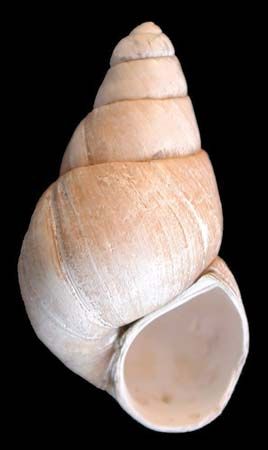
Worthenia is a genus of extinct gastropods, or snails, that are frequently found as fossils in rock layers dating from the Devonian to the Triassic periods…
What is Worthenia?
Worthenia is a genus of extinct gastropods, or snails, that are frequently found as fossils in rock layers dating from the Devonian to the Triassic periods (approximately 416 million to 200 million years ago).1
These fossils are particularly common in Late Carboniferous deposits located in the midcontinent region of North America. The genus is identified by its distinct turban-shaped shell, which features a prominent raised ridge along the margin of its whorls. This ridge is typically decorated with small nodes, and the shell possesses a large, oval-shaped opening.1
What are the main differences between gastropods and other mollusks?
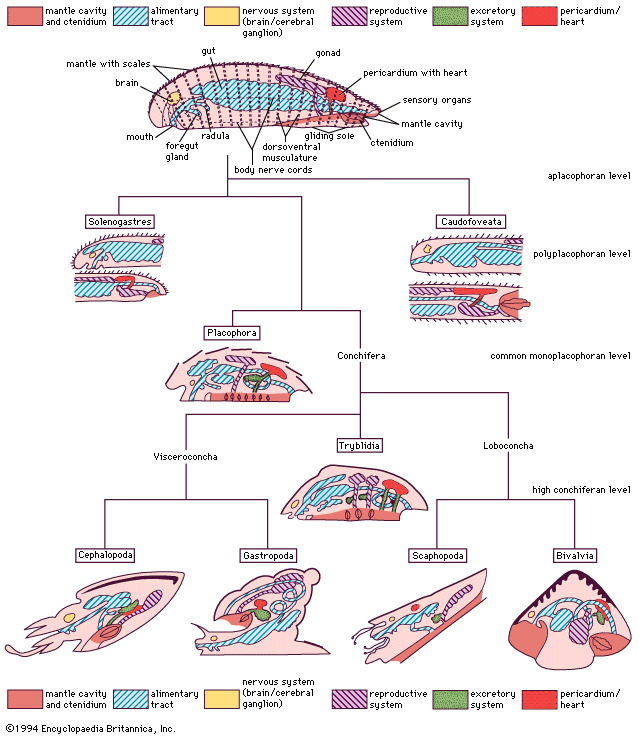
Gastropods represent the largest and most diverse class within the phylum Mollusca, distinguished from other mollusks by several unique structural and developmental characteristics.23
Key Differences
- Torsion: A defining feature of gastropods is the process of torsion, where the visceral mass undergoes a 180-degree rotation during development, bringing the mantle cavity and anus to a position above the head. While some species undergo secondary “detorsion,” this developmental shift is unique to the class.2
- Shell and Body Form: Unlike the laterally compressed shells of bivalves or the eight-plated shells of chitons, gastropod shells are typically coiled in a logarithmic spiral. In many species, this shell includes an operculum—a calcified disk on the foot that seals the aperture for protection. In slugs, the shell has been reduced or lost entirely through evolution.2453
- Head and Sensory Organs: Gastropods possess a distinct, free head equipped with paired tentacles and eyes, a feature not found in bivalves.24
- Reproductive Anatomy: Gastropods exhibit significant variability in reproductive systems. They typically possess a single gonad located in the visceral hump, which connects to the outside via a remnant of the right kidney.6
While all mollusks share a soft body, a mantle, and a radula, gastropods are uniquely successful across marine, freshwater, and terrestrial environments, a versatility unmatched by most other molluscan classes.237
How do scientists use fossils to determine the age of rock layers?
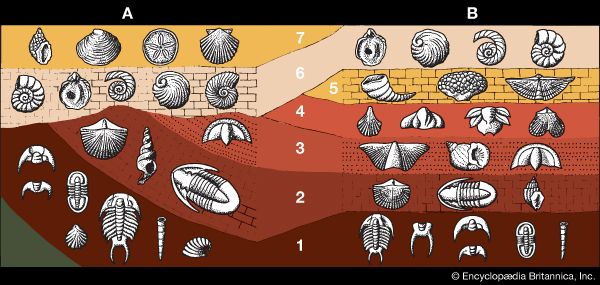
Scientists determine the age of rock layers using fossils by applying the law of faunal succession, which observes that fossilized plants and animals appear in rock strata in a predictable, nonrepetitive order over time. By identifying these sequences, geologists can correlate rock layers across different geographic regions.9
Key methods include:
- Index Fossils: Scientists use index fossils to define boundaries in the geologic time scale. A useful index fossil is abundant, widely distributed, easily recognizable, and existed for only a short span of time.10
- Biostratigraphic Correlation: By comparing the specific assemblages of fossils found in different locations, researchers can match strata and reconstruct the geologic history of a region.119
- Calibration with Absolute Dating: While fossils provide relative ages, they are often calibrated using radiometric dating. This involves measuring the decay of radioactive isotopes in minerals to provide a precise numerical age, which helps calibrate the fossil record.1112
What was the environment like during the Carboniferous period?
The Carboniferous Period (approximately 358.9 to 298.9 million years ago) was a time of significant geological and biological transformation, characterized by shifting landmasses and diverse environments.14
Paleogeography and Climate
During the early part of the period, the world was divided into two major landmasses: Laurussia in the Northern Hemisphere and the massive Gondwana in the Southern Hemisphere, separated by the Tethys Sea. By the late Carboniferous, these landmasses fused, closing the sea and triggering mountain-building events.1415
The climate was heavily influenced by latitude. Equatorial regions were tropical, while midlatitudes were dry and higher latitudes were cooler and moist. Notably, Gondwana experienced widespread continental glaciations, while the Northern Hemisphere saw the development of extensive coal swamps in wetter, lower-latitude regions.1617
Life and Atmosphere
The period is famous for its lush, vascular land plants, which formed vast coal-producing forests. Atmospheric oxygen levels were significantly higher than today—reaching approximately 30 percent—which likely enabled insects, such as dragonflies, to reach massive sizes. Marine environments were dominated by crinoids and other invertebrates, while on land, the period marked the peak of amphibian development and the emergence of the first reptiles.1417
Sources
- Worthenia — Encyclopædia Britannica
- mollusk - Annotated classification — Encyclopædia Britannica
- Animal reproductive system - Annelids and mollusks — Encyclopædia Britannica
- gastropod — Encyclopædia Britannica
- mollusk — Encyclopædia Britannica
- mollusk - External features — Encyclopædia Britannica
- gastropod - Form and function — Encyclopædia Britannica
- gastropod - Size range and diversity of structure — Encyclopædia Britannica
- index fossil — Encyclopædia Britannica
- geologic time — Encyclopædia Britannica
- law of faunal succession — Encyclopædia Britannica
- dating - Distinctions between relative-age and absolute-age measurements — Encyclopædia Britannica
- Tertiary Period - Correlation of Tertiary strata — Encyclopædia Britannica
- A Journey Through Time Since the Precambrian - Carboniferous Period: 358.9 million to about 298.9 million years ago — Encyclopædia Britannica
- Carboniferous Period - Paleoclimate — Encyclopædia Britannica
- Carboniferous Period - Distinctive features — Encyclopædia Britannica
- Carboniferous Period - Paleogeography — Encyclopædia Britannica
- geologic history of Earth - Formation of the secondary atmosphere — Encyclopædia Britannica
Published on · 3 min read