Black Mamba
The black mamba (Dendroaspis polylepis) is a large, highly venomous snake native to sub-Saharan Africa. Despite its name, the snake is not black; its…
What is black mamba?
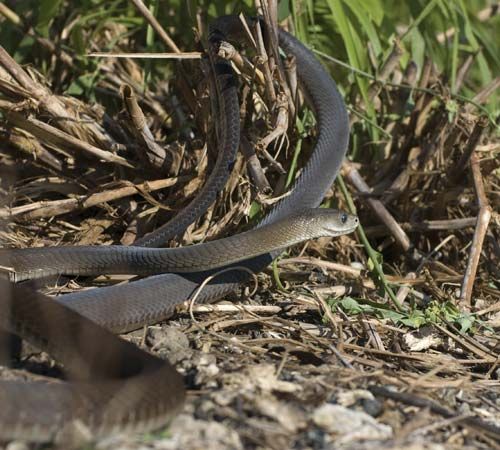
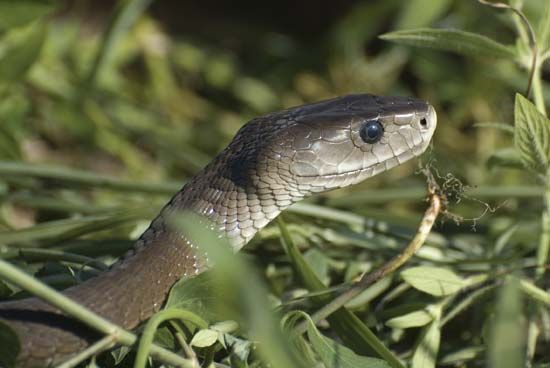
The black mamba (Dendroaspis polylepis) is a large, highly venomous snake native to sub-Saharan Africa. Despite its name, the snake is not black; its coloration ranges from gray to dark brown. The name actually refers to the distinct black lining inside its mouth, which distinguishes it from other mamba species that have white mouths.12
Known for its speed—reaching over 12 miles per hour—and its potent venom, the black mamba is considered one of the continent’s most dangerous snakes. It is primarily ground-dwelling, often inhabiting rocky savannas and termite mounds. While it has an aggressive reputation, the species is generally shy and prefers to flee from threats. If cornered, however, it may rear up and strike repeatedly. Its venom is highly toxic, attacking both the nervous system and the heart, though the snake is responsible for only a small number of human bites annually.12
How do green mambas differ from black mambas?
Green mambas and black mambas belong to the same genus, Dendroaspis, but they exhibit several key differences in size, habitat, and temperament.
Key Differences
Feature
Black Mamba
Green Mamba Species
Habitat
Primarily ground-dwelling; prefers rocky savannas and termite mounds.
Primarily arboreal (tree-dwelling).
Size
Larger; averages 2–2.5 meters (max 3.5–4.3 meters).
Smaller; averages 1.5–2 meters (max 2.7 meters).
Mouth Color
Black lining inside the mouth.
White lining inside the mouth.
Temperament
Nervous and defensive; known to strike repeatedly if cornered.
More timid; no reports of unprovoked attacks on humans.
While both are venomous elapids with potent neurotoxic venom, the black mamba is widely considered more dangerous due to its size, speed, and aggressive defensive behavior when threatened. Both species share similar defensive postures, such as flattening their necks into a narrow hood, and both prey on small mammals and birds.21
What makes the black mamba’s venom so dangerous?
The black mamba’s venom is exceptionally dangerous due to its extreme potency and its complex physiological impact. It is a powerful neurotoxic cocktail that simultaneously attacks both the nervous system and the heart. The toxicity is so high that it is reported that as little as two drops can be fatal to most humans.12
When a black mamba strikes, it often bites its victim repeatedly, delivering a significant dose of this fast-acting toxin. Because the venom disrupts critical biological functions, most untreated bites are fatal. This combination of high toxicity, rapid delivery, and the snake’s tendency to strike multiple times makes the black mamba one of the most dangerous snakes in Africa.12
What other snakes belong to the cobra family?
The “cobra family,” scientifically known as Elapidae, is a diverse group of approximately 300 venomous snake species characterized by short, fixed fangs at the front of the upper jaw. While cobras are the most famous members, the family includes a wide variety of other snakes found across the globe.34
Other notable members of the Elapidae family include:
- Mambas: Highly venomous, slender, and agile snakes found in Africa, including the well-known black mamba.534
- Coral Snakes: Small, brightly patterned snakes found in both the New World and the Old World.6
- Sea Snakes: Highly specialized marine snakes, including true sea snakes and sea kraits, that have adapted to life in the ocean.74
- Kraits: A genus (Bungarus) of venomous snakes found in Asia.4
- Taipans: Large, highly venomous snakes native to Australia.34
- Black Snakes and Brown Snakes: Various genera of Australian elapids.4
- Tiger Snakes: Another group of venomous snakes primarily found in Australia.4
- Bandy-bandy: A distinct genus of small, burrowing elapids.4
Sources
- black mamba — Encyclopædia Britannica
- mamba — Encyclopædia Britannica
- cobra — Encyclopædia Britannica
- elapid — Encyclopædia Britannica
- sea snake — Encyclopædia Britannica
- List of snakes — Encyclopædia Britannica
- coral snake — Encyclopædia Britannica
Published on · 3 min read