Brocket
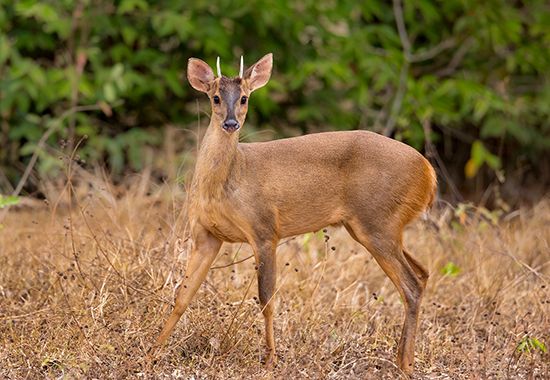
A brocket is any of several small deer belonging to the genus Mazama within the family Cervidae. These animals are native to regions ranging from Mexico to…
What is brocket?
A brocket is any of several small deer belonging to the genus Mazama within the family Cervidae. These animals are native to regions ranging from Mexico to South America ranging from Mexico to South America.1
Brockets are characterized by their stout bodies, arched backs, and short tails, typically standing between 43 and 69 cm (17 to 27 inches) tall at the shoulder. As timid browsers, they generally inhabit wooded environments and live either alone or in pairs. There are approximately four species, including the red brocket (M. americana) and the brown brocket (M. gouazoubira). Notably, the males of these species possess short, unbranched antlers.1
How do brocket deer differ from other deer species?
Brocket deer (genus Mazama) are distinct from many other deer species primarily due to their physical size, morphology, and antler structure. While many deer species are known for large, complex, branching antlers, male brockets possess only short, simple, unbranched antlers.12
Key differences include:
- Size and Build: Brockets are small, stout-bodied animals with arched backs and short tails, standing between 43 and 69 cm (17 to 27 inches) at the shoulder. In contrast, other deer species vary significantly in size, ranging from the tiny 30 cm (12 inch) pudu to the massive moose, which can stand 2 meters (7 feet) or more.13
- Behavior: Unlike some larger, more gregarious deer species, brockets are noted for being timid browsers that typically live alone or in pairs within wooded habitats.1
- Classification: They belong to the subfamily Capreolinae, which also includes diverse species such as reindeer, white-tailed deer, and roe deer, each adapted to vastly different environments and ecological niches.34
What predators do brocket deer face in their natural habitat?
Sorry, the Britannica knowledge base does not contain information regarding the specific predators that brocket deer face in their natural habitat.
Why do male brocket deer have unbranched antlers?
Male brocket deer (Mazama) possess short, unbranched antlers primarily due to their small body size and the physiological constraints of antler growth.15
In the family Cervidae, the energy and nutrient requirements for growing antlers are substantial, as they are composed of bone and must be regenerated annually. The demand for these resources increases exponentially with body size; consequently, larger deer species are capable of supporting the metabolic cost of producing large, complex, branching antlers. Because brocket deer are small, stout-bodied animals, they lack the body mass and the high-nutrient intake capacity required to grow and maintain the elaborate, multi-branched structures seen in larger deer species.61
Antlers serve as weapons for combat and as display organs for courtship. While larger deer use complex antlers for these purposes, the simple, spike-like antlers of the brocket deer are sufficient for their specific ecological niche, which involves living in dense, wooded habitats where they typically remain solitary or in pairs.621
Sources
- brocket — Encyclopædia Britannica
- brocket — Merriam-Webster
- deer - New World deer — Encyclopædia Britannica
- List of deer — Encyclopædia Britannica
- deer - Morphology and behaviour — Encyclopædia Britannica
- artiodactyl - Horns and antlers — Encyclopædia Britannica
Published on · 2 min read