Blue-ringed Octopus
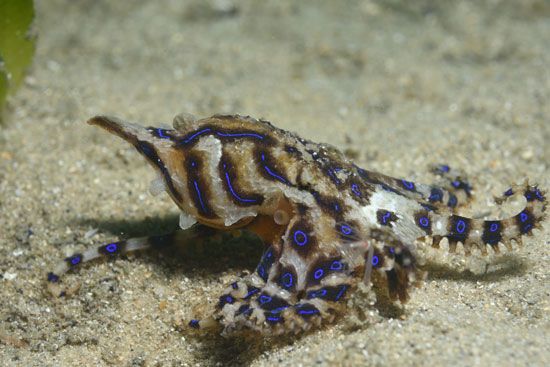
The blue-ringed octopus (genus Hapalochlaena) is a small, highly venomous cephalopod found in the Indo-Pacific region. These animals are famous for their…
What is Blue-ringed octopus?
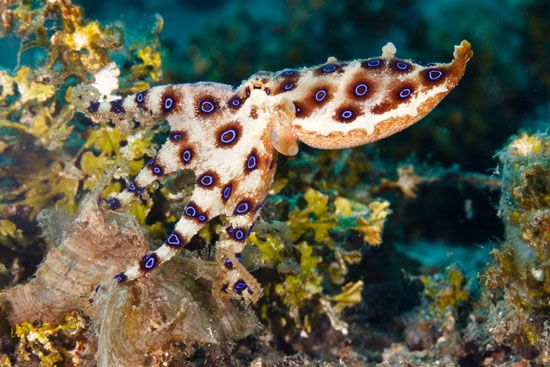
The blue-ringed octopus (genus Hapalochlaena) is a small, highly venomous cephalopod found in the Indo-Pacific region. These animals are famous for their aposematism—flashing vivid, iridescent blue rings or stripes when threatened to warn predators of their toxicity.12
Despite their small size—rarely exceeding 22 cm (8.7 inches) or 100 grams—they possess a potentially fatal bite. Their saliva contains tetrodotoxin (TTX), a potent neurotoxin produced by symbiotic bacteria. This toxin blocks nerve signals, leading to muscle paralysis and respiratory failure. There is no known antivenom, though timely respiratory support can be life-saving. Importantly, these octopuses are not aggressive and generally do not bite unless provoked.12
There are four recognized species: H. lunulata, H. maculosa, H. fasciata, and H. nierstraszi, each with distinct regional distributions ranging from Australia and India to Indonesia and the Philippines.12
How do chromatophores and iridophores allow an octopus to change color?
Octopuses achieve rapid color changes through the coordinated action of specialized skin structures controlled by their nervous system.13
Chromatophores
Chromatophores are elastic sacs filled with pigment (such as brown, black, red, or yellow) that function as the primary mechanism for rapid color display. Each sac is surrounded by a ring of radiating muscle fibers. When the octopus’s brain sends neural signals, these muscles contract, stretching the sac into a broad, thin disk that exposes the pigment. When the muscles relax, the sac contracts, concentrating the pigment into a tiny, nearly invisible point. This process allows cephalopods to change color in half a second or less.143
Iridophores
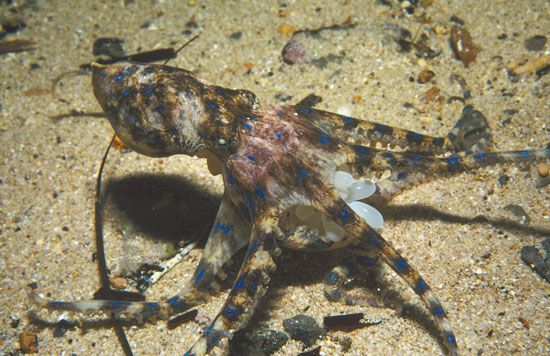
Iridophores (or iridocytes) are reflecting cells that produce iridescent colors, such as blue or green, by reflecting light. In species like the blue-ringed octopus, these structures are arranged in specific patterns, such as rings or stripes. While chromatophores provide the dark, contrasting background, muscle movements expose the iridophores to create vivid, shimmering warning displays known as aposematism.51
Together, these systems allow octopuses to exhibit complex patterns for camouflage, defense, or communication.1
What is aposematism and why is it an effective survival strategy?
Aposematism is a biological strategy in which a dangerous or noxious organism advertises its toxicity or unpalatability to potential predators. By signaling its defensive capabilities, the organism discourages attacks, thereby avoiding the physical injury that often occurs even during a successfully repelled encounter.78
This strategy is effective because it leverages the predator’s ability to learn and retain information. Through experience—or sometimes innate recognition—predators learn to associate specific signals with negative outcomes, such as foul taste or pain. Natural selection favors signals that are unambiguous and distinct to ensure rapid learning.910
Aposematic mechanisms include:
- Visual signals: Bright, contrasting colors (e.g., the black and yellow of wasps or the patterns of skunks).p) or the patterns of skunks).78
- Acoustic signals: Sounds like the rattle of a rattlesnake or the ultrasonic clicks of certain moths.8
- Behavioral displays: Stylized movements that draw attention to warning colors.8
Many organisms combine these signals with concealing coloration, revealing their warning displays only when threatened to minimize unnecessary exposure.11
How do symbiotic bacteria help the blue-ringed octopus produce its venom?
The blue-ringed octopus produces its potent venom through a symbiotic relationship with bacteria that reside within its salivary glands. These bacteria synthesize the neurotoxin tetrodotoxin (TTX), which is then distributed throughout the octopus’s body, with the highest concentrations found in the posterior salivary glands.1
This toxin is exceptionally powerful—roughly 1,000 times more potent than sodium cyanide—and functions by blocking nerve signals, leading to muscle paralysis. While the octopus uses this venom to subdue prey, it also exhibits a tolerance to the substance, even coating its eggs with it to provide protection against predators.21
Sources
- Blue-ringed octopus: Top Questions — Encyclopædia Britannica
- Blue-ringed octopus — Encyclopædia Britannica
- cephalopod - Behaviour — Encyclopædia Britannica
- coloration - Physiological control — Encyclopædia Britannica
- nervous system - Arthropods — Encyclopædia Britannica
- coloration - Short-term changes — Encyclopædia Britannica
- aposematism — Encyclopædia Britannica
- mimicry - The role of the receiver — Encyclopædia Britannica
- mimicry - The selective advantage of warning — Encyclopædia Britannica
- mimicry - The effectiveness of warning systems — Encyclopædia Britannica
- mimicry - Combination of warning systems with concealing coloration — Encyclopædia Britannica
Published on · 3 min read