Bluebell
The term "bluebell" refers to several different plants, as the name is commonly applied to various species with bell-shaped flowers.
What is Bluebell?
The term “bluebell” refers to several different plants, as the name is commonly applied to various species with bell-shaped flowers.
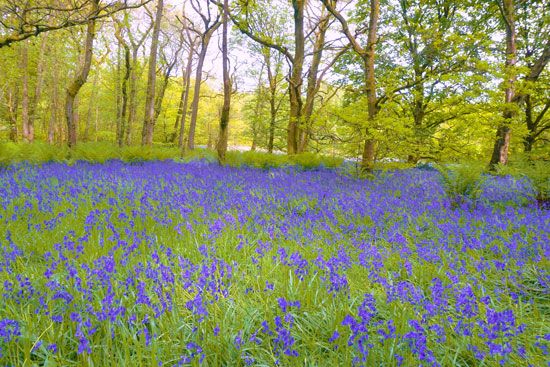
The primary bluebell refers to the genus Hyacinthoides, which includes 11 species of bulbous perennial plants in the Asparagaceae family native to Eurasia. This includes the English bluebell (Hyacinthoides non-scripta) and the Spanish bluebell (H. hispanica), both of which are popular garden ornamentals.1
In the United States, the name is most frequently used for the Virginia bluebell (Mertensia virginica), a member of the Boraginaceae family. Unlike the Eurasian species, these plants feature drooping, bell-shaped flowers that begin as pink buds before turning blue.123
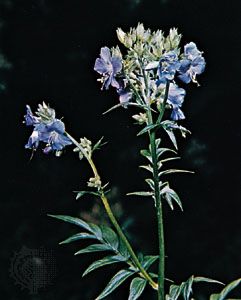
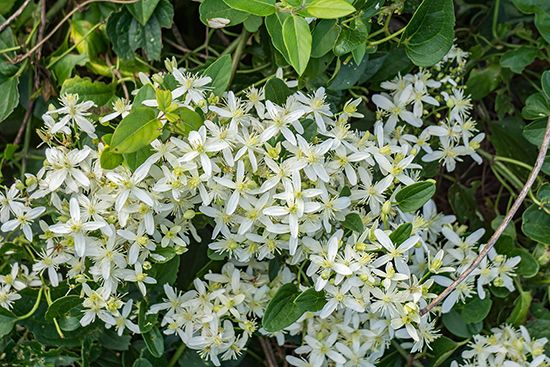
Additionally, the name is used for various other plants, including species within the genera Campanula, Polemonium, and Clematis.1
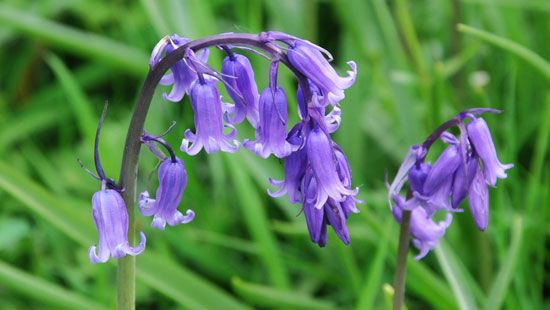
How do English and Spanish bluebells differ?
While both the English bluebell (Hyacinthoides non-scripta) and the Spanish bluebell (H. hispanica) belong to the same genus and are popular garden ornamentals reaching about 30 cm (1 foot) in height, they are distinct species within the Asparagaceae family.1
The provided information confirms they are both bulbous perennial plants native to Eurasia, but it does not detail specific morphological differences—such as petal shape, scent, or leaf width—that distinguish the two in the field.1
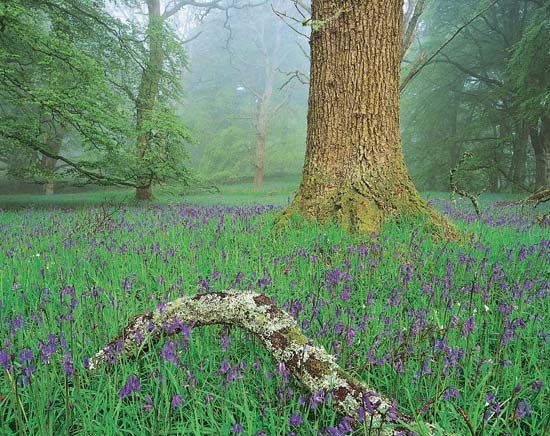
What makes Virginia bluebells change color from pink to blue?
The color change in Virginia bluebells (Mertensia virginica) from pink buds to blue flowers is primarily driven by the presence of anthocyanins, which are water-soluble flavonoid pigments found in plant cell vacuoles2.2
The specific hue of these pigments is determined by the acidity or alkalinity of the cell sap. Generally, anthocyanin pigments appear red in acidic environments and shift toward blue as the environment becomes more alkaline. As the Virginia bluebell matures and its flowers open, the chemical environment within the flower tissues changes, causing the pigment to transition from the pink observed in the bud stage to the characteristic blue of the fully developed bloom.243
What are some other types of bell-shaped flowers?
Beyond the well-known bellflower (Campanula), many other plants in the Campanulaceae family exhibit characteristic bell-shaped blooms. These include:
- Ladybell (Adenophora): Similar to Campanula, these plants feature blue, bell-shaped flowers arranged in spikes or loose clusters, distinguished by a cuplike disk at the base of the style.5
- Canarian bellflower (Canarina): Native to the Canary Islands and Africa, these plants produce solitary, dull-yellow, bell-shaped flowers with purplish lines.5
- Bonnet bellflower (Codonopsis): A genus of sprawling perennials from Asia that bear long-stalked, pendent, bell-shaped flowers, often in shades of blue, white, or yellow.5
- Trailing bellflower (Cyananthus): Dainty, mat-forming Himalayan perennials with wide-open, blue bell tubes.5
- Grassy bellflower (Edraianthus): Low-growing perennials from the Balkans that produce clusters of upright, blue or purplish bells.5
- Giant bellflower (Ostrowskia magnifica): A large perennial that produces impressive, pale-lilac bells measuring up to 12 cm wide.5
- Ring bellflower (Symphyandra): Known for its long-tubed, nodding bells.5
Sources
- bluebell — Encyclopædia Britannica
- Mertensia — Encyclopædia Britannica
- bluebell — Merriam-Webster
- Anthocyanin — Encyclopædia Britannica
- Bellflower — Encyclopædia Britannica
- Campanulaceae — Encyclopædia Britannica
Published on · 3 min read