Bluefish
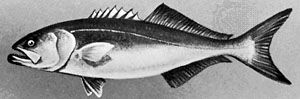
The bluefish (Pomatomus saltatrix) is a swift-moving marine fish and the sole member of the family Pomatomidae. Found in the warm and tropical regions of the…
What is bluefish?
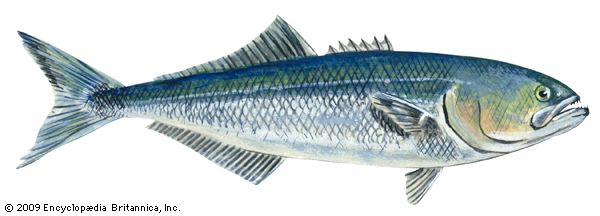
The bluefish (Pomatomus saltatrix) is a swift-moving marine fish and the sole member of the family Pomatomidae. Found in the warm and tropical regions of the Atlantic and Indian oceans, these fish travel in schools and are known for their voracious predatory behavior toward smaller animals and other fish.1
Physically, the bluefish is characterized by an elongated body, a forked tail, two dorsal fins, and a large mouth equipped with strong, pointed teeth. They typically display a blue or greenish coloration with silvery sides and can grow to approximately 1.2 meters (4 feet) in length, reaching weights of up to 11.5 kg (25 pounds). Beyond this specific species, the term is sometimes used to describe various other dark or bluish fish, such as the pollack.12
What other fish are found in the Atlantic Ocean?
The Atlantic Ocean supports a vast array of marine life, with its nutrient-rich continental shelves serving as primary habitats for numerous species. The fish found in these waters are generally categorized by their movement patterns and depth preferences.34
Key Fish Species
- Codfishes (Gadidae): This group includes cod, haddock, hake, and pollock, which are among the most important commercial species in the North Atlantic.53
- Pelagic Species: These free-swimming fish often travel in large schools and include mackerel, herring, menhaden, and pilchard.53
- Tuna and Related Species: Various tuna species, such as albacore, bluefin, and yellowfin, are found in the Atlantic, alongside related species like swordfish.5
- Flatfish: Species such as halibut, plaice, and sole reside primarily on the bottom of coastal shelves.5
- Other Notable Species: The Atlantic is also home to Atlantic salmon, redfish, eels, and various sharks.534
In addition to finfish, the Atlantic supports significant populations of shellfish, including sea scallops, blue mussels, shrimp, and lobsters.36
How do schools of fish protect themselves from predators?
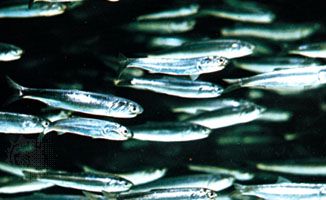
Schools of fish, particularly among clupeiform species like herring and anchovies, utilize schooling behaviour as a primary defensive strategy against predators. By swimming together in large, coordinated groups, individual fish gain significant protection that they would lack if living solitarily.78
When threatened, schools employ specific maneuvers to thwart predators:
- Tightening Formations: Upon sensing danger, fish often move closer together. Species like sardines and herring form compact, dense balls to minimize the space available for a predator to strike.8
- Contraction: Anchovies exhibit an intense reaction by contracting a school that may span hundreds of meters into a dense, writhing sphere only a few meters across. This rapid transformation makes it difficult for a predator to isolate or concentrate on a single individual, often resulting in the predator’s frustration.78
This collective behavior allows the school to function almost as a single organism, providing a survival advantage by confusing or overwhelming potential threats.78
What makes a fish popular for sport fishing?
The popularity of a fish for sport fishing is driven by a combination of cultural tradition, the challenge the species presents, and its accessibility to anglers.
Factors Influencing Popularity
- Challenge and Prestige: Species like tuna, marlin, and swordfish are highly sought after in big-game fishing because they require specialized equipment, such as heavy-duty rods and reels with internal drags, and physical endurance to land.9
- Cultural and Economic Significance: Traditional game fish like salmon and trout remain perennially popular, supported by massive government efforts to stock waters to meet high angler demand.1011
- Specialized Competition: Some species, such as the largemouth bass, have become so popular in the United States that they have spawned a dedicated industry, including custom-designed boats and professional tournament circuits broadcast on television.11
- Global Accessibility: Increased air travel has allowed anglers to seek out new, exotic game fish, such as the dorado and tigerfish, expanding the definition of what constitutes a “sport fish.”11
Sources
- bluefish — Encyclopædia Britannica
- bluefish — Merriam-Webster
- commercial fishing - Fishes — Encyclopædia Britannica
- Atlantic Ocean - Fisheries of the Atlantic Ocean — Encyclopædia Britannica
- Atlantic Ocean: Top Questions — Encyclopædia Britannica
- Atlantic Ocean - Biological resources — Encyclopædia Britannica
- Schooling behaviour — Encyclopædia Britannica
- clupeiform - Schooling behaviour — Encyclopædia Britannica
- protacanthopterygian - Importance — Encyclopædia Britannica
- fishing - Recent trends in fishing — Encyclopædia Britannica
- fishing - Big-game fishing — Encyclopædia Britannica
- Atlantic salmon — Encyclopædia Britannica
Published on · 3 min read