Bonefish
The term "bonefish" refers to a specific species, whereas "bony fish" is a broad biological classification. It is important to distinguish between the two to…
What is bonefish?
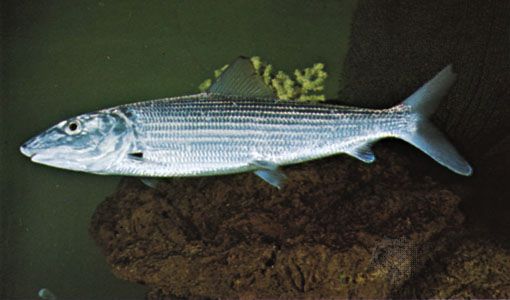
The term “bonefish” refers to a specific species, whereas “bony fish” is a broad biological classification. It is important to distinguish between the two to avoid confusion.
The bonefish (Albula vulpes) is a marine game fish belonging to the family Albulidae. It is found in shallow, tropical coastal waters and is highly regarded by anglers for its notable speed and strength. These fish typically reach a maximum size of about 76 cm (30 inches) and 6.4 kg (14 pounds). They are characterized by a piglike snout, a small mouth, and a deeply notched tail fin, and they feed by grubbing on the sea floor for worms and other prey.1
In contrast, bony fish (superclass Osteichthyes) represent a vast group comprising the majority of the world’s fish species. Their defining characteristic is a skeleton composed at least partially of true bone rather than cartilage.2
What is the difference between bony fish and cartilaginous fish?
The primary difference between bony fish and cartilaginous fish lies in the composition of their skeletons.
Bony Fish (Superclass Osteichthyes)
- Skeleton: Their skeletons are composed at least partially of true bone, which provides a rigid internal structure.3
- Anatomy: Most bony fishes possess a swim bladder for buoyancy, gill covers (opercula) that protect the gill chamber, and a skull with sutures.3
- Diversity: This group includes the vast majority of living fish species—over 29,000—ranging from ray-finned fishes to lobe-finned fishes.3
- Reproduction: They often utilize external fertilization, and hermaphroditism is more common in this group than in any other vertebrate class.43
Cartilaginous Fish (Class Chondrichthyes)
- Skeleton: Their skeletons are composed wholly or largely of cartilage, which is more flexible than bone. The only exception is the presence of true bone in the roots of their teeth.25
- Anatomy: This class includes sharks, rays, skates, and chimaeras. They lack the bony gill covers found in bony fish; instead, they have gill clefts that open directly to the exterior.235
- Reproduction: They employ internal fertilization and typically either lay large, heavy-shelled eggs or give birth to live young.4
How do bonefish use their specialized snouts to find food?
The bonefish (Albula vulpes) utilizes its specialized, piglike snout to forage for food by grubbing along the sea floor. This behavior allows the fish to locate and consume worms and other prey items buried in the substrate.1
While the provided information confirms that the bonefish uses its snout to grub for food on the bottom, the specific sensory mechanisms—such as whether it relies primarily on chemosensory acuity or other tactile adaptations within the snout—are not detailed in the current knowledge base. We know that many fishes living in similar environments utilize taste buds on their lips and body to identify food items, but further research would be required to confirm the exact sensory role of the bonefish’s snout in this process.10
Why are bonefish considered such a challenge for recreational anglers?
The bonefish is highly regarded by recreational anglers primarily due to its exceptional speed and strength. While the provided search results confirm that bonefish are a popular target for saltwater fishing, they do not explicitly detail the specific behavioral traits—such as their wariness or camouflage—that make them a technical challenge to catch.1
In the context of angling, the difficulty often stems from the fish’s physical prowess and the environment in which they are pursued, but the available Britannica records focus on their biological classification and status as a game fish rather than the specific tactical challenges of the sport.
Sources
- bonefish — Encyclopædia Britannica
- bony fish — Encyclopædia Britannica
- cartilaginous fish — Merriam-Webster
- Reproductive behaviour - Fishes — Encyclopædia Britannica
- Respiratory system - Fishes — Encyclopædia Britannica
- muscle - Jawed fishes — Encyclopædia Britannica
- fish - Annotated classification — Encyclopædia Britannica
- skeleton - Cuticular structures — Encyclopædia Britannica
- skeleton - Principal types of skeletal elements — Encyclopædia Britannica
- ostariophysan - Taste and smell — Encyclopædia Britannica
- Animal communication - Signal reception — Encyclopædia Britannica
- fishing - Saltwater fishing — Encyclopædia Britannica
Published on · 3 min read