Boomslang
The boomslang (Dispholidus typus) is a venomous snake native to the savannas of sub-Saharan Africa. Within its ecosystem, it functions as a specialized…
What role do boomslang snakes play in their ecosystem?
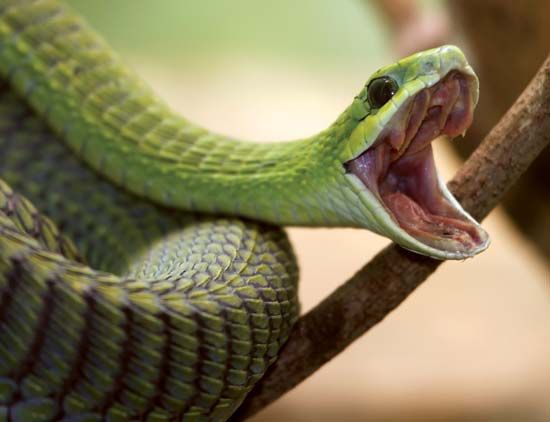
The boomslang (Dispholidus typus) is a venomous snake native to the savannas of sub-Saharan Africa. Within its ecosystem, it functions as a specialized predator that primarily hunts birds and chameleons.1
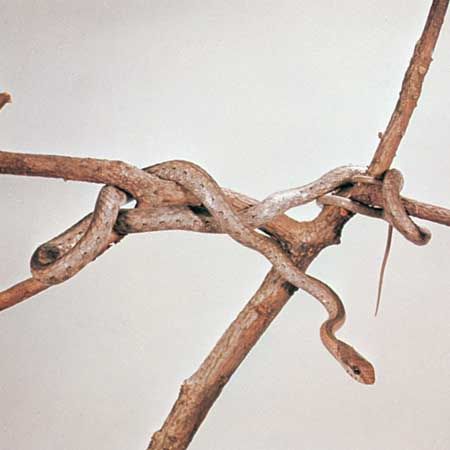
The snake is well-adapted to its environment through excellent camouflage, which allows it to remain undetected while waiting for prey. It typically hunts by positioning the forepart of its body motionless in the air among the branches of trees or bushes. While it is a rear-fanged species, its venom is highly potent, causing hemorrhages in its prey. Although the boomslang is generally retiring, it will inflate its neck and strike if threatened.1
How venomous is the boomslang, and what makes its venom unique?
The boomslang (Dispholidus typus) is a highly venomous snake native to sub-Saharan Africa that is considered decidedly dangerous to humans. While some sources characterize it as “practically harmless” due to its retiring nature, this is misleading; its venom is potent and can be fatal to humans even in small amounts.13
The boomslang’s venom is unique primarily due to its physiological effects and the snake’s method of delivery:
- Mechanism of Action: The venom is a powerful hemotoxin that causes extensive hemorrhages throughout the body.1
- Delivery System: As a rear-fanged snake, the boomslang does not inject venom through a quick strike like many front-fanged vipers. Instead, it must chew on its victim to effectively deliver the toxins into the tissue.2
- Anatomical Adaptation: Although it is classified as a rear-fanged species, its fangs are positioned relatively far forward in the mouth, which facilitates the delivery of its lethal venom.1
Where are boomslang snakes typically found in the wild?
Boomslang snakes (Dispholidus typus) are primarily found throughout the savannas of sub-Saharan Africa.1
These snakes are arboreal, meaning they are well-adapted for life in trees and bushes. They typically spend their time in these elevated positions, where they use their excellent camouflage to remain hidden while waiting to ambush prey such as birds and chameleons. While they are often associated with the broader sub-Saharan region, they are also specifically noted as being present in southern Africa.12
How did the boomslang snake get its name?
The name “boomslang” is derived from Afrikaans, a language spoken primarily in southern Africa. The term is a compound word formed by combining two distinct elements:
- boom: meaning “tree”
- slang: meaning “snake”
This name is highly descriptive, as the boomslang is an arboreal species that spends the majority of its life in trees and bushes. The word slang itself traces back to Middle Dutch, sharing linguistic roots with terms related to winding or slithering movements.2
Sources
- boomslang — Encyclopædia Britannica
- boomslang — Merriam-Webster
- 9 of the World’s Deadliest Snakes — Encyclopædia Britannica
Published on · 2 min read