Bog Rosemary
Bog rosemary (Andromeda polifolia) is a low-growing evergreen shrub belonging to the heath family (Ericaceae). It is native to bogs across northern North…
What is bog rosemary?
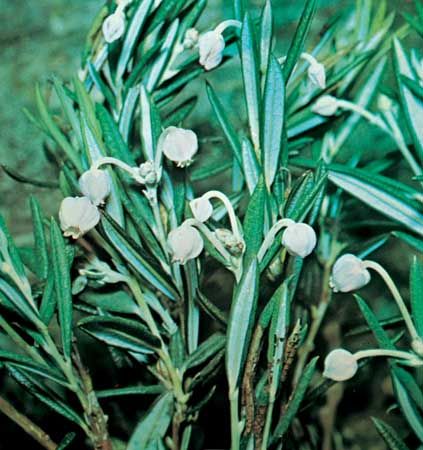
Bog rosemary (Andromeda polifolia) is a low-growing evergreen shrub belonging to the heath family (Ericaceae). It is native to bogs across northern North America, Europe, and Asia.1
The plant typically reaches heights of 30 to 60 cm (1 to 2 feet) and features narrow leaves that resemble those of true rosemary, though the two species are unrelated. It produces small, urn-shaped pinkish-white flowers in terminal clusters. While some ornamental cultivars exist, the plant requires specific cool, moist, and acidic soil conditions to thrive.1
It is important to note that all parts of the bog rosemary plant contain andromedotoxin and are considered poisonous; therefore, it should be handled with caution. The plant is also known as moorwort.12
What are the characteristics of a bog ecosystem?
A bog is a wetland ecosystem defined by its wet, spongy, and poorly drained peat-rich soil. These environments are characterized by several distinct features:3
- High Acidity and Low Minerals: Typical bogs are highly acidic, often with a pH below 5. They are primarily fed by rainwater, which provides very few minerals, creating a nutrient-poor environment.34
- Dominance of Sphagnum: These ecosystems are dominated by peat mosses (Sphagnum), which absorb minerals from the water and release hydrogen ions, further increasing acidity.34
- Retarded Decomposition: The combination of high acidity, low oxygen levels, and low temperatures inhibits the activity of bacteria and fungi. This prevents the decay of organic matter, leading to the accumulation of thick layers of peat.56
- Unique Flora: Due to the harsh, acidic conditions, bog vegetation is specialized. Common plants include heaths, sedges, grasses, orchids, and insectivorous species like sundews and pitcher plants.4
- Instability: Many bogs are “quaking bogs,” where a floating mat of vegetation sits atop water or soft peat, causing the surface to sink or tremble under weight.6
Why is andromedotoxin dangerous to humans and animals?
Andromedotoxin is a potent plant toxin found in species such as mountain laurel and bog rosemary. It is dangerous to both humans and animals because it acts as a systemic poison that disrupts normal physiological functions when ingested.8
The toxic effects of andromedotoxin include a range of severe symptoms, such as:
- Hypersalivation and excessive tearing
- Impaired vision
- Tingling sensations in the skin
- Dizziness and vomiting
- Muscular paralysis
- Convulsions and coma
In severe cases, exposure to this toxin can lead to death. Because of these serious health risks, it is essential to treat plants containing this substance with extreme caution and ensure they are kept away from children and animals.8
How does bog rosemary differ from common culinary rosemary?
Although bog rosemary (Andromeda polifolia) and common culinary rosemary (Salvia rosmarinus) share similar-sounding names and leaf shapes, they are entirely unrelated plants with vastly different properties.
Key Differences
- Classification and Family: Culinary rosemary belongs to the mint family (Lamiaceae) and is a member of the genus Salvia. In contrast, bog rosemary is a member of the heath family (Ericaceae).19
- Toxicity: Culinary rosemary is a safe, widely used herb for seasoning foods. Bog rosemary, however, is highly toxic; all parts of the plant contain andromedotoxin, which can cause serious illness or death if ingested.19
- Habitat: Culinary rosemary is native to the dry, rocky regions of the Mediterranean and thrives in well-drained, sandy or loamy soils. Bog rosemary is a wetland plant native to cool, acidic bogs across northern regions of North America, Europe, and Asia.19
- Appearance: While both are evergreen shrubs, culinary rosemary typically grows larger (up to 2 meters) and produces small bluish flowers. Bog rosemary is a smaller shrub, usually reaching only 30 to 60 cm in height, and features distinct urn-shaped, pinkish-white flowers.19
We could dive deeper into the culinary history of herbs or explore other poisonous plants that are often mistaken for edible varieties.
Sources
- bog rosemary — Encyclopædia Britannica
- bog rosemary — Merriam-Webster
- Bog — Encyclopædia Britannica
- peat moss — Encyclopædia Britannica
- Bog - Flora — Encyclopædia Britannica
- Bog - Formation and structure — Encyclopædia Britannica
- Bog - Distribution — Encyclopædia Britannica
- poison - Plant poisons (phytotoxins) — Encyclopædia Britannica
- rosemary — Encyclopædia Britannica
- wild rosemary — Merriam-Webster
Published on · 3 min read