Tarsier
Sorry, the Britannica knowledge base does not contain information regarding the representation of tarsiers in local cultures and folklore.
How have tarsiers been represented in local cultures and folklore where they are found?
Sorry, the Britannica knowledge base does not contain information regarding the representation of tarsiers in local cultures and folklore.
What is the evolutionary history of tarsiers and how are they related to other primates?
Tarsiers are unique primates that occupy a distinct evolutionary position, often described as a “living fossil” due to their ancient lineage. They are classified within the suborder Haplorrhini alongside monkeys, apes, and humans, but they constitute their own separate infraorder, Tarsiiformes.13
Evolutionary History
The fossil record of the Tarsiidae family dates back to the Eocene Epoch (56 million to 33.9 million years ago). Ancestral forms such as the European Necrolemur antiquus and the Egyptian Afrotarsius chatrathi are believed to be related to the ancestors of the modern genus Tarsius. Evidence of the modern genus has been identified in the Eocene of China and the Miocene Epoch of Thailand, demonstrating a long-standing presence in Asia.1
Relationship to Other Primates
Tarsiers exhibit a blend of characteristics that bridge the gap between lemurs and monkeys. While they share nocturnal habits and a well-developed sense of smell with lemurs, they possess dry, hair-covered noses and simiiform-like placental structures, which align them more closely with monkeys, apes, and humans.3
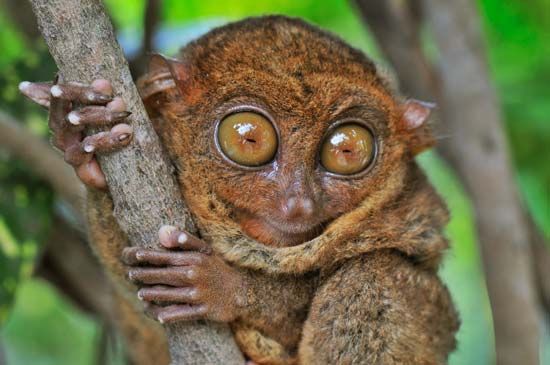
How do tarsiers’ enormous eyes contribute to their nocturnal lifestyle?
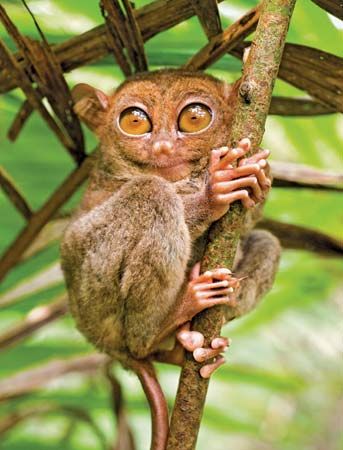
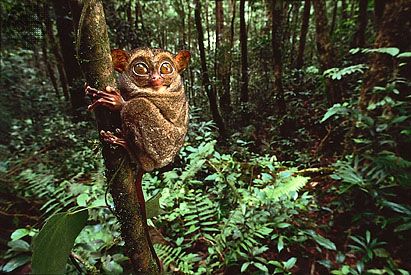
The enormous, goggling eyes of the tarsier are a critical adaptation for their nocturnal lifestyle, serving as their most striking feature. Because tarsiers lack a tapetum lucidum—a reflective layer behind the retina found in most other nocturnal mammals to enhance low-light vision—they have evolved exceptionally large eyes to capture as much light as possible in dim environments.15
To support these oversized eyes, tarsiers possess a small brain with an enormous visual cortex dedicated to processing the vast amount of sensory information they receive. This specialized anatomy allows them to navigate and hunt effectively in the dark, where they prey on insects, lizards, and snakes.1
The size of their eyes is so significant that it often makes the tarsier’s head appear broader than it is long. This visual specialization is essential for their survival as entirely carnivorous, nocturnal primates, allowing them to thrive in the forests of Southeast Asia.1
What are the physical characteristics that distinguish tarsiers from other primates?
Tarsiers are distinct from other primates due to a unique combination of physical traits that bridge the gap between lemurs and monkeys. Their distinguishing characteristics include:
- Sensory Anatomy: Unlike lemurs, which have moist, bald noses, tarsiers possess dry, hair-covered noses similar to those of monkeys, apes, and humans. Their most striking feature is their enormous, goggling eyes, which lack the reflective tapetum layer found in most other nocturnal mammals. To process this visual input, they have an exceptionally large visual cortex within a relatively small brain.1
- Skeletal Structure: They are named for their elongated ankle bones (tarsals), which facilitate their leaping locomotion. They also feature a round head capable of rotating 180°, large, constantly moving ears, and a scaly tail often tipped with a brush of hair.1
- Diet and Grip: Tarsiers are the only entirely carnivorous primates, feeding on insects, lizards, and snakes. To support their arboreal lifestyle, their digits are equipped with disklike adhesive pads that aid in gripping tree trunks.1
Sources
- tarsier — Encyclopædia Britannica
- tarsier — Merriam-Webster
- primate - Eocene — Encyclopædia Britannica
- Tarsioidea — Merriam-Webster
- Why do cats have slit pupils? — Encyclopædia Britannica
- Photoreception - Diversity of eyes — Encyclopædia Britannica
- primate - Eyes and vision — Encyclopædia Britannica
- skeleton - Limbs — Encyclopædia Britannica
Published on · 3 min read