Snake
Snakes are ectothermic—often referred to as cold-blooded—meaning they rely on external environmental sources rather than internal metabolic processes to…
How do snakes regulate their body temperature?
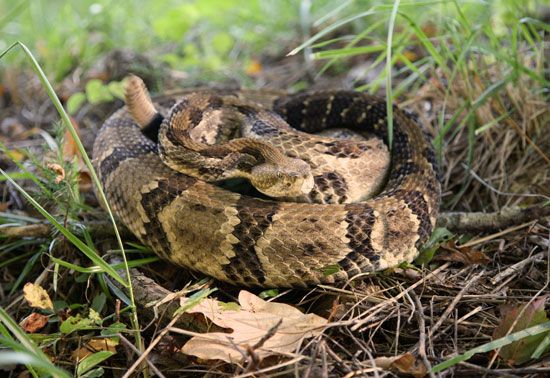
Snakes are ectothermic—often referred to as cold-blooded—meaning they rely on external environmental sources rather than internal metabolic processes to regulate their body temperature.12
To maintain an optimal temperature for activities like hunting or digestion, snakes employ several behavioral strategies:
- Basking and Shading: Snakes move between sunlit areas to absorb heat and cooler, shaded areas to prevent overheating.13
- Postural Adjustments: They alter their body position or orientation relative to solar radiation to control the rate of heat absorption.13
- Environmental Contact: Snakes may lie on warm surfaces or adjust their contact with the soil to gain or lose heat.13
- Dormancy: During extreme temperatures, they seek refuge underground or in sheltered niches. In winter, this state of torpor is known as brumation.4
Additionally, certain snakes, such as pit vipers and boas, possess specialized pit organs that act as highly sensitive thermoreceptors, allowing them to detect and localize the heat radiated by prey.3

How do snakes shed their skin, and why is this process important?
Snakes periodically shed their outer layer of skin, a process known as molting or ecdysis, because their skin does not grow along with their bodies.67
The Process of Shedding
As a snake grows, it forms a new, functional layer of skin beneath the old one. Before shedding, the snake’s eyes often appear cloudy or milky blue, signaling that the old skin—including the eye cap—is loosening. Once the eyes clear, the snake begins the process by rubbing its mouth and nose against a surface to break the old skin. It then crawls out of the old layer entirely, leaving behind a complete, discarded skin and revealing a fresh, vibrant layer underneath.68
Importance of Molting
This cycle is essential for several reasons:
- Growth: It allows the snake to accommodate its increasing size.6
- Health and Hygiene: Shedding acts as a vital maintenance mechanism. It removes damaged skin and helps the snake rid itself of external parasites, such as mites, that may have attached to the old surface.68

What are the defining characteristics of snakes as reptiles?
Snakes (suborder Serpentes) are a specialized group of reptiles within the order Squamata that have evolved through significant structural reduction and simplification. Their defining characteristics include:9
- Body Form: Snakes are distinguished by their limbless condition and greatly elongated bodies and tails. While they lack external limbs, some families, such as boas and pythons, retain vestigial pelvic and femoral elements.109
- Skull and Jaw Mobility: Snakes possess the most kinetic skulls among vertebrates. Their skulls are light with a reduced number of bones held together by flexible ligaments, allowing them to swallow prey much larger than their own heads. This mobility includes independent movement of jaw arches and a highly mobile quadrate bone.1112
- Sensory Adaptations: Snakes lack external ear openings, relying instead on bone conduction to detect low-frequency vibrations. They also lack movable eyelids, having instead a transparent scale called a spectacle that covers the eye. Many species utilize a highly developed vomeronasal system for chemoreception, while some, like pit vipers, use specialized heat-sensing pit organs9.1291310
- Internal Anatomy: Snakes exhibit significant internal elongation and asymmetry, often featuring a reduced or absent left lung and the absence of a urinary bladder.9
What are the different types of venom found in snakes, and how do they use it?
Snake venom is a complex mixture of toxic enzymes and proteins that snakes use primarily to immobilize or kill prey and to defend against predators. While historical terms like neurotoxic, hemotoxic, and cardiotoxic are often used to categorize these venoms, they are considered simplifications of the diverse and overlapping ways these substances affect a victim’s body.1415
Types of Venom Effects
- Neurotoxic: These components target the nervous system, potentially causing paralysis, respiratory failure, or heart rhythm disturbances.1415
- Hemotoxic: These affect the circulatory system and blood, causing internal hemorrhaging, coagulation defects, or damage to blood vessels.1415
- Cytotoxic and Myotoxic: These cause direct destruction of cells and muscle tissue.14
Methods of Delivery
Snakes have evolved specialized salivary glands and delivery systems to inject these toxins:15
- Biting: Most venomous snakes use specialized teeth, such as the long tubular fangs of vipers, the short fixed fangs of elapids, or grooved rear teeth in some species.15
- Spraying: Spitting cobras can eject venom from their fangs toward a threat, specifically aiming for the eyes to cause intense pain and potential blindness as a defensive measure.16
Sources
- Why are reptiles cold-blooded? — Encyclopædia Britannica
- Thermoreception - Reptiles and amphibians — Encyclopædia Britannica
- Dormancy - Effects of temperature — Encyclopædia Britannica
- reptile — Encyclopædia Britannica
- dinosaur - Ectothermy and endothermy — Encyclopædia Britannica
- Why do snakes shed their skin? — Encyclopædia Britannica
- Ecdysis — Encyclopædia Britannica
- snake - Molt — Encyclopædia Britannica
- snake - Skull and sense organs — Encyclopædia Britannica
- lizard - Evolution and classification — Encyclopædia Britannica
- snake - Form and function — Encyclopædia Britannica
- reptile - Skull and dentition — Encyclopædia Britannica
- snake — Encyclopædia Britannica
- Venom — Encyclopædia Britannica
- spitting cobra — Encyclopædia Britannica
- black-tailed rattlesnake — Encyclopædia Britannica
- Did you know? — Merriam-Webster
- snake - Specializations for securing food — Encyclopædia Britannica
- snake - Coloration — Encyclopædia Britannica
Published on · 4 min read