Bolas Spider
A bolas spider refers to any of about 50 species of spiders in the genus Mastophora, as well as members of the genera Cladomelea, Encyosaccus, and Ordgarius.…
What is bolas spider?
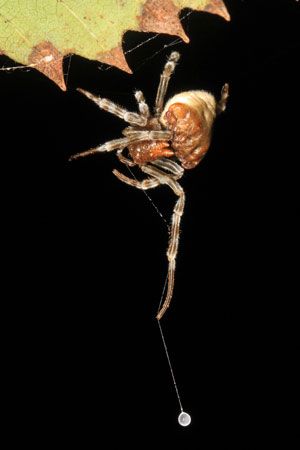
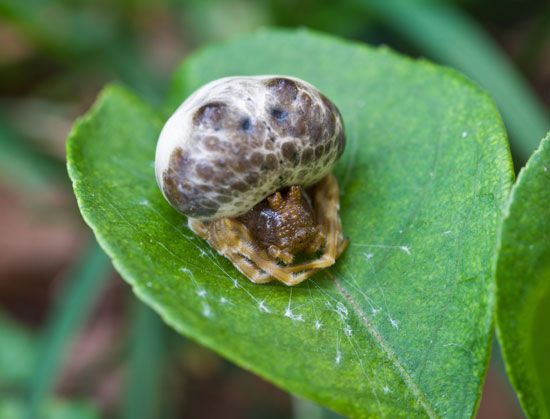
A bolas spider refers to any of about 50 species of spiders in the genus Mastophora, as well as members of the genera Cladomelea, Encyosaccus, and Ordgarius. Although they belong to the orb weaver family, they are ambush predators that do not build traditional webs.12
These spiders are best known for their unique hunting method: female spiders capture flying prey by swinging a sticky droplet at the end of a silk thread, a technique similar to the South American bola hunting weapon. To lure prey, the spider uses aggressive chemical mimicry, releasing pheromones that imitate those of female moths to attract males. Once a moth approaches, the spider flings the sticky bola at its target, immobilizing it with venom.3142
Bolas spiders exhibit strong sexual dimorphism, with males being significantly smaller than females. They are found in temperate and tropical regions throughout the Americas.1
How do spiders use chemical mimicry to attract prey?
Spiders, particularly those in the genus Mastophora known as bolas spiders, utilize aggressive chemical mimicry to lure prey by exploiting the reproductive behaviors of other insects.135
The process functions through the following mechanism:
- Pheromone Production: Female bolas spiders produce and release chemical compounds that mimic the sex-attractant pheromones typically emitted by female moths.35
- Luring Prey: Male moths, searching for a mate, are attracted to the scent, which they perceive as a signal from a potential female.354
- Capture: As the moth approaches the source of the scent, the spider detects the vibrations of the moth’s wings. It then uses a specialized hunting tool—a silk thread with a sticky, viscous droplet at the end—to strike the moth.354
- Immobilization: Once the moth is successfully struck and trapped by the sticky droplet, the spider uses venom to immobilize its prey for consumption.35
This sophisticated strategy allows the spider to effectively hunt flying insects without the need for a traditional web.34
What are some other unique hunting strategies used by spiders?
Spiders have evolved a diverse array of hunting strategies beyond traditional web-building to capture prey. These methods range from active stalking to sophisticated ambush techniques:
- Active Stalking: Wolf spiders and jumping spiders rely on keen eyesight to locate prey. Jumping spiders, in particular, stalk their targets and pounce when they are within a few centimeters.47
- Ambush Hunting: Many crab spiders wait for prey on flowers that match their own coloration, grasping unsuspecting insects with their legs and delivering a lethal bite.4
- Spitting: Spitting spiders use a unique method where they shoot a zigzag stream of sticky material from their fangs to entangle prey before approaching to bite.4
- Burrow Ambush: Trap-door spiders construct silk-lined burrows with hinged doors. They wait inside and dart out to capture passing insects.48
- Net-Casting: Ogre-faced spiders construct a small, flat web that they hold between their front legs. When an insect passes by at night, they throw the web over the victim to ensnare it.9
- Active Web Manipulation: Some spiders, such as those in the genus Hyptiotes, hold a thread attached to a partial web. When an insect touches the web, the spider manipulates the tension to entangle the victim.9
Why do female and male bolas spiders differ so much in size?
Bolas spiders exhibit extreme sexual dimorphism, with females significantly larger than males. Females can reach 10–15 mm (0.4–0.6 inch) in length, while males are typically only 1.5–2.25 mm (0.06–0.09 inch) long.3
This size disparity is driven by different evolutionary pressures on each sex:
- Female Fecundity: Larger body size in females is favored by selection processes that prioritize reproductive output, or fecundity.10
- Male Mobility: Small size in males is advantageous for “bridging,” a locomotion technique used to traverse distances by creating silk bridges that are carried by the wind. Because smaller, lighter males can build and cross these bridges more rapidly than larger, heavier ones, they gain more mating opportunities, which reinforces the selection for their diminutive size.10
While females hunt using a specialized sticky bola, males do not employ this method; instead, they capture prey by hiding on leaves and grabbing insects directly with their front legs.3
Sources
- bolas spider: Top Questions — Encyclopædia Britannica
- bolas spider — Merriam-Webster
- bolas spider — Encyclopædia Britannica
- spider - Stalking prey — Encyclopædia Britannica
- Chemoreception - Sex-attractant pheromones — Encyclopædia Britannica
- Chemoreception - Predator chemical cues and prey escape — Encyclopædia Britannica
- Types of Spiderwebs — Encyclopædia Britannica
- trapdoor spider — Encyclopædia Britannica
- spider - Spiderwebs — Encyclopædia Britannica
- spider - Size range — Encyclopædia Britannica
- arachnid - Reproduction and life cycle — Encyclopædia Britannica
Published on · 3 min read