Bombacaceae
Bombacaceae, commonly known as the bombax or kapok family, is a group of 27 genera of flowering trees and shrubs within the mallow order (Malvales). These…
What is Bombacaceae?
Bombacaceae, commonly known as the bombax or kapok family, is a group of 27 genera of flowering trees and shrubs within the mallow order (Malvales). These plants are primarily found in tropical regions and are closely related to the mallow family.1
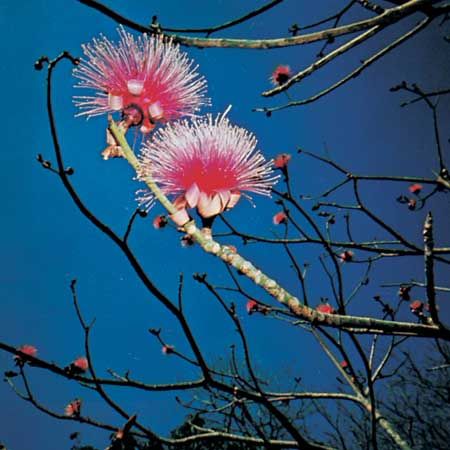
Members of this family are characterized by their palmate leaves and large, often showy flowers. They produce either dry or fleshy fruits that typically contain woolly seeds. Notable species include:12
- African baobab (Adansonia digitata)1
- Red silk-cotton tree (Bombax ceiba)1
- Shaving-brush tree (Pseudobombax ellipticum)1
- Kapok (Ceiba), which provides commercial fiber1
- Balsa (Ochroma lagopus), known for its exceptionally lightweight wood1
- Durian (Durio zibethinus), famous for its large size and distinctive odor1
What makes the baobab tree unique?
The baobab tree (Adansonia) is a remarkable genus of nine deciduous species known for its extraordinary longevity and distinctive, barrel-like trunks. These trees are highly valued for their ethnobotanical importance, as local populations utilize them for food, medicine, and raw materials.3
Key features that make the baobab unique include:
- Water-Storing Trunks: The trees are famous for their massive, swollen trunks, which can reach diameters of up to 9 meters (30 feet). These trunks often serve as natural water reservoirs or temporary shelters for humans and animals.34
- Longevity: Baobabs are exceptionally long-lived; for instance, the African baobab (A. digitata) is considered the oldest known angiosperm tree, with some specimens dated at over 1,200 years old.3
- Ecological Role: Their unique, pendulous flowers are primarily pollinated by bats, bush babies, or moths, depending on the species.3
- Cultural Significance: Often called the “Tree of Life,” they hold deep cultural and religious importance. Their hollow trunks have historically been used for diverse purposes, including as burial sites, stables, and even prisons.3
How is kapok fiber used in everyday products?
Kapok fiber, obtained from the seed pods of the Ceiba pentandra tree, is a lightweight, moisture-resistant, and buoyant material. Because the fibers are too brittle for spinning into yarn, they are primarily utilized as a filling or insulation material.67
Common everyday applications for kapok include:
- Bedding and Furniture: It is frequently used as stuffing for pillows, mattresses, and upholstery.67
- Water-Safety Equipment: Due to its high buoyancy—capable of supporting up to 30 times its own weight in water—it has historically been used in life preservers.67
- Outdoor Gear: It serves as a filling for sleeping bags.7
- Insulation: The fiber is employed as an insulation material.67
- Medical Use: It has been used as a substitute for absorbent cotton in surgical settings.6
While kapok was once highly valued, its use has declined in favor of synthetic fibers, plastics, and foam rubber due to its high flammability. Additionally, the tree’s seeds are processed to produce oil for soap, with the remaining residue utilized as cattle feed and fertilizer.6
Why is balsa wood so popular for model building?
Balsa wood (Ochroma pyramidale) is highly favored for model building primarily due to its extremely lightweight nature. This characteristic makes it an ideal material for projects where weight reduction is critical, such as in the construction of model aircraft and other scale replicas.8
Beyond its low density, the wood is valued for its versatility and ease of use in various commercial applications, including insulation and packing. Historically, the wood’s buoyancy—the name “balsa” is Spanish for “raft” or “float”—has also made it a practical choice for flotation devices. While it grows rapidly in full sun, the wood’s physical properties remain consistent, allowing hobbyists to cut, shape, and assemble it with relative ease compared to denser timber.8
Sources
- Bombacaceae — Encyclopædia Britannica
- Bombacaceae — Merriam-Webster
- Baobab — Encyclopædia Britannica
- tree - Trees of special interest — Encyclopædia Britannica
- baobab — Merriam-Webster
- kapok — Encyclopædia Britannica
- kapok — Merriam-Webster
- balsa — Encyclopædia Britannica
Published on · 3 min read