Bonnet Monkey
The bonnet monkey (Macaca radiata), also known as the bonnet macaque, is a macaque native to southern India. It is named for the distinctive thatch of long…
What is bonnet monkey?
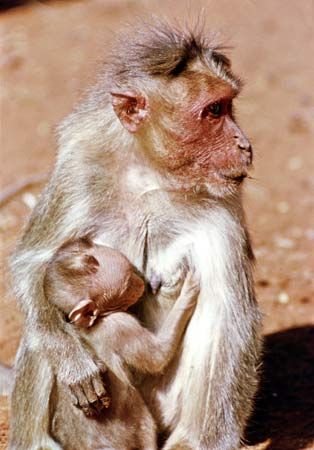
The bonnet monkey (Macaca radiata), also known as the bonnet macaque, is a macaque native to southern India. It is named for the distinctive thatch of long hair on its head that forms a cap or “bonnet,” which grows from a central whorl.123
Physically, the bonnet monkey is grayish-brown with a hairless pink face. Adults typically measure 35–60 cm (14–24 inches) in length, excluding their long tails, with females weighing about 4 kg (9 pounds) and males averaging 6.7 kg. As an agile and gregarious primate, this species is known to raid gardens and food stores. It is closely related to the toque macaque of Sri Lanka, though the bonnet monkey is generally larger and darker in appearance.132
What are the main differences between Old World and New World monkeys?
Monkeys are categorized into two primary groups: Old World and New World. While they share many primate characteristics, they are distinguished by several key anatomical and geographical differences.4
Anatomical Differences
- Nose Structure: Old World monkeys are catarrhines (“downward-nosed”), possessing narrow noses with a thin septum and downward-facing nostrils. New World monkeys are platyrrhines (“flat-nosed”), characterized by broad noses with a wide septum and outwardly directed nostrils.4
- Sitting Pads: Old World monkeys have hard, bare “sitting pads” known as ischial callosities on their buttocks, a feature lacking in New World monkeys.4
- Manual Dexterity: Many Old World monkeys possess opposable thumbs, allowing for precise handling of objects. New World monkeys lack this level of dexterity; in many species, the thumb is reduced or absent, and the main divergence in the hand is between the index and middle fingers.4
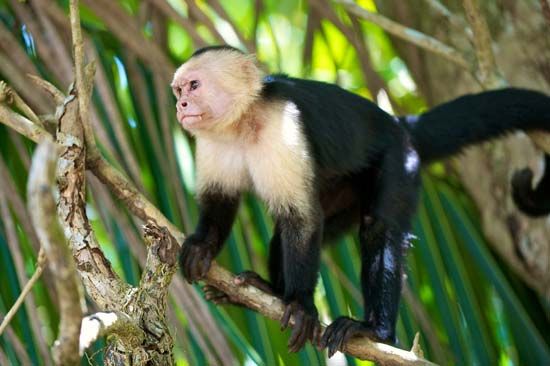
- Tails: Some New World monkeys have prehensile tails capable of supporting their entire body weight. No Old World monkeys have this ability, and some, such as macaques, are nearly tailless4.5
Geographic and Ecological Differences
- Range: New World monkeys are primarily found in the tropical forests of South America. Old World monkeys inhabit Africa and Asia.4
- Dietary Adaptations: Old World monkeys are divided into two subfamilies: the Cercopithecinae, which have cheek pouches for food storage, and the Colobinae, which possess complex, multi-chambered stomachs for fermenting cellulose. No New World monkey possesses such a stomach.4
How do macaques establish and maintain their social hierarchy?
Macaques live in complex social groups typically consisting of several males and females, where they establish and maintain a dominance hierarchy to manage competition for resources and mates.6
Establishing and Maintaining Hierarchy
- Competitive Interactions: Dominance is established through direct or indirect aggression or through mutual displays. In these displays, a dominant individual often assumes a higher stature, while a subordinate may bow or mimic juvenile behavior to signal submission.7
- Stability and Conflict Reduction: Once a hierarchy is clearly established, it remains relatively stable. Direct conflict becomes rare because subordinates typically step aside when confronted by a higher-ranking individual. This structure is advantageous to the group as it reduces the frequency of dangerous and energetically expensive fighting.87
- Social Dynamics: In many macaque troops, females remain in their birth group, creating a network of closely related individuals. Males, however, join new troops upon maturity, often leading to antagonism between them as they navigate their new social standing.6
Subordinates often accept their lower status because the alternatives—such as becoming solitary or attempting to join a new group—carry significant survival costs.7
What are some other examples of primates found in India?
In addition to the rhesus monkey and the Hanuman langur, India is home to several other primate species:
- Hoolock Gibbon: This is the only ape found in India, inhabiting the rainforests of the country’s eastern region.9
- Lion-tailed Macaque: Found in the Western Ghats, this species is distinguished by a distinctive halo of hair around its face and is currently considered rare due to poaching.9
- Nilgiri Langur: A rare species of leaf monkey found in southern India, which may be closely related to the Hanuman langur.10
These primates represent a diverse range of adaptations within the Indian subcontinent, from the highly adaptable rhesus monkey that thrives near human settlements to the specialized, forest-dwelling gibbons and langurs.109
Sources
- bonnet monkey — Encyclopædia Britannica
- bonnet monkey — Merriam-Webster
- macaque — Encyclopædia Britannica
- monkey - Old World monkeys versus New World monkeys — Encyclopædia Britannica
- Tail — Encyclopædia Britannica
- monkey — Encyclopædia Britannica
- Dominance hierarchy — Encyclopædia Britannica
- Animal social behavior - Dominance — Encyclopædia Britannica
- primate - Distribution and abundance — Encyclopædia Britannica
- hoolock gibbon — Merriam-Webster
- langur — Encyclopædia Britannica
- Asia - Mammals — Encyclopædia Britannica
- India - Mammals — Encyclopædia Britannica
Published on · 3 min read