Capuchin Monkey
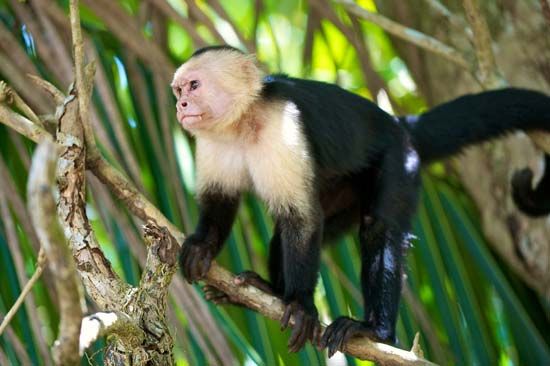
Capuchin monkeys (genus Cebus) are widely considered among the most intelligent of all New World monkeys. Their high level of cognitive ability is supported…
How intelligent are capuchin monkeys, and what examples demonstrate their problem-solving abilities?
Capuchin monkeys (genus Cebus) are widely considered among the most intelligent of all New World monkeys. Their high level of cognitive ability is supported by large brains and the physical dexterity provided by their opposable thumbs, which allow them to perform complex manipulative tasks.123
A primary example of their problem-solving capability is their spontaneous use of objects as tools. For instance, capuchins have been observed using stones to crack open nuts to access the food inside. This behavior demonstrates an ability to interact with their environment in sophisticated ways to overcome physical obstacles and secure resources. While they are highly adept at learning from their own experiences, they generally do not reach the cognitive levels of great apes, nor do they typically learn new behaviors from one another as readily as some other primate species.32
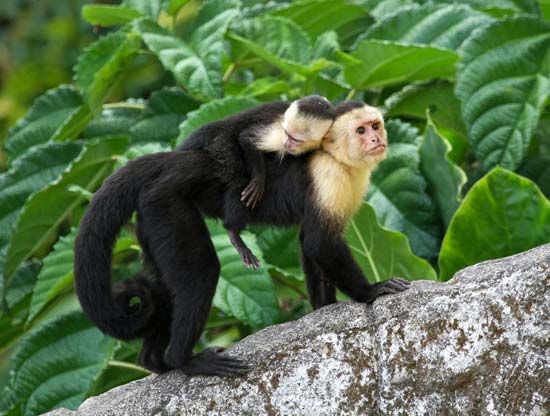
What is the diet of capuchin monkeys, and how do they forage for food?
Capuchin monkeys possess a broad and varied diet, reflecting their adaptability as primates that roam throughout the vertical range of their habitat, from the forest floor to the canopy. Their diet encompasses over 95 plant species in some regions, with a particular preference for palm fruits. In addition to fruit and other vegetable matter, they consume small animals. When opportunities arise, they are also known to raid plantations and farms to feed on crops such as oranges and corn.13
Regarding their foraging behavior, capuchins are highly active during the day, often traveling about 3 km (1.9 miles) daily within their home range. They frequently forage in noisy troops, sometimes associating with squirrel monkeys while searching for food. Their foraging is characterized by high intelligence and the use of physical dexterity; for example, stronger individuals will spontaneously use stones as tools to smash nuts to access the insides.12
What are the different species of capuchin monkeys, and how do they differ from each other?
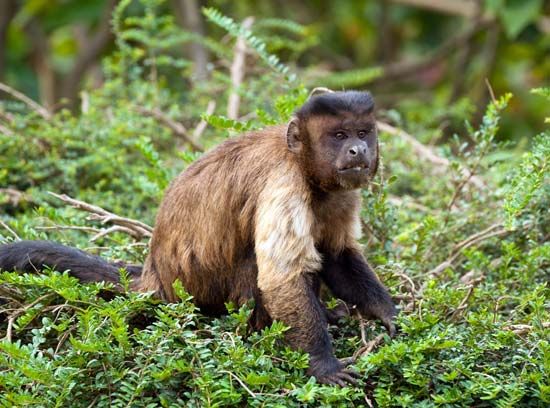
The genus Cebus comprises five or more species of capuchin monkeys, which are typically categorized into two distinct groups based on their physical characteristics, particularly the appearance of the hair on their crowns.3
The Crested (Tufted) Group
This group is characterized by a crown that bears a dark cap of long, erect hairs, which often form noticeable tufts or crests. The primary representative of this group is the brown capuchin (C. apella).3
The Uncrested (Untufted) Group
Members of this group are generally more lightly built and possess a crown featuring a smooth, dark, and more or less pointed cap. This group includes:
- White-throated capuchin (C. capucinus)
- White-fronted capuchin (C. albifrons)
- Weeper capuchin (C. nigrivittatus)3
It is worth noting that taxonomic classification can vary depending on the criteria used, and the name “black-capped capuchin” has historically been applied to both C. apella and C. nigrivittatus. While these monkeys share common traits such as prehensile tails, opposable thumbs, and high intelligence, their physical differences—specifically the presence or absence of crests and variations in facial markings—serve as the primary means of distinguishing between these species.3
How long do capuchin monkeys typically live, and what is their lifecycle like?
Capuchin monkeys (genus Cebus) are highly intelligent primates with a life cycle characterized by significant maternal care and a relatively long period of development.
Reproduction and Development
Capuchins appear to breed throughout the year, though in Central America, births occur more frequently during the dry season. The gestation period lasts approximately six months, typically resulting in a single offspring. Females generally give birth at intervals of one to two years. Like other monkeys, capuchin infants are born with their eyes open and are fully furred, possessing the ability to cling to their mother’s fur from birth. The juvenile period of psychological maternal dependency for monkeys is estimated to last about six years. Capuchins reach physical maturity in three to four years.
Lifespan and Social Context
While specific maximum lifespans in the wild can be difficult to track, capuchins are known for their complex social structures, living in noisy troops that consist of several adults and their young. Their intelligence and ability to learn from experience contribute to their survival in diverse tropical forest environments.
Sources
- Did you know? — Merriam-Webster
- monkey — Encyclopædia Britannica
- capuchin monkey — Encyclopædia Britannica
- monkey - Old World monkeys versus New World monkeys — Encyclopædia Britannica
- monkey - Classification — Encyclopædia Britannica
- primate - Infancy — Encyclopædia Britannica
Published on · 3 min read