Box Turtle
A box turtle is any member of two distinct groups of turtles—one North American and one Asian—that are named for their unique ability to withdraw their head…
What is box turtle?
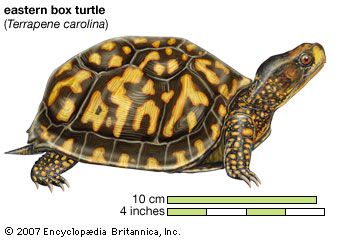
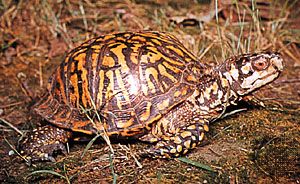
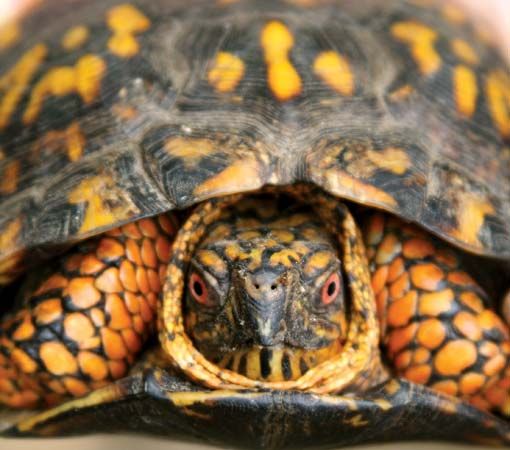
A box turtle is any member of two distinct groups of turtles—one North American and one Asian—that are named for their unique ability to withdraw their head and limbs completely into their shell and close it tightly like a box.12
Despite their similar appearance and common name, these groups are not closely related. North American box turtles belong to the genus Terrapene (family Emydidae), while Asian box turtles belong to the genera Cuora and Pyxidea (family Geoemydidae).12
Key characteristics include:
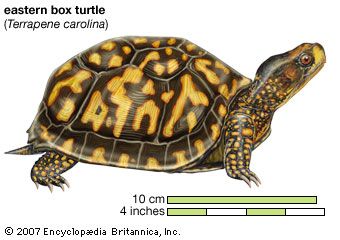
- Shell Structure: They possess a high, rounded upper shell (carapace) and a flattened bottom shell (plastron) connected by a transverse hinge and ligamentous bridges, which provide the flexibility needed to close the shell.2
- Habitat: North American species are largely terrestrial, preferring moist forests, whereas Asian species are typically semiaquatic, often found in forest ponds and streams.23
- Diet: Both groups are omnivorous.2
- Longevity: These turtles are known for their long lifespans, with some individuals living more than 30 years.4
How do North American and Asian box turtles differ?
North American and Asian box turtles are often confused due to their shared ability to close their shells tightly, but they are not closely related and differ in several key ways:
- Taxonomy: North American box turtles belong to the genus Terrapene within the family Emydidae, while Asian box turtles belong to the genus Cuora (and Pyxidea) within the family Geoemydidae.2
- Habitat: North American species are primarily terrestrial, typically inhabiting moist forests, with the notable exception of the semiaquatic Coahuilan box turtle. In contrast, Asian box turtles are generally semiaquatic, spending much of their time in forest ponds and streams.23
- Geography: Terrapene is found in temperate regions of North America, ranging from southern Canada through the United States and into Mexico. Cuora species are native to the subtropical and tropical regions of Asia, spanning from India to China and the Philippines.2
- Reproduction: While both groups are omnivorous and share similar adult shell sizes, North American box turtles tend to lay larger clutches of eggs compared to their Asian counterparts, which typically lay smaller clutches.2
What makes the box turtle’s shell unique compared to other turtles?
The box turtle’s shell is unique primarily due to its specialized mobility, which allows the animal to seal itself off from predators. Unlike most turtles, which have a rigid bony bridge connecting the upper shell (carapace) and the lower shell (plastron), box turtles possess a transverse hinge and ligamentous connections.62
This structural adaptation provides several distinct advantages:
- Complete Closure: The hinge allows the turtle to draw its head and limbs entirely inside the shell and pull the plastron upward to close the opening tightly, resembling a box.62
- Predator Defense: The high, domed shape of the carapace makes it difficult for many predators to hold the turtle in their mouths or crush it, while the ability to seal the shell provides an additional layer of protection against being pried open.64
- Flexibility: While most turtle shells are rigid skeletal structures that cannot be shed, the box turtle’s ligamentous bridges offer the necessary flexibility to facilitate this “closing” mechanism.16
What do box turtles typically eat in their natural habitat?
Box turtles, both the North American genus Terrapene and the Asian genus Cuora, are omnivorous animals2. This means their natural diet consists of a diverse range of both plant and animal matter.78
Because they are opportunistic feeders, their specific intake can vary based on what is available in their environment. Their diet typically includes:
- Plant Matter: They consume various types of vegetation, including fruits, leaves, and other plant parts found within their forest or woodland habitats.78
- Animal Matter: They also feed on a variety of small animals and invertebrates. While they are not specialized predators like some strictly carnivorous turtles, they readily consume available protein sources to supplement their nutritional needs.2879
Because box turtles are not social animals and often inhabit specific, localized environments, their feeding behavior is largely solitary, driven by the resources present in their immediate surroundings.9
Sources
- box turtle — Merriam-Webster
- box turtle — Encyclopædia Britannica
- turtle - Habitats — Encyclopædia Britannica
- turtle - Form and function — Encyclopædia Britannica
- Why do turtles live for so long? — Encyclopædia Britannica
- What are turtle shells made of? — Encyclopædia Britannica
- What do turtles eat? — Encyclopædia Britannica
- turtle: Top Questions — Encyclopædia Britannica
- turtle - Feeding behaviour — Encyclopædia Britannica
Published on · 3 min read