Bosporus
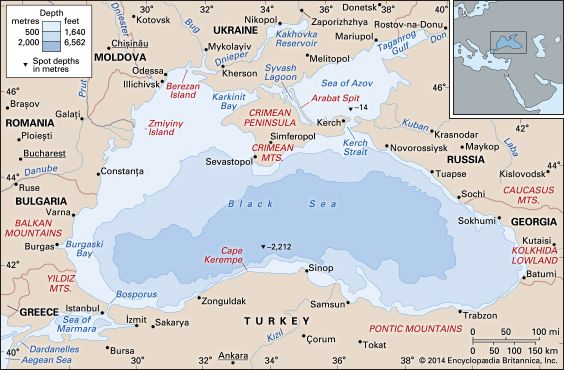
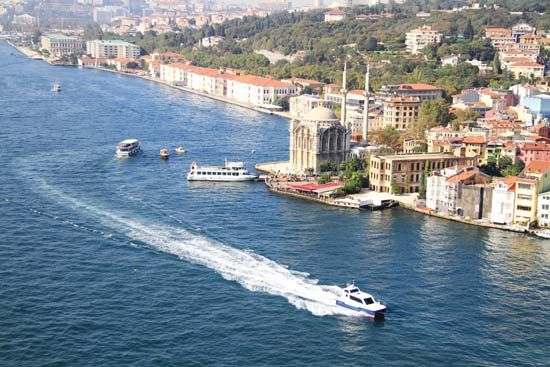
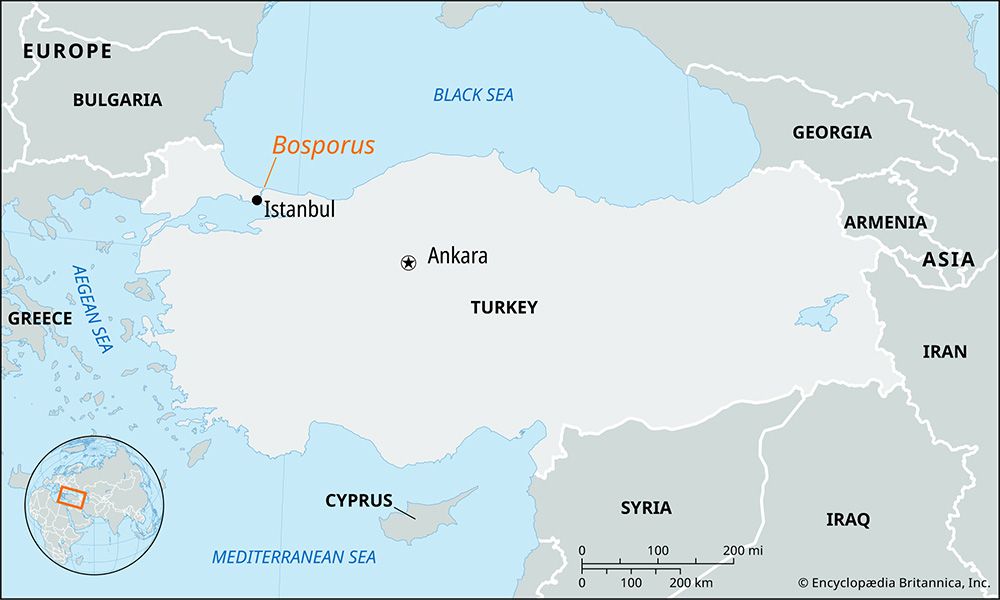
The Bosporus is a vital 19-mile (30-km) long strait connecting the Black Sea and the Sea of Marmara. Its width varies significantly, reaching a maximum of…
How deep and wide is the Bosporus Strait, and how does this affect navigation?
The Bosporus is a vital 19-mile (30-km) long strait connecting the Black Sea and the Sea of Marmara. Its width varies significantly, reaching a maximum of 2.3 miles (3.7 km) at its northern entrance and narrowing to just 2,450 feet (750 meters) at its tightest point. The depth in midstream ranges from 120 to 408 feet (36.5 to 124 meters).1
Navigation through the strait is influenced by complex hydrodynamics: a rapid surface current flows from the Black Sea toward the Sea of Marmara, while a deeper countercurrent carries more saline water in the opposite direction. Beyond these physical conditions, transit is governed by the Montreux Convention, which regulates the passage of naval and commercial vessels to ensure security and manage the strategic importance of this waterway.12
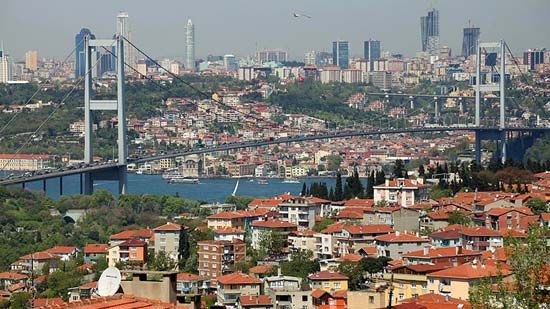
What are some of the major bridges and engineering projects associated with the Bosporus Strait?
The Bosporus Strait has been a site of significant engineering feats, ranging from historic fortifications to modern infrastructure connecting Europe and Asia.
Historic Fortifications
The strategic importance of the strait led to the construction of defensive structures by the Byzantine and Ottoman empires. Two prominent examples include:
- Anadoluhisar: Built on the Asian shore by Bayezid I in 1390–91.
- Rumelihisar: Constructed directly across the strait by Mehmed II in 1452.1
Modern Infrastructure
To facilitate transit between the two continents, several major bridges and tunnels have been completed:
Project
Completion Year
Key Feature
Bosporus I Bridge
1973
3,524-foot main span
Fatih Sultan Mehmed Bridge
1988
3,576-foot main span
Yavuz Sultan Selim Bridge
2016
4,620-foot main span
Rail Tunnel
2013
Submerged transit tunnel
Road Tunnel
2016
Submerged transit tunnel
These projects have significantly improved connectivity for the city of Istanbul.1
What major historical events have taken place around the Bosporus Strait?
The Bosporus Strait has served as a critical geopolitical and strategic crossroads for millennia, primarily due to its role as the gateway to Constantinople (modern Istanbul).
Strategic Control and Conflict
- Byzantine and Ottoman Defense: Because of its vital location, the strait was heavily fortified. Notable examples include the 14th-century fortress of Anadoluhisar and the 1452 construction of Rumelihisar by Mehmed II, which effectively blockaded the strait prior to the fall of Constantinople in 1453.41
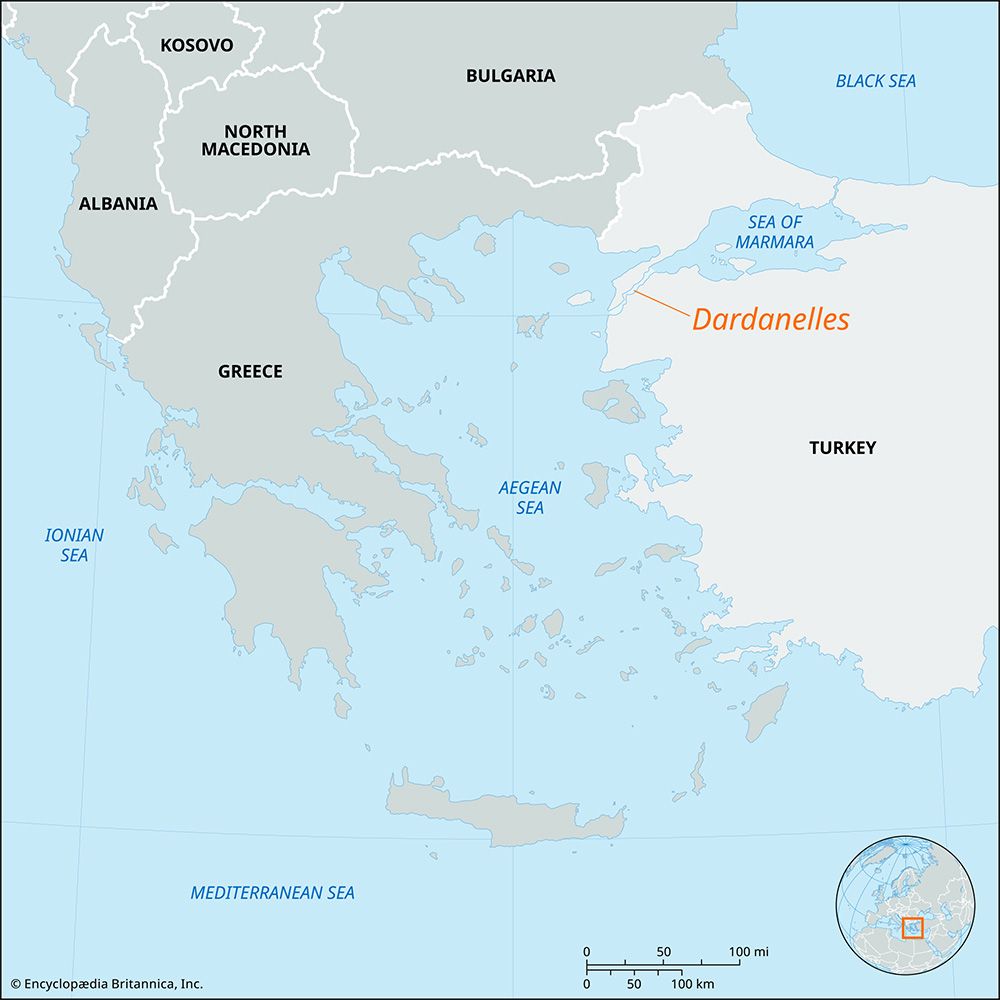
- The Straits Question: Throughout the 19th and 20th centuries, the “Straits Question” dominated European diplomacy, focusing on the right of warships to transit the Bosporus and the Dardanelles. This included the Crimean War, during which British and French fleets traversed the straits to engage Russia.2
Diplomatic Agreements
- Treaties and Conventions: Following World War I, control of the strait was briefly held by an international commission. This was superseded by the Lausanne Convention and eventually the Montreux Convention of 1936, which restored full Turkish military control and established current regulations for naval and commercial passage.542
How does the current flow in the Bosporus Strait, and why is it unique?
The flow of water in the Bosporus is unique due to its complex, two-layered system driven by differences in water density and salinity between the Black Sea and the Sea of Marmara.71
In the center of the strait, a rapid surface current flows from the Black Sea toward the Sea of Marmara. Simultaneously, a deeper countercurrent carries water of significantly higher salinity from the Sea of Marmara back into the Black Sea. This stratification is a result of the Black Sea’s lower salinity—roughly half that of the oceans—compared to the saltier, denser waters of the Sea of Marmara.17
This exchange is further complicated by surface winds, which significantly influence the flow, particularly over the shallow sill or threshold between the two basins. Because this water exchange is relatively slow, it has been estimated that a complete recycling of the Black Sea’s waters through this system takes approximately 2,500 years.7
Sources
- Bosporus — Encyclopædia Britannica
- Straits Question — Encyclopædia Britannica
- List of Important Straits — Encyclopædia Britannica
- Montreux Convention — Encyclopædia Britannica
- Istanbul - Constantinople of Istanbul — Encyclopædia Britannica
- Crimea - Early history to the Crimean War — Encyclopædia Britannica
- Black Sea - Hydrology — Encyclopædia Britannica
- density current - Density currents originating from marginal seas — Encyclopædia Britannica
Published on · 3 min read