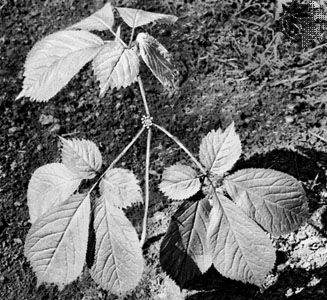
Boston Ivy
Boston ivy (Parthenocissus tricuspidata) is a clinging, woody vine belonging to the grape family (Vitaceae). Native to eastern Asia, it is widely cultivated…
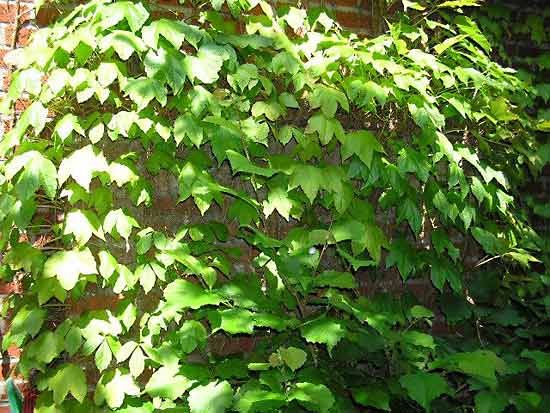
What is Boston ivy?
Boston ivy (Parthenocissus tricuspidata) is a clinging, woody vine belonging to the grape family (Vitaceae). Native to eastern Asia, it is widely cultivated as an ornamental plant to cover stone and brick facades. It is notably associated with the Ivy League due to its prevalence on historic university buildings in northeastern North America1.1
The plant can grow up to 18 meters (60 feet) in length and features leaves that turn a vibrant scarlet in the autumn. It attaches to surfaces using specialized adhesive holdfasts, or sucker disks, located at the ends of its tendrils. While often referred to as an “ivy,” it is distinct from the true ivy genus (Hedera), which belongs to the ginseng family (Araliaceae).12
How does Boston ivy differ from English ivy?
Boston ivy and English ivy are often confused due to their shared use as climbing ornamentals, but they belong to entirely different botanical families and exhibit distinct characteristics.
Feature
Boston Ivy (
Parthenocissus tricuspidata
)
English Ivy (
Hedera helix
)
Family
Vitaceae
(Grape family)
Araliaceae
(Ginseng family)
Foliage
Deciduous; leaves turn bright scarlet in autumn
Evergreen; leaves remain green year-round
Attachment
Adhesive holdfasts (sucker disks) at
tendril
ends
Aerial roots with adhering disks
Native Range
Eastern
Asia
Europe
and parts of
Asia
/place/Europe) and parts of
Asia
While both plants are used to cover walls, English ivy is an evergreen that can thrive in deep shade, whereas Boston ivy is a deciduous vine known for its dramatic seasonal color changes. Additionally, English ivy can potentially damage structures if it penetrates existing fissures in walls, and it may harm trees by overshadowing them or adding excessive weight.13
What is the origin of the term Ivy League?
The term “Ivy League” originated from a blend of 19th-century academic tradition and 20th-century sports journalism. Contrary to the common assumption that the name derives solely from the Boston ivy vines covering historic campus buildings, the “ivy” component stems from “Ivy Day,” a 19th-century tradition where graduating students planted ivy as a symbol of enduring growth.45
The “league” portion was coined by sportswriter Stanley Woodward in 1933, who used the phrase “ivy colleges” to describe the schools’ football teams. The term gained formal traction in 1936 when student newspapers began calling for an athletic league to rival the Big Ten Conference.4
The official Ivy League was established in 1945 when eight universities—Harvard, Yale, Pennsylvania, Princeton, Columbia, Brown, Dartmouth, and Cornell—signed the Ivy Group Agreement, which expanded to all intercollegiate sports by 1954.4
How do adhesive holdfasts help vines climb?
Adhesive holdfasts, often referred to as sucker disks, are specialized structures that allow certain vines to climb vertical surfaces like stone or brick facades. These structures typically form at the ends of a plant’s tendrils, which are sensitive, threadlike organs that respond to physical contact.67
When a tendril brushes against a firm surface, it undergoes a process of attachment:
- Contact and Response: The tendril is sensitive to touch, a behavior known as thigmotropism, which prompts it to seek out and interact with solid objects.8
- Adhesion: Upon making contact with a suitable substrate, the terminal end of the tendril flattens and secretes a powerful adhesive substance.7
- Cementing: This secretion effectively cements the tendril to the surface, providing a secure anchor that allows the vine to support its own weight as it grows upward.71
By utilizing these adhesive disks, plants like Boston ivy can scale structures without needing to wrap around supports or penetrate the surface itself.6
Sources
- Boston ivy — Encyclopædia Britannica
- Boston ivy — Merriam-Webster
- ivy — Encyclopædia Britannica
- How did the Ivy League get its name? — Encyclopædia Britannica
- Ivy League — Merriam-Webster
- tendril — Encyclopædia Britannica
- Did you know? — Merriam-Webster
- holdfast — Merriam-Webster
Published on · 3 min read