Bottlenose Whale
Bottlenose dolphins, often referred to as bottlenose whales in casual conversation, are highly social animals known for complex behaviors that reflect their…
What interesting behaviors have been observed in bottlenose whales during their social interactions?
Bottlenose dolphins, often referred to as bottlenose whales in casual conversation, are highly social animals known for complex behaviors that reflect their intelligence and adaptability. Their social interactions are characterized by several fascinating traits:12
- Exceptional Social Memory: They possess the longest social memories of any nonhuman species, allowing them to recognize the unique signature whistles of individuals they have not encountered for over 20 years.12
- Complex Communication: Each dolphin develops a distinctive “signature whistle,” which functions similarly to a human name to identify itself to others. They also use rapid clicking for echolocation and various sounds to interact with their pod and other species.2
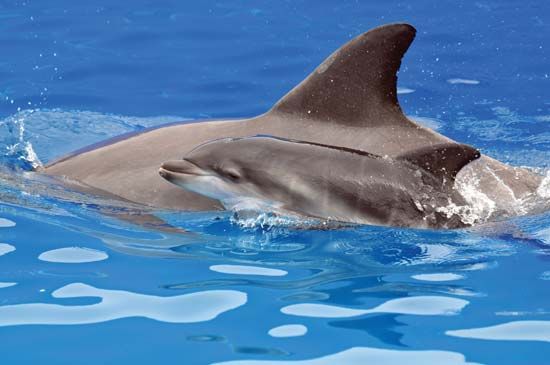
- Cooperative Care: Dolphins often live in pods with flexible membership. In some populations, females engage in cooperative calf-rearing, effectively creating a shared “nursery” or daycare arrangement. Males also form alliances to assist with mating and defense.2
- Epimeletic Behavior: They exhibit altruistic care, where healthy individuals support sick or wounded members of their group.3
- Play and Tool Use: Young dolphins frequently engage in play to practice social and aggressive behaviors. Some also use tools, such as wearing sponges on their snouts to protect them while foraging.32
Where are bottlenose whales typically found in the ocean?
It is important to clarify that “bottlenose whales” and “bottlenose dolphins” are distinct animals. Bottlenose whales are beaked whales belonging to the family Ziphiidae, while bottlenose dolphins are oceanic dolphins in the family Delphinidae.51
Bottlenose Whales
These whales inhabit deep offshore waters and are categorized by their specific ranges:
- Northern Bottlenose Whale (H. ampullatus): Found in the Atlantic Ocean, ranging from New England, Nova Scotia, and northern Europe to Greenland, Iceland, and the pack ice of the Davis Strait.5
- Southern Bottlenose Whale (H. planifrons): Observed near South Africa, Argentina, Uruguay, the Falkland Islands, Sri Lanka, Australia, and New Zealand, sometimes straying as far north as southern Brazil.5
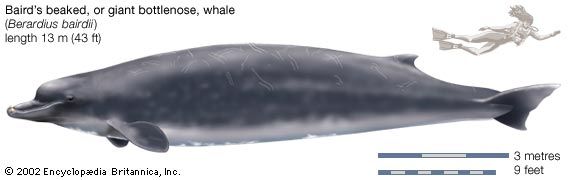
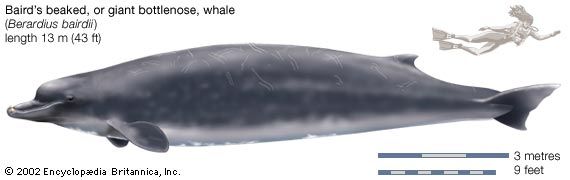
- Giant Bottlenose Whales: Arnoux’s beaked whale is found in the southern oceans from Argentina, the Falkland Islands, Australia, and New Zealand southward. Baird’s beaked whale inhabits the northern Pacific from Japan and the Baja peninsula northward into the Sea of Okhotsk and the Bering Sea.5
Bottlenose Dolphins
- Common Bottlenose Dolphin (T. truncatus): Widely distributed worldwide in warm and temperate seas.16
- Indian Ocean Bottlenose Dolphin (T. aduncus): Inhabits continental shelf areas of the Indian Ocean and waters fringing Southeast Asia, Indonesia, and Australia.1
- Southern Australian Bottlenose Dolphin (T. australis): Frequents the waters off Australia’s southern and southeastern shores.1
What role do bottlenose whales play in their marine ecosystem?
Bottlenose whales, which belong to the beaked whale family (Ziphiidae), play a significant role in their marine ecosystems primarily as specialized predators of the deep ocean.71
As toothed whales, they occupy a niche as active hunters that forage in deep offshore waters. Their diet consists primarily of squid, fish, and various bottom-dwelling invertebrates. By hunting at extreme depths—with some species capable of diving nearly 1,500 meters and remaining submerged for nearly two hours—they help regulate populations of deep-sea organisms that are otherwise inaccessible to many other marine predators.571
Beyond their role as predators, these whales are part of a complex food web where they may also serve as prey for larger marine animals, such as sharks, which are known to leave bite marks on their bodies. Their presence and activities, including their deep-diving behavior and social structures, contribute to the biological dynamics of the deep-sea environment.17
What unique adaptations do bottlenose whales have for deep-sea diving?
Bottlenose whales, like other deep-diving cetaceans, possess specialized physiological adaptations that allow them to remain submerged for nearly two hours and reach depths of approximately 1,500 meters.1011
These adaptations include:
- Myoglobin Concentration: Similar to other deep-diving mammals, bottlenose whales have high levels of myoglobin in their muscle tissue. This protein acts as an efficient oxygen-storage unit, providing a vital supply of oxygen to muscles during prolonged dives.12
- Thoracic Flexibility: To manage the intense hydrostatic pressure of the deep ocean, these whales have elastic chest cavities. This flexibility allows their lungs and thoracic cavity to compress safely as they descend, preventing the damage that would occur if the lungs were rigid.135
- Gas Management: As they dive, air is forced out of the gas-exchange regions of the lungs and into the trachea and bronchioles, where no gas uptake occurs. This prevents excessive nitrogen from entering the bloodstream, which protects the whales from decompression sickness (the “bends”) upon surfacing.5
- Efficient Metabolism: Their bodies are adapted to use gases in the bloodstream more conservatively, enabling them to sustain activity during long periods without access to surface air.13
Sources
- bottlenose dolphin — Encyclopædia Britannica
- cetacean - Social behaviour — Encyclopædia Britannica
- cetacean - Intelligence — Encyclopædia Britannica
- How intelligent are dolphins? — Encyclopædia Britannica
- bottlenose whale — Encyclopædia Britannica
- dolphin — Encyclopædia Britannica
- What do whales eat? — Encyclopædia Britannica
- cetacean - Aggression and defense — Encyclopædia Britannica
- beaked whale — Encyclopædia Britannica
- How long can whales hold their breath? — Encyclopædia Britannica
- thoracic squeeze — Encyclopædia Britannica
- cetacean - Breathing and diving — Encyclopædia Britannica
- Myoglobin — Encyclopædia Britannica
- Biosphere - Hydrostatic pressure — Encyclopædia Britannica
Published on · 4 min read