Bougainville Island
The Bougainville Civil War, which began in 1988, was a devastating conflict triggered by disputes over environmental damage, perceived racism, and the…
How did the Bougainville Civil War impact the island and its people?
The Bougainville Civil War, which began in 1988, was a devastating conflict triggered by disputes over environmental damage, perceived racism, and the inequitable distribution of revenues from the Panguna copper and gold mine.12
The impact on the island and its people was profound:
- Human Cost: The war lasted eight years, resulting in thousands of deaths—estimates range from 7,000 to 20,000—with the majority of fatalities caused by a lack of health care during the conflict.13
- Infrastructure and Economy: The conflict forced the closure of the Panguna mine in 1989, which had previously accounted for more than half of Papua New Guinea’s export earnings. The fighting caused widespread destruction across the region.132
- Social Disruption: The central government imposed a naval blockade and cut off services to the island, exacerbating the suffering of the local population.1
- Political Shift: Following a peace process, the island transitioned into an autonomous region in 2005, with a path established for a future referendum on independence.12
Where is Bougainville Island located, and what are its key geographical features?
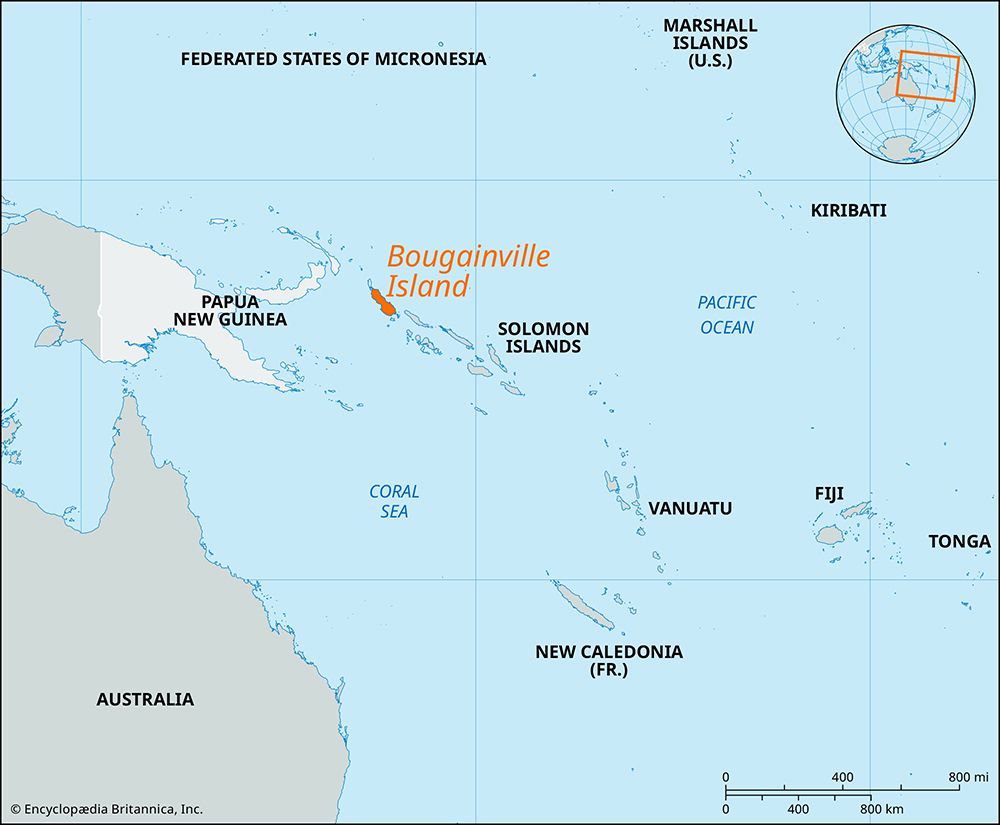
Bougainville Island is the easternmost island of Papua New Guinea, situated in the Solomon Sea within the southwestern Pacific. It is geographically the largest of the Solomon Islands and is located near the northern end of that chain.3
The island measures approximately 75 miles (120 km) in length and 40–60 miles (65–95 km) in width. Its topography is defined by two major mountain ranges: the Emperor Range, which occupies the northern half and features the active volcanoes Balbi (9,000 feet [2,743 meters]) and Bagana, and the Crown Prince Range, which occupies the southern half. The island’s coastline is fringed by coral reefs.3
Together with Buka Island and several other island groups, Bougainville forms an autonomous region of Papua New Guinea.34
What are the main economic activities and natural resources on Bougainville Island?
The economy of Bougainville Island has historically been defined by large-scale mineral extraction and agricultural exports.
Mineral Resources
The island is home to the Panguna mine, which was once one of the world’s largest open-pit copper mines. Beginning production in 1972, the mine also extracted gold and, by the early 1980s, accounted for more than half of Papua New Guinea’s total export earnings. The mine was forced to close in 1989 due to the civil war, though there have been ongoing discussions regarding its potential reopening to support the region’s economic recovery.523
Agriculture and Commerce
Beyond mining, the island supports various commercial and agricultural activities, primarily centered around the town of Kieta. Key agricultural exports include:
- Copra: A primary export commodity.3
- Cocoa: Produced for export.3
- Timber: Harvested and exported from the region.3
While the mining sector historically dominated the economy, these agricultural products remain significant to the local commercial landscape.3
What efforts have been made towards reconciliation and peace-building on Bougainville Island since the civil war?
Following the civil war on Bougainville, which resulted in thousands of deaths, a significant peace process was initiated to foster stability and reconciliation.
The peace process began after the 1997 election, facilitated by the government of New Zealand. A pivotal truce was signed in October 1997 at an army base in Burnham, New Zealand. Subsequently, the Australian government provided aid as a “peace dividend” and assumed a lead role in peacekeeping operations, supported by the United Nations and other regional partners.
Over the following decade, the region underwent extensive disarmament, reconciliation discussions, and formal peace ceremonies. These efforts culminated in a 2001 agreement between the leaders of Bougainville and Papua New Guinea, which established Bougainville as an autonomous region. This agreement also mandated a future referendum on independence and led to the approval of a constitution in 2004, followed by the election of a local parliament in 2005.
Sources
- Papua New Guinea - Attempts at secession — Encyclopædia Britannica
- Panguna — Encyclopædia Britannica
- Bougainville Island — Encyclopædia Britannica
- Buka Island — Encyclopædia Britannica
- Papua New Guinea - Resources and power — Encyclopædia Britannica
- Burkina Faso - Agriculture — Encyclopædia Britannica
Published on · 3 min read