Campbell Island
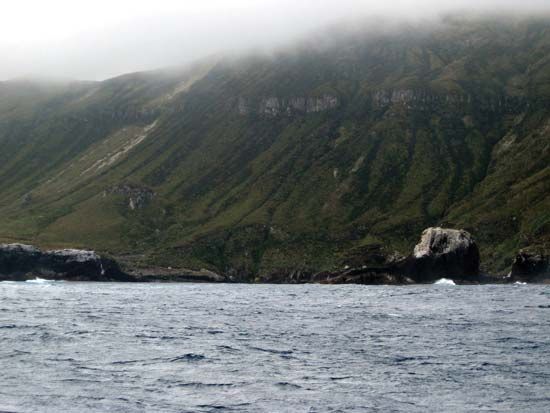
Campbell Island is an outlying volcanic island belonging to New Zealand, situated in the South Pacific Ocean approximately 400 miles (644 km) south of the…
Where is Campbell Island located and what are its geographical features?
Campbell Island is an outlying volcanic island belonging to New Zealand, situated in the South Pacific Ocean approximately 400 miles (644 km) south of the country’s South Island.1
The island covers an area of 41 square miles (106 square km) and is characterized by high, rugged terrain. Its highest point is Mount Honey, which reaches an elevation of 1,867 feet (569 m), before the landscape gradually levels off toward the north. The geography is further defined by cliffs along the southern and western coasts, while the eastern side features deep indentations known as Perseverance and North East harbours. The region experiences a cold, humid, and windy climate.1
What is the climate like on Campbell Island and how does it influence the island’s environment?
Campbell Island experiences a cold, humid, and windy climate. This harsh environment has played a significant role in the island’s ecological history.1
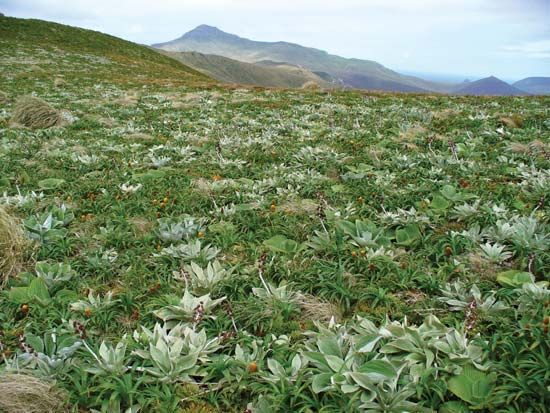
The climate is a defining feature of the subantarctic landscape, which historically supported natural vegetation before the introduction of non-native species. In 1896, sheep were introduced to the island; however, their presence proved detrimental, as they destroyed much of the island’s native plant life. Since the establishment of a meteorological station in 1941, the island has served as a site for monitoring these challenging weather conditions.1
What is the geological origin of Campbell Island?
Campbell Island is identified as an outlying volcanic island of New Zealand. While the provided search results confirm its volcanic nature, they do not offer specific details regarding the precise geological timeline or the tectonic processes responsible for its formation.1
New Zealand’s broader geological history is complex, involving continental drift, mountain-building episodes, and significant volcanism associated with its position on the Ring of Fire. However, the available information does not explicitly link the formation of Campbell Island to these specific regional events.2
How did Campbell Island get its name and when was it discovered?
Campbell Island was discovered in 1810 by the crew of the sealing ship Perseverance. While the provided records confirm the date of discovery, they do not explicitly state the origin of the name “Campbell Island.” It is worth noting that the island was named during an era when many subantarctic islands were being charted by sealing and whaling expeditions.1
Sources
- Campbell Island — Encyclopædia Britannica
- New Zealand - Relief of New Zealand — Encyclopædia Britannica
- Dominica - History — Encyclopædia Britannica
Published on · 2 min read