Braconid Wasp
Sorry, the Britannica knowledge base does not contain specific information regarding the sensory mechanisms or behavioral processes braconid wasps use to…
How do braconid wasps locate and select their host insects?
Sorry, the Britannica knowledge base does not contain specific information regarding the sensory mechanisms or behavioral processes braconid wasps use to locate and select their host insects.
The available information confirms that braconid wasps are parasitoids that typically target the eggs or larvae of other arthropods, such as moths, butterflies, and beetles. While some species are known to paralyze their hosts using an ovipositor before laying eggs, the specific cues or methods they use to identify these hosts are not detailed in the provided text.1
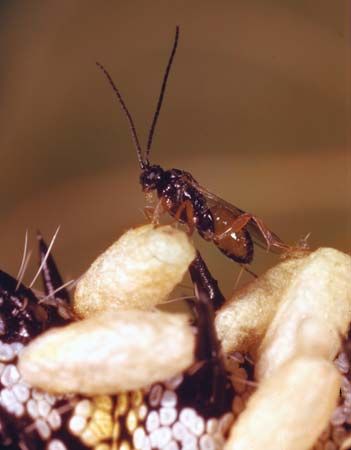
How do braconid wasps impact ecosystems and agricultural systems?
Braconid wasps play a significant role in both natural ecosystems and agricultural systems primarily as parasitoids. By developing on or within the bodies of other arthropods—including moths, butterflies, beetles, and flies—they act as natural regulators of insect populations.1
Impact on Agriculture
In agricultural settings, braconid wasps are highly valued for biological control. Because they target many destructive pests, they are often introduced and managed to protect crops:
- Crop Protection: Species such as Apanteles glomeratus help control the cabbage butterfly and cabbage looper, which are major pests for Brassica crops.1
- Pest Management: Other species target specific threats, such as the tobacco hornworm and tomato hornworm, or wood-boring beetles and grain weevils that damage stored goods.1
- Olive Cultivation: In the Mediterranean, Opius concolor is used to manage the olive fly, a pest that can devastate commercial olive production1.
Beyond their role as parasitoids, adult braconid wasps feed on nectar and pollen, serving as incidental pollinators within these environments.1
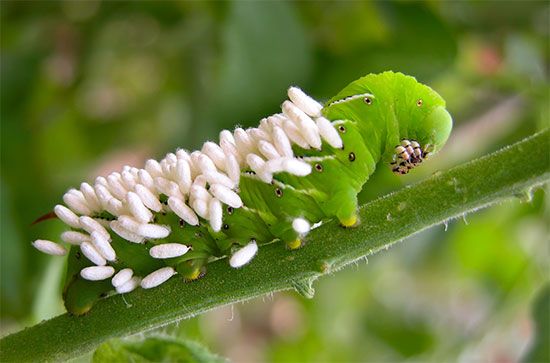
What is the life cycle of a typical braconid wasp?
The life cycle of a typical braconid wasp is defined by its role as a parasitoid, meaning it develops on or within the body of another arthropod host, such as a moth, butterfly, or beetle larva.1
Development Stages
- Oviposition: The adult female uses her ovipositor to deposit eggs into or onto the host. Some species are egg-larval parasitoids, laying eggs within host eggs that remain dormant until the host hatches.1
- Larval Stage: The larvae are either endoparasitic (living inside the host) or ectoparasitic (living on the host). They feed on the host’s tissues and fluids until they are fully grown. In some species, a single host may support up to 150 developing larvae.1
- Pupation: Once the host’s resources are exhausted, the larvae pupate. This may occur inside the host’s body, attached to the host, or away from the host within a cocoon on a leaf or stem.1
- Adulthood: After emerging, the adult wasps typically feed on nectar and pollen.1
Some ectoparasitic species are idiobionts, meaning they paralyze the host with their ovipositor before laying eggs to ensure the host remains available for the developing larvae.1
What are the defining characteristics of braconid wasps?
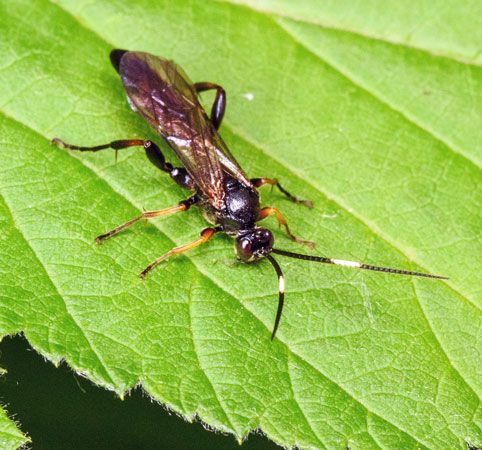
Braconid wasps, belonging to the family Braconidae, are a large and diverse group of parasitic wasps characterized by several distinct features:
- Physical Appearance: They are typically small, dark, or dull-colored insects, rarely exceeding 1.5 cm (0.6 inch) in length. Like other insects, they possess a head, thorax, abdomen, and six legs. They generally feature a slender, curved abdomen with a narrow waist, compound eyes, and three simple eyes (ocelli). Compared to social wasps, they usually have longer, multi-segmented antennae.1
- Ovipositor: Females possess a long, conspicuous ovipositor used for laying eggs. While this organ is essential for reproduction, only a few species utilize it as a stinger for defense.1
- Parasitoid Nature: Braconids are primarily parasitoids, meaning their larvae develop on or within other arthropods, such as moths, butterflies, beetles, and flies.1
- Diet: As adults, most species feed on nectar and pollen, often acting as incidental pollinators.1
Sources
- braconid wasp — Encyclopædia Britannica
- Hymenoptera - Solitary forms — Encyclopædia Britannica
- Braconidae — Merriam-Webster
Published on · 3 min read