Cabbage Looper
The cabbage looper (Trichoplusia ni) is a green, white-striped larva belonging to the owlet moth family, Noctuidae. It is widely recognized as an…
What is cabbage looper?
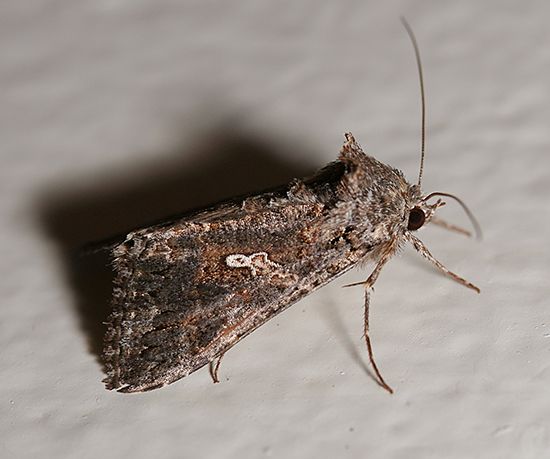
The cabbage looper (Trichoplusia ni) is a green, white-striped larva belonging to the owlet moth family, Noctuidae. It is widely recognized as an agricultural pest that feeds on cabbage and other cruciferous crops throughout Europe and the United States.12
The insect earns its name from its distinctive movement; because it possesses only three pairs of prolegs instead of the usual four, it crawls in a looping fashion similar to a measuring worm. The adult form, often called the Ni moth, is a mottled brown moth with a wingspan of approximately 25 mm (1 inch) and a characteristic pale, Y-shaped mark on each forewing. These moths are known for their ability to migrate over significant distances.1
Why do they move in a looping motion?
The cabbage looper moves in a characteristic looping motion because of its anatomy. While many caterpillars possess four pairs of prolegs on their mid-abdomen, the cabbage looper has only two or three pairs.1
Because they lack the full set of prolegs found in other species, they cannot move in a standard crawling fashion. Instead, they must draw their hind end up to meet their front end, creating a loop, before extending the front of their body forward again to continue moving. This unique gait is similar to that of measuring worms in the family Geometridae, which also exhibit this behavior due to a reduced number of prolegs.134
What are some natural ways to control garden pests?
Natural pest control relies on ecologically harmonious methods that minimize the need for synthetic chemicals. These strategies are often categorized into cultural, physical, and biological approaches.78
Cultural and Physical Methods
Cultural practices focus on creating an environment unfavorable to pests. Key techniques include:
- Crop Rotation: Alternating crops to disrupt the life cycles of pests that favor specific plants.89
- Sanitation: Removing plant debris and infected materials to eliminate habitats where pests harbor.8
- Physical Barriers: Using garden fences, protective bags for fruit, or sticky barriers to prevent pest access.810
- Soil Management: Adjusting soil acidity or using heat treatment in greenhouses to eliminate soil-borne pathogens and pests.8
Biological and Genetic Controls
Biological control utilizes the natural enemies of pests, such as predatory insects (e.g., ladybugs) or parasitoids like certain wasps. Other methods include:9
- Microbial Agents: Using naturally occurring pathogens like the bacteria Bacillus thuringiensis to target specific pests.119
- Pheromone Traps: Using sex attractants to lure and monitor or trap pests.711
- Resistant Varieties: Breeding crops that are naturally resistant to attack, which serves as an ideal long-term solution.119
How do caterpillars transform into moths?
Caterpillars transform into moths through a process called complete metamorphosis, which consists of four distinct stages: egg, larva, pupa, and adult.12
The transformation occurs during the pupal stage. Before this stage begins, the caterpillar—which has spent its life feeding and growing—stops eating and often seeks a protected location. Many moth species construct a cocoon made of silk, sometimes incorporating materials like leaves or wood pulp, to shield themselves during this transition.131415
Inside this protective covering, the caterpillar undergoes a dramatic biological reorganization. Larval tissues and organs are broken down, and adult structures, such as wings, are developed. This process is regulated by hormones. This process is regulated by hormones. Once the transformation is complete, the adult moth emerges by splitting the pupal skin, chewing through the cocoon, or using fluids to soften it. The duration of this stage varies significantly, ranging from a week to several months depending on the species and environmental conditions.151214
Sources
- cabbage looper — Encyclopædia Britannica
- cabbage looper — Merriam-Webster
- Lepidoptera - The larva, or caterpillar — Encyclopædia Britannica
- How Many Legs Does a Caterpillar Have? — Encyclopædia Britannica
- Did you know? — Merriam-Webster
- annelid - Locomotion — Encyclopædia Britannica
- Integrated pest management — Encyclopædia Britannica
- horticulture - Pest control — Encyclopædia Britannica
- Agricultural technology - Biological controls — Encyclopædia Britannica
- Pest — Encyclopædia Britannica
- Organic farming — Encyclopædia Britannica
- pupa — Encyclopædia Britannica
- Metamorphosis — Encyclopædia Britannica
- Lepidoptera - Larva, or caterpillar — Encyclopædia Britannica
- Lepidoptera - Pupa , or chrysalis — Encyclopædia Britannica
Published on · 3 min read