Brahmaputra River
The Brahmaputra River is fed by numerous tributaries throughout its long course across Tibet, India, and Bangladesh. These tributaries vary significantly…
What are some of the major tributaries of the Brahmaputra River?
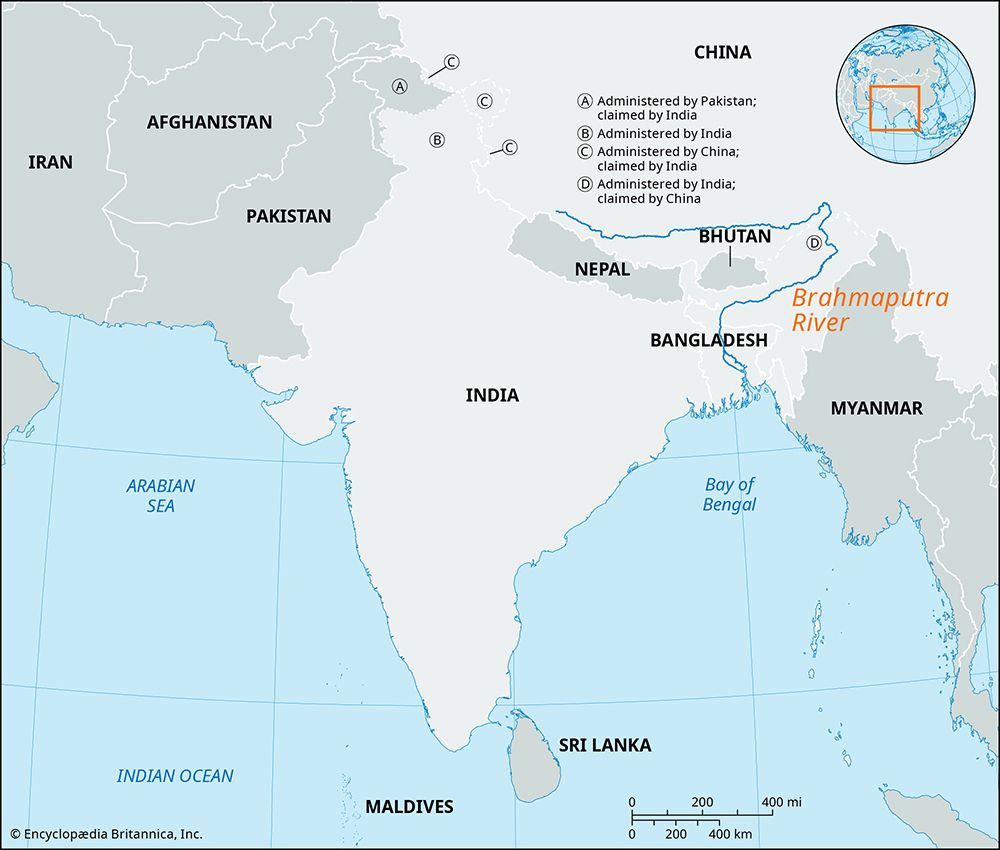
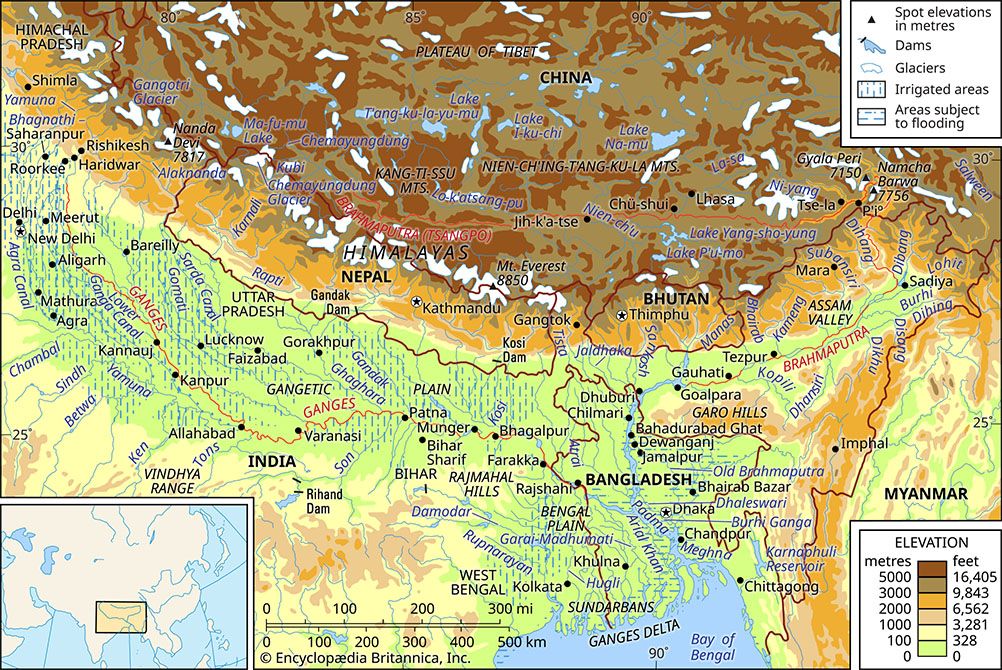
The Brahmaputra River is fed by numerous tributaries throughout its long course across Tibet, India, and Bangladesh. These tributaries vary significantly depending on the region:
- In Tibet: As the Tsangpo, the river receives important left-bank tributaries such as the Raka Zangbo and the Lhasa (Kyi) River. The Nyang Qu (Gyamda) joins from the north, while another river also named the Nyang Qu (Nyang Chu) joins on the right bank.1
- In Assam, India: The river is joined by the Lohit and Dibang rivers near Sadiya. As it flows through the valley, it receives several Himalayan streams, including the Subansiri, Kameng, Bhareli, Dhansiri, Manas, Champamati, Saralbhanga, and Sankosh. Tributaries from the southern plateau include the Burhi Dihing, Disang, Dikhu, and Kopili.1
- In Bangladesh: The river (known as the Jamuna) is joined by the Tista River on its right bank. It also receives the waters of the Baral, Atrai, and Hurasagar rivers, and gives rise to the Dhaleswari River.12
What role does the Brahmaputra River play in international relations between countries in the region?
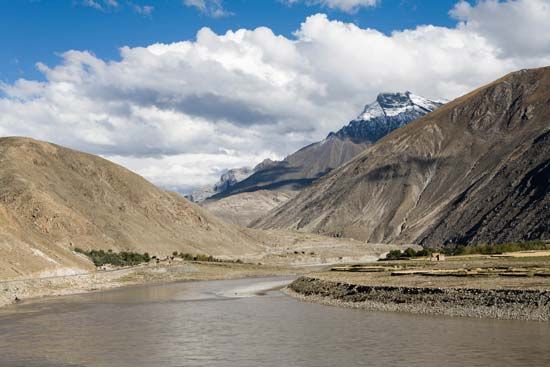
The Brahmaputra River is a critical transboundary resource that significantly influences international relations in South Asia. Because the river flows through China, India, and Bangladesh, its management is central to regional food security, irrigation, flood control, and hydroelectric power generation.45
Key aspects of these international relations include:
- Water-Sharing Disputes: The equitable distribution of water is a persistent source of friction. Tensions exist between India and Bangladesh regarding the Teesta River, a major tributary of the Brahmaputra. While a treaty has been proposed to manage water allocation for irrigation and agriculture, it remains unresolved.46
- Infrastructure and Upstream Control: Because the headwaters of the river’s major systems originate outside of Bangladesh, that nation lacks full control over the water flow that sustains its landscape. Upstream infrastructure projects, such as dams and barrages, often raise concerns among downstream neighbors regarding water availability during the dry season.46
- Navigation and Connectivity: The river serves as an important inland waterway between Indian states. However, political conflicts have occasionally disrupted the movement of traffic through Bangladesh, highlighting the river’s role in regional logistics and geopolitical stability.7
What is the significance of the Brahmaputra River for the regions it passes through?
The Brahmaputra River is a vital, dual-natured force for the regions it traverses, acting as both a creator and a destroyer. Its significance is defined by its role in the economy, agriculture, and physical geography of Tibet, India, and Bangladesh.4
Economic and Agricultural Importance
The river is a crucial inland waterway, facilitating the transport of raw materials, timber, and crude oil across the Bengal Plain and Assam valley. Its waters are increasingly harnessed for hydroelectric power, with major installations like the Kopili Hydel Project and the Ranganadi plant in India, and large-scale projects in Tibet. Additionally, the river deposits vast quantities of fertile alluvial soil, which supports agriculture; in Bangladesh, the seasonal emergence of *char*s (newly deposited lands) provides essential cultivable areas.3476
Environmental Challenges
The river’s immense discharge and heavy sediment load make it a frequent source of disastrous flooding during the summer monsoon. While flood-control schemes and embankments, such as the Tista Barrage Project, have been implemented to mitigate damage, the river remains highly dynamic, constantly shifting its course and eroding land.647
How does the Brahmaputra River change its course during different seasons?
The Brahmaputra River does not follow a fixed path; rather, it is a highly dynamic system that undergoes constant erosion and deposition of silt. While the river’s main channel shifts over long periods—such as the major diversion of the Tista River in 1787 that established the modern Jamuna channel—it also experiences significant seasonal changes.3
During the wet monsoon months, the river experiences massive increases in water volume and discharge, leading to extensive flooding. This high-energy environment causes the river to be in a state of constant flux, meaning it is never in exactly the same place for two successive years. A key feature of this seasonal activity is the appearance and disappearance of *char*s, which are islands or newly deposited lands formed by shifting silt. These chars are highly valuable to the local economy as they provide additional cultivable areas, though they are subject to the river’s ongoing erosion and movement.3
Sources
- Brahmaputra River - Physiography — Encyclopædia Britannica
- Teesta River — Encyclopædia Britannica
- Brahmaputra River - Hydrology — Encyclopædia Britannica
- Brahmaputra River - Irrigation and flood control — Encyclopædia Britannica
- South Asia - Water sharing — Encyclopædia Britannica
- Brahmaputra River — Encyclopædia Britannica
- Brahmaputra River - Navigation and transport — Encyclopædia Britannica
- Bangladesh - Rivers of Bangladesh — Encyclopædia Britannica
Published on · 3 min read