Gomati River
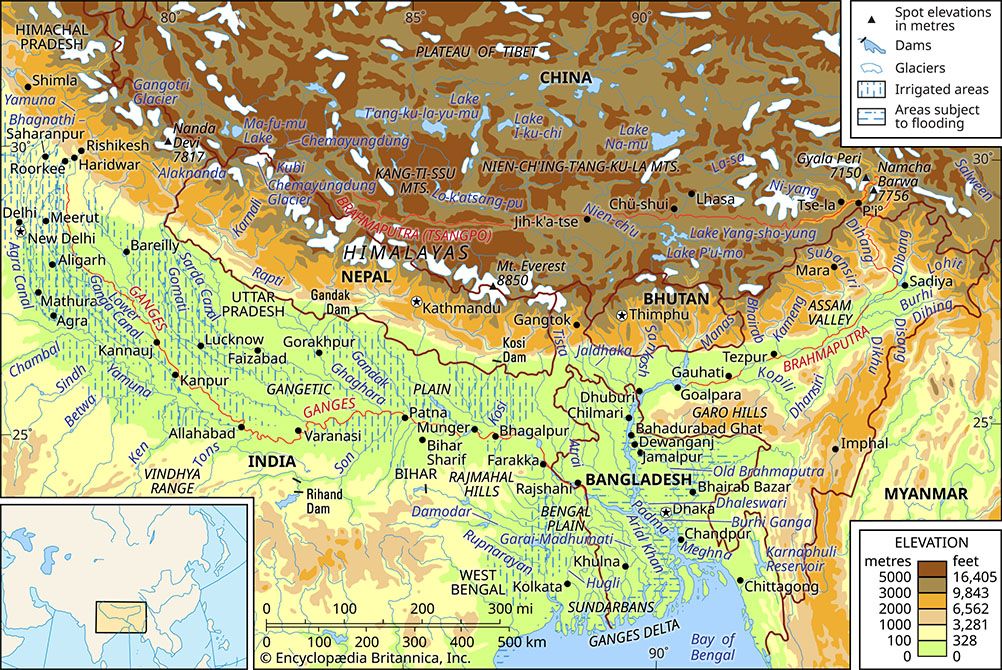
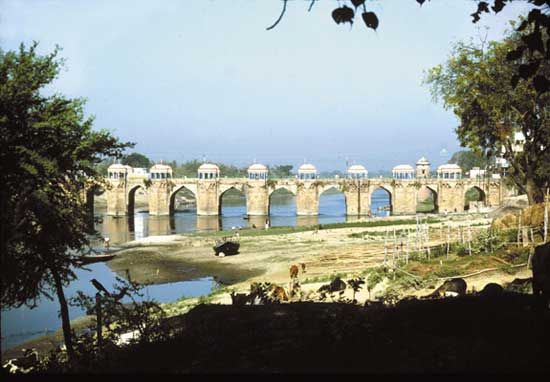
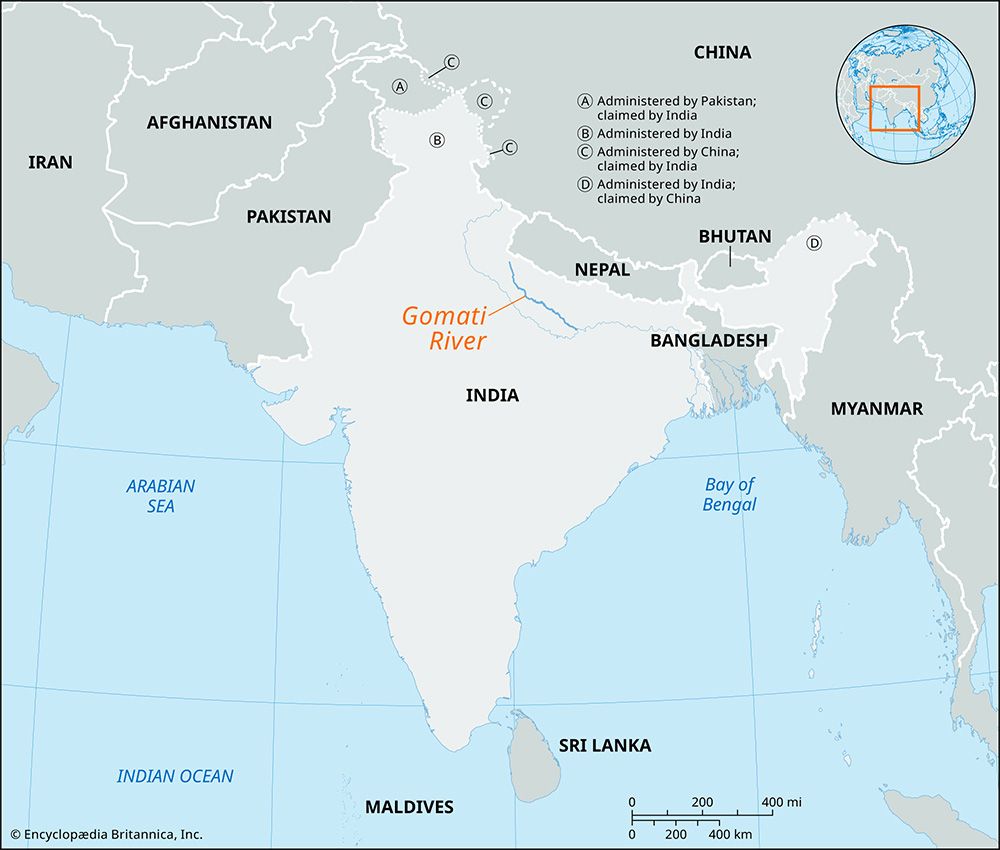
The Gomati River is a tributary of the Ganges (Ganga) River located in the northern Indian state of Uttar Pradesh.
What is Gomati River?
The Gomati River is a tributary of the Ganges (Ganga) River located in the northern Indian state of Uttar Pradesh.12
The river originates in northern Uttar Pradesh, approximately 32 miles (51 km) east of Pilibhit. Its course is intermittent for the first 35 miles (56 km) until it joins the Joknai, after which it becomes a perennial stream. From that point, the Gomati flows southeastward for about 500 miles (800 km), draining a basin of roughly 7,240 square miles (18,750 square km). Along its path, it receives its only major tributary, the Sai River, near Jaunpur, before eventually emptying into the Ganges near Saidpur.1
How do seasonal monsoons affect the water levels of the Ganges and its tributaries?
The water levels of the Ganges River and its tributaries are significantly influenced by seasonal climate patterns, characterized by marked variations throughout the year.32
- Monsoon Season (July to October): The southwesterly monsoon winds bring heavy rainfall to the basin, which is the primary driver of increased water levels and seasonal flooding. During this period, the volume of the Ganges increases markedly as it receives water from its numerous tributaries. In the delta region, these rains often cause extensive flooding, frequently submerging large areas to depths of three feet or more.32
- Hot Season (April to June): Before the onset of the monsoon, the river is fed by the melting of Himalayan snows. This glacial melt provides a critical water supply during the hot, dry months.32
- Winter (December and January): The river’s flow typically declines during the winter months, as there is very little rainfall during this time.32
Additionally, the delta region is susceptible to tropical cyclones originating in the Bay of Bengal, which can occur before the monsoon (March to May) or at its conclusion (September to October), further impacting water levels and causing severe flooding events.3
What are the primary differences between a river’s tributary and its distributary?
The primary difference between a tributary and a distributary lies in the direction of their flow relative to a main river channel.
- Tributary: A tributary is a stream or river that flows into a larger body of water, such as a main river or lake. By contributing its water to the larger system, it acts as a “feeder” that increases the volume of the main stream.562
- Distributary: A distributary is a river branch that flows away from the main stream. These channels typically occur in a river’s delta region, where the main river splits into multiple smaller channels as it approaches the sea, effectively distributing its water and sediment across a wider area.78
In essence, while a tributary adds water to a main river, a distributary carries water away from it.57
Why are the Sundarbans considered an important ecological region?
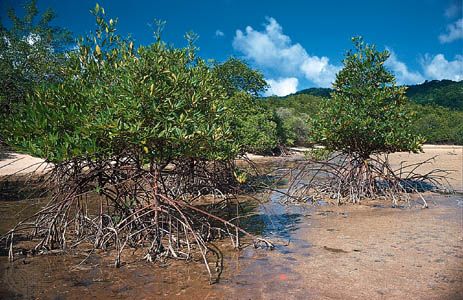
The Sundarbans is a vital ecological region primarily because it contains the largest mangrove forest in the world, serving as a critical buffer against tropical cyclones and coastal erosion. Spanning the Ganges-Brahmaputra delta in India and Bangladesh, this UNESCO World Heritage site is a hub of biodiversity.91011
Key reasons for its ecological importance include:
- Endangered Species Habitat: It is a primary refuge for the Bengal tiger, which has uniquely adapted to a semiaquatic life in the region. It also supports diverse fauna, including Ganges river dolphins, estuarine crocodiles, and numerous migratory bird species.910
- Unique Flora: The region is named after the sundari tree (Heritiera fomes), a dominant mangrove species that thrives in the saline, tidal environment.910
- Biosphere Protection: Designated as a biosphere reserve, the area protects a complex network of tidal creeks, estuaries, and mudflats essential for maintaining regional ecological balance.910
The region faces significant threats from climate change, rising sea levels, and human activities like saltwater intrusion, which endanger its delicate balance.910
Sources
- Gomati River — Encyclopædia Britannica
- Ganges River - Physiography — Encyclopædia Britannica
- Ganges River - Climate and hydrology — Encyclopædia Britannica
- Ganges River - Navigation — Encyclopædia Britannica
- tributary — Merriam-Webster
- Did you know? — Merriam-Webster
- distributary — Merriam-Webster
- tributaries — Merriam-Webster
- West Bengal: Top Questions — Encyclopædia Britannica
- Sundarbans National Park — Encyclopædia Britannica
- Sundarbans — Encyclopædia Britannica
Published on · 3 min read