Ganges River
The Ganges River is fed by numerous tributaries that join its main course as it flows across the Indo-Gangetic Plain. These are generally categorized by the…
What are the major tributaries of the Ganges River?
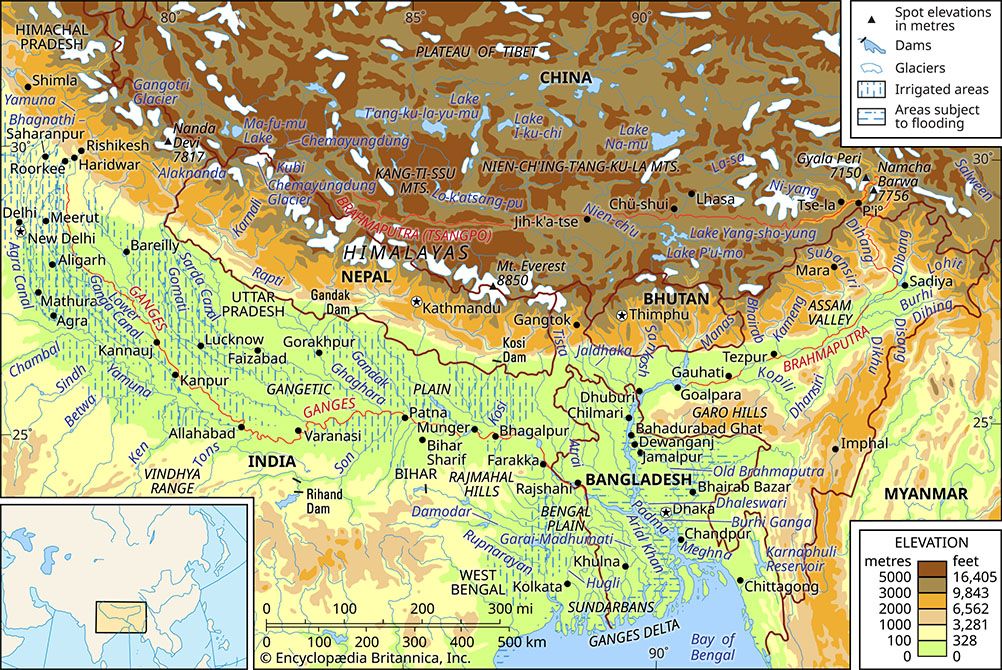
The Ganges River is fed by numerous tributaries that join its main course as it flows across the Indo-Gangetic Plain. These are generally categorized by the bank from which they enter the river:
Northern (Left-Bank) Tributaries
These rivers primarily originate in the Himalayas:
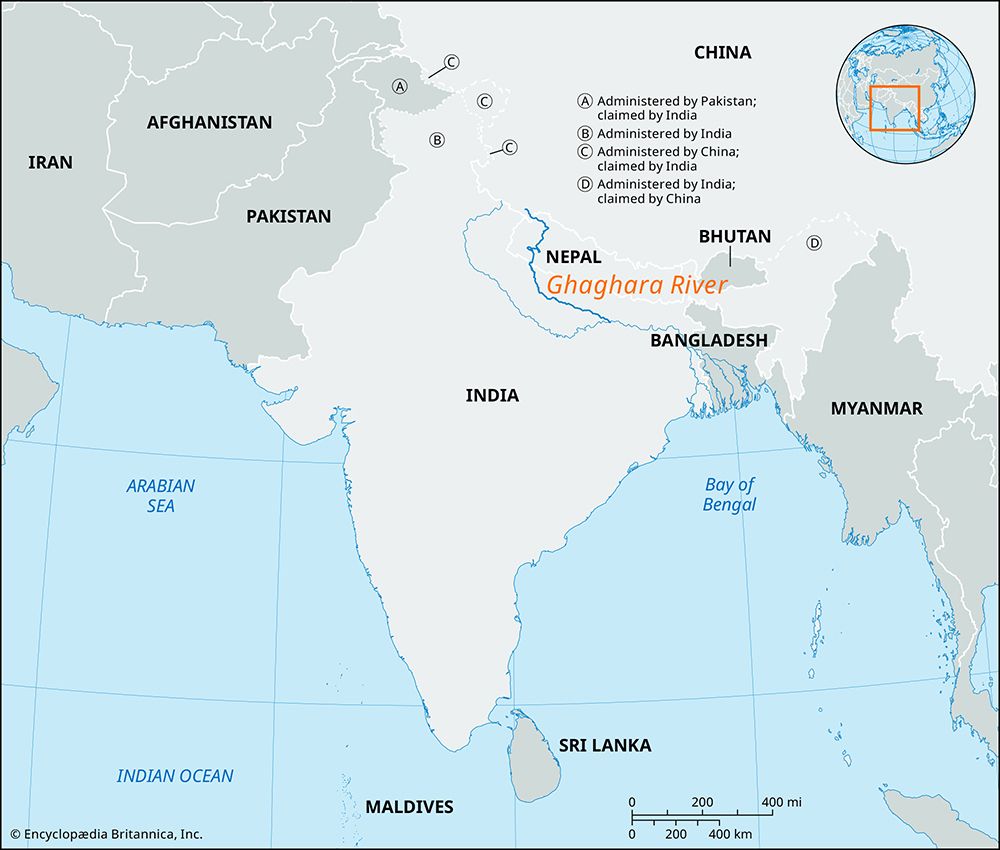
- Ramganga, Gomati, and Ghaghara join the main stream in Uttar Pradesh.1
- Gandak, Burhi Gandak, Ghugri, and Kosi are major tributaries that join in Bihar.12
- Mahananda joins the river after it enters West Bengal.1
Southern (Right-Bank) Tributaries
These rivers originate largely from the peninsular region:
- Yamuna River: The most significant right-bank tributary, which flows parallel to the Ganges before joining it near Prayagraj. It is further fed by rivers such as the Chambal, Betwa, and Ken.12
- Tons: Joins the Ganges just below Prayagraj.1
- Son River: A major southern tributary that joins the Ganges in Bihar.12
- Damodar and Rupnarayan: These flow into the Hugli, a distributary of the Ganges.1
How has the Ganges River Basin changed over time due to human activities?
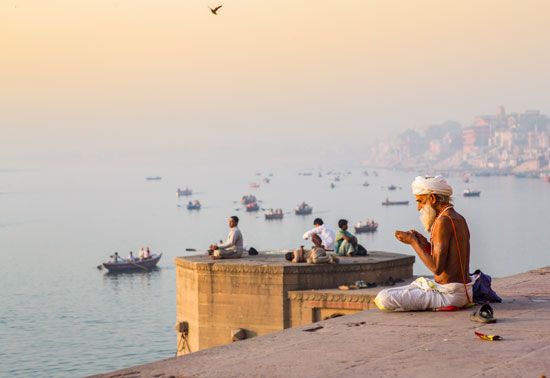
Human activities have profoundly transformed the Ganges River Basin over centuries, shifting its role from a primary transportation artery to a heavily utilized and stressed resource.
Infrastructure and Water Management
Historically, the Ganges and its tributaries were vital for inland navigation. However, the mid-19th-century construction of railways and the increasing diversion of water for irrigation significantly reduced large-scale river transport. Extensive canal systems, such as the Upper and Lower Ganga canals, have been developed since ancient times to support agriculture, though these diversions often leave rivers with insufficient flow to assimilate waste. Furthermore, large-scale projects like the Farakka Barrage have altered hydrology, leading to geopolitical disputes over water sharing and environmental concerns regarding siltation and salinity.678
Environmental Degradation
The basin is one of the world’s most densely populated regions, placing immense pressure on the river. Key human-driven impacts include:
- Pollution: Untreated sewage from cities, industrial waste, agricultural runoff, and remnants from funeral rites have introduced high levels of bacteria and toxic substances like arsenic and chromium into the water.910
- Hydroelectric Development: The construction of dams has caused habitat destruction, the displacement of local populations, and the disruption of natural water supplies.9
Restoration Efforts
In response to severe degradation, various government initiatives have been launched. While early efforts like the Ganga Action Plan were largely considered inadequate, the Namami Gange program, initiated in 2014, has made measurable progress in sewage treatment, ecological renewal, and improving water quality.9
What is the geographical origin and course of the Ganges River?
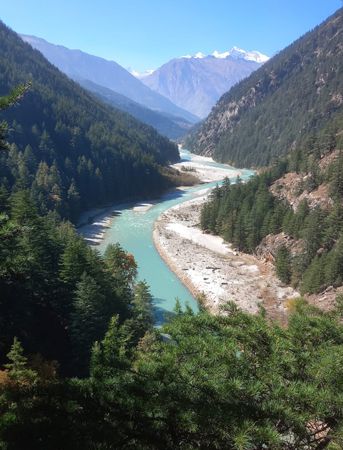
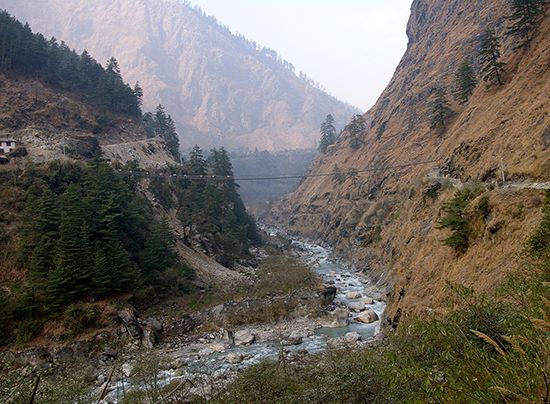
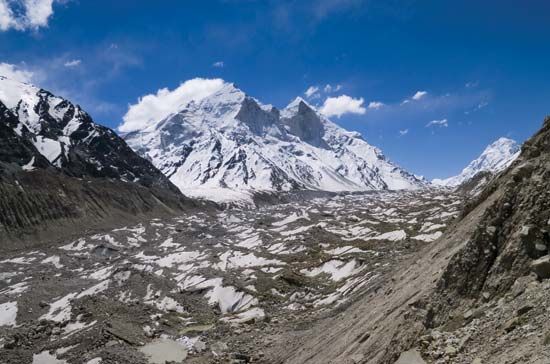
The Ganges River originates in the southern Great Himalayas within the Indian state of Uttarakhand. Its primary headstreams are the Alaknanda and the Bhagirathi, the latter of which rises at the foot of the Gangotri Glacier. These two streams unite at Devaprayag to form the main river, which then emerges from the mountains onto the Indo-Gangetic Plain at Haridwar.215
The river flows generally from northwest to southeast across northern India, passing through the states of Uttar Pradesh, Bihar, and West Bengal. Along its course, it receives numerous tributaries, including the Yamuna and Son from the south, and the Ghaghara, Gandak, and Kosi from the north.21115
Upon reaching central West Bengal, the river begins to form its vast delta. It eventually enters Bangladesh, where it is known as the Padma. There, it merges with the Brahmaputra (called the Jamuna in Bangladesh) and the Meghna River before emptying into the Bay of Bengal through a complex network of channels.2114
How does the Ganges River support agriculture and the economy in India?
The Ganges River has been a cornerstone of India’s economy and agricultural productivity for millennia. Its role is primarily defined by its extensive irrigation systems and historical importance as a transportation artery.
Agricultural Support
The Ganges valley is a highly productive agricultural region, supported by a sophisticated network of irrigation infrastructure. Since ancient times, gravity canals have diverted river water to sustain crops. Today, major projects like the Upper and Lower Ganga canals and the Sarda Canal facilitate the production of cash crops, including sugarcane, cotton, and various oilseeds. In areas where canal irrigation is not feasible, such as the northern edges of the plain, farmers rely on groundwater pumped from wells to maintain their fields.7
Economic Navigation
While the rise of railways in the 19th century diminished the river’s role in large-scale transport, it remains vital for regional commerce. The Inland Waterways Authority of India maintains a system of national waterways, particularly between Prayagraj and Haldia, to support cargo transport.6
Sources
- Ganges River — Encyclopædia Britannica
- Ganges River - Physiography — Encyclopædia Britannica
- Uttarakhand - Drainage — Encyclopædia Britannica
- India - The Ganges-Brahmaputra river system — Encyclopædia Britannica
- Bhagirathi River — Encyclopædia Britannica
- Ganges River - Navigation — Encyclopædia Britannica
- Ganges River - Irrigation — Encyclopædia Britannica
- Ganges River - Environmental issues — Encyclopædia Britannica
- Ganges River: Top Questions — Encyclopædia Britannica
- pollution in India - Pollutant buildup in rivers — Encyclopædia Britannica
- Ganges delta — Encyclopædia Britannica
Published on · 4 min read