Brazilian Highlands
The Brazilian Highlands are an expansive, eroded plateau region covering more than half of Brazil’s total landmass. Located primarily across the states of…
What is Brazilian Highlands?
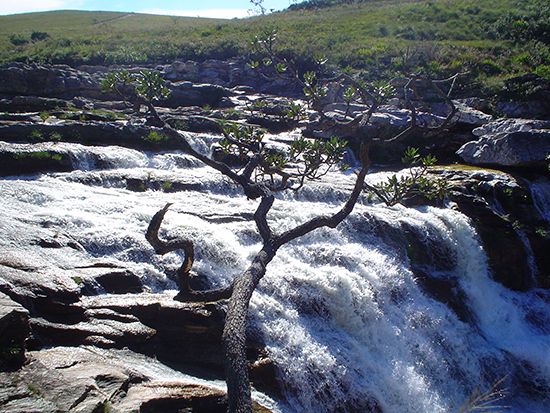
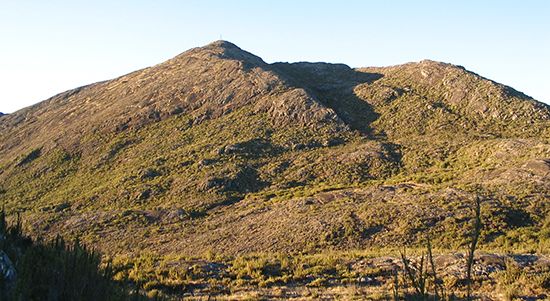
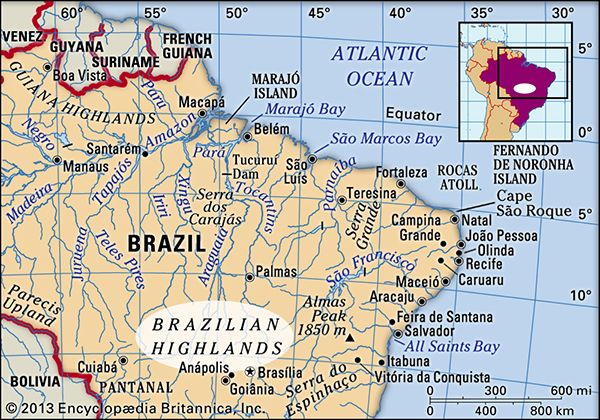
The Brazilian Highlands are an expansive, eroded plateau region covering more than half of Brazil’s total landmass. Located primarily across the states of Minas Gerais, São Paulo, Goiás, and Mato Grosso, the region is characterized by hilly uplands, low mountains, and tabular plateaus, with an average elevation of about 3,300 feet (1,000 meters).12
Geologically, the highlands are the primary source of Brazil’s mineral wealth. The landscape is defined by a massive eastern escarpment, including the Serra do Mar, which runs along the Atlantic coast. While the central region—often called the Planalto Central—is generally dry during the winter months, it experiences significant precipitation during the summer. The area faces ongoing environmental challenges, as large sections of forest are cleared for agriculture and pasture.234
How do the Brazilian Highlands compare to the Guiana Highlands?
The Brazilian Highlands and Guiana Highlands are geologically similar regions composed of ancient crystalline rocks that have been significantly shaped by prolonged erosion. Despite this shared foundation, they differ in geography and climate:561
- Location and Extent: The Guiana Highlands are situated north of the Amazon River and south of the Orinoco River, spanning parts of Venezuela, the Guianas, northern Brazil, and Colombia. The Brazilian Highlands cover more than half of Brazil’s landmass, primarily in the central and southeastern states.51
- Elevation and Terrain: The Brazilian Highlands have a higher average elevation of approximately 3,000 to 3,300 feet (900–1,000 meters) and are defined by numerous sierras and deep river basins. The Guiana Highlands are generally lower, with much of the region below 1,000 feet (300 meters), though they feature dramatic, high-altitude tabular plateaus known as tepuis.615
- Climate and Vegetation: The Guiana Highlands receive abundant rainfall year-round, supporting dense tropical rainforests, whereas the Brazilian Highlands experience more distinct seasonal variations, including drier periods in the central Planalto Central.56
What is the sertão and why is it significant to the region?
The sertão (Portuguese for “backwoods” or “bush”) is a semiarid, interior region of northeastern Brazil characterized by caatingas—scrubby, upland forests that lose their leaves during the dry season. It is often associated with the “drought quadrilateral,” a zone where low and unpredictable rainfall frequently leads to severe droughts, famine, and economic hardship.8910
The significance of the sertão is multifaceted:
- Social and Economic Impact: The region’s harsh climate has historically driven significant domestic migration, as rural families—known as sertanejos—flee to cities or frontier areas in search of stability. Despite these challenges, the area supports cattle ranching and the cultivation of crops like cotton.11109
- Cultural Identity: The sertão represents an “other” Brazil, distinct from the coastal centers of power. It has become a central theme in Brazilian literature, serving as a symbol of national struggle and resilience. Notable works, such as Euclides da Cunha’s Rebellion in the Backlands and Graciliano Ramos’s Barren Lives, have brought national attention to the region’s social tragedies and the plight of its neglected populations.2
How does the climate of the highlands affect agriculture in Brazil?
The climate of the Brazilian Highlands significantly dictates agricultural patterns through its distinct seasonal variations and elevation-based temperature differences.
Seasonal Precipitation and Agriculture
The central highlands experience a tropical wet-dry climate, characterized by a concentrated rainy season from November to April and a generally dry winter. This cycle necessitates careful water management, as the region’s agriculture must adapt to both torrential summer downpours and prolonged dry periods. In the northeastern backlands, or sertão, these shifting conditions are particularly severe; unpredictable rainfall can lead to total crop failure, famine, and economic disruption, forcing many to rely on subsistence farming or migrate.294
Temperature and Crop Diversity
While the tropics generally present challenges for agriculture—such as rapid soil nutrient leaching and high pest activity—the elevation of the Brazilian Highlands provides a critical advantage. The highlands are cooler than the lowlands, allowing for the cultivation of a wider variety of crops, including those typically associated with temperate climates.122
Land Use and Forestry
The climate also influences land-clearing practices. Vast tracts of wooded highland areas are frequently cleared to create pastures and make room for crops. Additionally, the region’s forests are vital for the production of charcoal, particularly in states like Minas Gerais, while the cooler, higher-altitude areas support diverse agricultural outputs that differ from the strictly tropical crops found in the Amazon basin.3212
Sources
- Brazilian Highlands — Encyclopædia Britannica
- Brazil - Climate of Brazil — Encyclopædia Britannica
- Brazil - Forestry of Brazil — Encyclopædia Britannica
- Brazil - Brazilian Highlands — Encyclopædia Britannica
- Guiana Highlands — Encyclopædia Britannica
- South America - The plateaus — Encyclopædia Britannica
- Brazil - Guiana Highlands — Encyclopædia Britannica
- sertão — Encyclopædia Britannica
- Ceará — Encyclopædia Britannica
- Brazilian literature - Modernismo and regionalism — Encyclopædia Britannica
- Brazil - Ongoing domestic migration — Encyclopædia Britannica
- South America - Tropical climates — Encyclopædia Britannica
- Agricultural technology - Tropical farming — Encyclopædia Britannica
Published on · 3 min read