Cryptoblastus
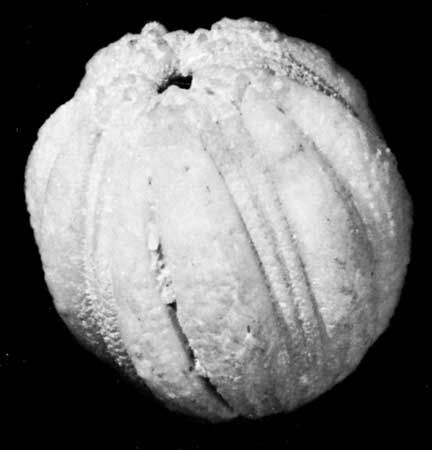
Cryptoblastus is an extinct genus of blastoids, which are a primitive group of echinoderms related to modern sea lilies and starfish.
What is Cryptoblastus?
Cryptoblastus is an extinct genus of blastoids, which are a primitive group of echinoderms related to modern sea lilies and starfish.12
These organisms existed during the Carboniferous Period, specifically appearing in marine rock formations dating from 360 to 320 million years ago. As members of the class Blastoidea, they were sedentary animals that anchored themselves to the seafloor using a stemlike column composed of circular plates. They were characterized by a highly regular body structure, featuring an external skeleton made of calcium carbonate arranged in three distinct circles.12
It is important to note that Cryptoblastus is distinct from the family Cryptocercidae, which refers to a group of wingless insects within the order Blattodea (cockroaches).3
What are echinoderms and how are they classified?
Echinoderms are a diverse phylum of invertebrate marine animals characterized by a hard, spiny skin—a feature from which their name is derived (from the Greek echinos, meaning “spiny,” and derma, meaning “skin”). While they exhibit a wide range of body forms, living species are defined by pentamerous (five-part) radial symmetry, an internal skeleton, and a unique water-vascular system used for locomotion and respiration.45
Echinoderms are classified into 21 classes based primarily on their skeletal structures, with over 6,500 extant species and approximately 13,000 described fossil species. Living representatives are grouped into several subphyla:4
- Asterozoa: Includes sea stars (class Asteroidea) and brittle stars (class Ophiuroidea).6
- Crinozoa: Includes crinoids, such as sea lilies and feather stars.6
- Echinozoa: Includes sea urchins (class Echinoidea) and sea cucumbers (class Holothuroidea).6
Additionally, the phylum has a rich fossil history that includes extinct groups such as blastoids, carpoids, and cystoids.46
How do scientists use index fossils to date rock layers?
Scientists use index fossils to date and correlate rock layers by applying the principle of faunal succession, which observes that life-forms have followed a specific, predictable order throughout Earth’s history.8
To be effective, an index fossil must meet several criteria:
- Short temporal range: The species existed for a relatively brief period, allowing geologists to pinpoint a specific interval of geologic time.98
- Wide distribution: The organism was cosmopolitan, meaning it was found across large geographic areas and diverse environments.98
- Abundance and distinctiveness: The fossils are easily recognizable and common enough to be reliably discovered in the field.98
By identifying these fossils in separated rock outcrops, geologists can establish that the strata were formed contemporaneously. This biochronology serves as a primary tool for defining boundaries in the geologic time scale. While physical correlation and radiometric dating are also used, fossil-based correlation remains a cornerstone of stratigraphy.8910
What are some other examples of extinct marine life from the Carboniferous Period?
The Carboniferous Period (358.9 to 298.9 million years ago) hosted a diverse array of marine life, many of which are now extinct. While some groups like crinoids persist today, others defined the era’s unique ecosystems.
Notable examples of extinct marine life from this period include:
- Blastoids: A class of stalked echinoderms that were significant components of Carboniferous marine ecosystems. They were sedentary, anchored to the seafloor, and are often used as index fossils, such as the genus Pentremites.11212
- Ammonoids: Extinct cephalopods that exhibited rapid evolutionary development during the Carboniferous. Along with fusulinids—a group of single-celled, shell-bearing protozoans that dominated assemblages until the Permian—they are vital for biostratigraphic dating.12
- Graptolites: These small, colonial planktonic animals were present during the early Carboniferous but went extinct during the Mississippian subperiod.12
- Arthrodires: These armored, jawed fish, which were prominent in the Devonian, became extinct almost immediately at the start of the Mississippian.13
Sources
- Cryptoblastus — Encyclopædia Britannica
- blastoid — Encyclopædia Britannica
- cockroach - Annotated classification — Encyclopædia Britannica
- echinoderm — Encyclopædia Britannica
- Circulatory system - Echinodermata — Encyclopædia Britannica
- echinoderm - Size range and diversity of structure — Encyclopædia Britannica
- List of echinoderms — Encyclopædia Britannica
- index fossil — Encyclopædia Britannica
- dating - Principles and techniques — Encyclopædia Britannica
- Triassic Period - Correlation of Triassic strata — Encyclopædia Britannica
- A Journey Through Time Since the Precambrian - Carboniferous Period: 358.9 million to about 298.9 million years ago — Encyclopædia Britannica
- Carboniferous Period - Fishes — Encyclopædia Britannica
- Carboniferous Period - Invertebrates — Encyclopædia Britannica
Published on · 3 min read