Brocken
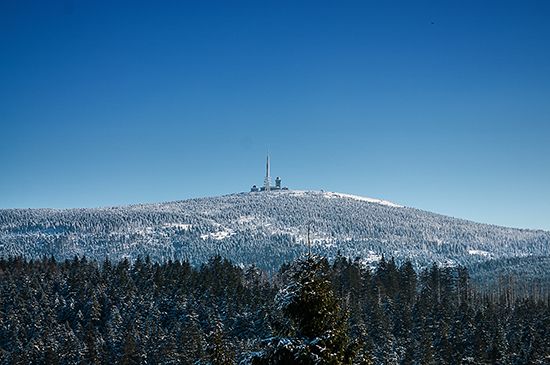
The Brocken is the highest peak of the Harz Mountains in Germany, reaching an elevation of 3,747 feet (1,142 meters). Located within the Harz National Park…
What is Brocken?
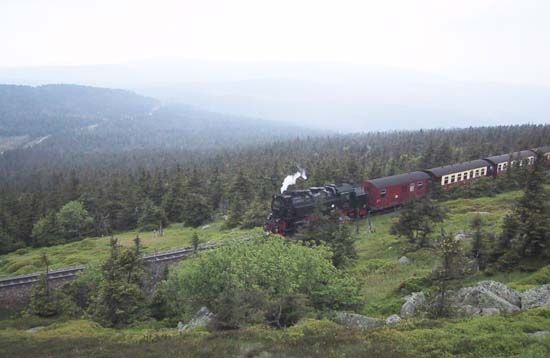
The Brocken is the highest peak of the Harz Mountains in Germany, reaching an elevation of 3,747 feet (1,142 meters). Located within the Harz National Park, this granite-strewn dome is a popular destination accessible by a mountain railway.1
The peak is famous for the Brocken spectre, an optical phenomenon where an observer’s shadow is cast onto low-lying clouds or fog and appears greatly magnified, sometimes surrounded by rainbow-colored rings. This effect has contributed to the mountain’s rich folklore, including its association with Walpurgis Night, a traditional Witches’ Sabbath held annually on April 30. The Brocken is also famously featured in J.W. von Goethe’s drama Faust.12
How does the Brocken spectre optical illusion work?
The Brocken spectre is an optical illusion that occurs when an observer stands on a mountain peak with the Sun positioned low behind them. The observer casts a shadow onto the upper surfaces of clouds located below the mountain level.3
The perceived magnification of the shadow is a psychological effect: because the shadow is cast on relatively nearby clouds, the observer’s brain incorrectly judges the shadow to be at the same distance as faraway land objects visible through gaps in the cloud layer. This discrepancy in depth perception makes the shadow appear much larger than it actually is.3
Additionally, the shadow is often surrounded by rainbow-colored rings. These bands are caused by the diffraction of sunlight as it interacts with tiny water droplets within the clouds. This same phenomenon can frequently be seen from airplanes when flying above a cloud deck.3
What are the traditions associated with Walpurgis Night?
Walpurgis Night, celebrated on April 30, is a traditional holiday in northern Europe and Scandinavia with roots in pagan fertility rites and the arrival of spring. Over time, it became associated with the legend of St. Walburga, whose feast day falls on May 1.4
Traditions vary by region:
- Germany: Celebrations often involve wearing costumes, playing pranks, and making loud noises to ward off evil spirits. People may hang blessed foliage on homes or leave offerings of bread, butter, and honey (ankenschnitt) for phantom hounds. The Brocken mountain is historically linked to the holiday as a site for a traditional Witches’ Sabbath.41
- Sweden: Festivities typically feature the singing of traditional spring folk songs and the lighting of large bonfires.4
- Finland: Known as Vappu, the holiday is a major carnival-like event. It involves public merrymaking, the consumption of sparkling wine and sima (a homemade mead), and family picnics in parks decorated with balloons.4
How is the Brocken mountain featured in Goethe’s Faust?
In Johann Wolfgang von Goethe’s famous drama Faust, the Brocken mountain serves as the setting for the “Walpurgisnacht” (Walpurgis Night) scene.1
In this sequence, the character Méphistophélès brings Faust to the mountain, which is depicted as a site of demonic revelry. The scene draws upon the mountain’s long-standing reputation in folklore as a gathering place for witches and spirits during the Witches’ Sabbath, which traditionally takes place on the night of April 30. Within the narrative, this chaotic and supernatural environment serves as a backdrop for Faust’s experiences as he is led through his companion’s dark kingdom.71
Sources
- Brocken — Encyclopædia Britannica
- Brocken specter — Merriam-Webster
- Brocken spectre — Encyclopædia Britannica
- Walpurgis Night — Encyclopædia Britannica
- Walpurgis Night — Merriam-Webster
- Walpurgisnacht — Merriam-Webster
- Faust - Act IV — Encyclopædia Britannica
Published on · 3 min read