Brontothere
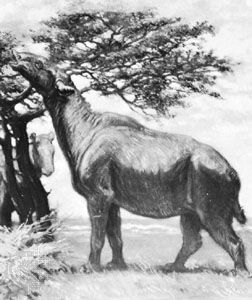
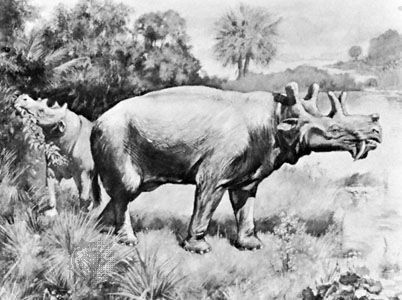
A brontothere (also known as a titanothere) is a member of an extinct group of large, hoofed, herbivorous mammals that lived during the Eocene and Oligocene…
What is brontothere?
A brontothere (also known as a titanothere) is a member of an extinct group of large, hoofed, herbivorous mammals that lived during the Eocene and Oligocene epochs, approximately 50 to 28 million years ago.12
These animals originated in Asia and North America and were perissodactyls, sharing a common ancestry with the dawn horse. Physically, they were bulky creatures with strong, pillar-like limbs, reaching heights of up to 2.5 meters (8 feet) at the shoulder. Despite their massive, long skulls, they possessed relatively small brains. Many species were characterized by a pair of large, bony, skin-covered horns on the front of the head, which may have been used for defense or intraspecific combat. They were adapted to feed on soft vegetation and likely moved in herds.132
How are brontotheres related to modern horses?
Brontotheres (also known as titanotheres) and modern horses are related through their shared classification as perissodactyls, an order of odd-toed, hoofed mammals.15
Their evolutionary connection is rooted in a common ancestor that lived during the early Eocene Epoch, which was likely very similar to the dawn horse (Hyracotherium). While they share this ancient lineage, the two groups diverged significantly in their physical development:1
- Ancestral Link: Both groups originated from small, browsing mammals that possessed a primitive, bunodont (low-rounded cusp) dentition.56
- Divergent Paths: While the Equidae family evolved toward specialized grazing, developing high-crowned teeth and a single-toed, rigid limb structure for swift running, brontotheres evolved into massive, graviportal (heavy-bodied) browsers.576
- Anatomical Differences: Unlike the modern horse’s specialized, single-hoofed foot, brontotheres retained a more primitive foot structure with four toes on the forefeet and three on the hindfeet. Additionally, brontotheres developed unique, large, bony horn-like processes on their skulls, a feature not found in the horse lineage.571
What were the primary predators of brontotheres?
The provided search results do not contain information regarding the specific predators of brontotheres. While the records note that these animals possessed large, bony protuberances that may have served as defensive weapons against predators, the specific species that preyed upon them are not identified in the available data.1
How did the environment change during the Oligocene Epoch?
During the Oligocene Epoch (33.9 to 23 million years ago), the Earth experienced significant climatic and environmental shifts following the warmer conditions of the preceding Eocene.9
Climate and Geography
The epoch was defined by a steady decline in global temperatures, driven in part by tectonic movements that altered ocean circulation. The opening of the Drake Passage between South America and Antarctica isolated Antarctica within a cold polar sea, facilitating the development of a continental ice sheet. While many regions maintained temperate or subtropical conditions, the overall cooling trend led to a shift in vegetation zones toward the Equator.10119
Terrestrial Environment
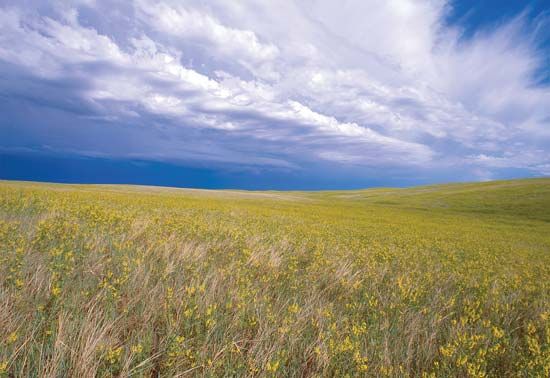
The landscape underwent a notable transformation as forested regions dwindled and grasslands began to expand. This change in habitat influenced the evolution of terrestrial life, favoring the rise of modern mammalian groups.912
- Vegetation: Tropical flora flourished along the borders of the Tethyan Sea, while warm, swampy conditions in areas like modern-day Germany supported the formation of extensive lignite coal deposits.9
- Fauna: Following the extinction of archaic vertebrates at the end of the Eocene, land mammal communities became dominated by groups such as horses, rhinoceroses, and early primates.912
Sources
- brontothere — Encyclopædia Britannica
- titanothere — Encyclopædia Britannica
- perissodactyl - Titanotheres — Encyclopædia Britannica
- end-Triassic extinction — Encyclopædia Britannica
- perissodactyl - Limbs — Encyclopædia Britannica
- perissodactyl - Annotated classification — Encyclopædia Britannica
- horse - Evolution of the horse — Encyclopædia Britannica
- perissodactyl - Horses — Encyclopædia Britannica
- Climate change - Cenozoic climates — Encyclopædia Britannica
- Paleocene-Eocene Thermal Maximum — Encyclopædia Britannica
- Oligocene Epoch — Encyclopædia Britannica
- Tertiary Period - The rise of mammals — Encyclopædia Britannica
Published on · 3 min read