Brown Trout
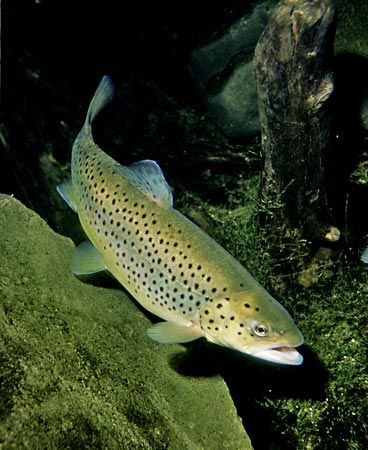
The brown trout (Salmo trutta) is a prized European game fish belonging to the family Salmonidae. It is widely recognized by the light-ringed black spots…
What is brown trout?
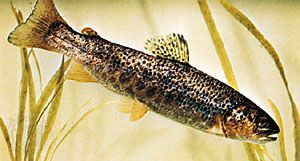
The brown trout (Salmo trutta) is a prized European game fish belonging to the family Salmonidae. It is widely recognized by the light-ringed black spots found on its brown body.12
As the only trout species still classified in the genus Salmo, the brown trout is highly valued for its ability to thrive in warmer waters than most other trout species. Because of this adaptability, it has been successfully introduced to suitable waters across the globe, including regions in Africa, South America, Australia, and New Zealand.123
While typically a freshwater fish, some individuals migrate to the sea; these ocean-going forms are known as sea trout and are generally larger than their freshwater counterparts. On average, brown trout grow to about 9 kilograms (20 pounds), though some specimens have been recorded weighing as much as 24 kilograms (53 pounds). They are popular both as a food source and for the sport they provide to anglers.124
What is the difference between a sea trout and a freshwater brown trout?
The primary difference between a sea trout and a freshwater brown trout lies in their migratory behavior and resulting physical characteristics, despite both belonging to the same species, Salmo trutta.15
- Migratory Behavior: While freshwater brown trout spend their entire life cycle within inland waters like streams or lakes, sea trout are ocean-going individuals. These fish migrate from freshwater environments to the sea to feed and mature before returning to their natal streams to spawn.137
- Size: Sea trout are generally larger than their freshwater counterparts. While the average brown trout grows to about 9 kilograms (20 pounds), the increased food availability in the marine environment allows sea-run individuals to reach greater sizes.1
- Classification: The term “sea trout” is a common name used for various trout and chars that enter the sea, whereas the brown trout is the only trout species still classified in the genus Salmo.15
Interestingly, the differences in their life cycles are often governed by slight heritable factors, and it is possible for offspring of non-migratory parents to go to sea if given the opportunity.3
How do brown trout differ from other trout species like rainbow or brook trout?
Brown trout (Salmo trutta) are distinguished from other trout species primarily by their unique classification and physical traits. While many trout species were formerly grouped in the genus Salmo, the brown trout is the only one that remains in that genus; species like the rainbow trout and cutthroat trout are now classified under the genus Oncorhynchus.3
Key differences include:
- Taxonomy and Anatomy: Members of the genus Oncorhynchus (such as rainbow trout) typically feature red or black spots on a lighter-colored body and possess teeth on both the front and shaft of the vomer bone. In contrast, brown trout are recognized by light-ringed black spots on a brown body.31
- Genus Salvelinus: Other common trout, such as the brook trout and lake trout, are actually members of the genus Salvelinus and are technically classified as chars. These are distinguished by red- or cream-colored spots on a darker body and teeth located only on the front of the vomer.3
- Environmental Adaptability: Brown trout are particularly noted for their ability to thrive in warmer water temperatures than most other trout species, which has facilitated their widespread introduction into diverse global environments.1
What does the life cycle of a trout look like from egg to adult?
The life cycle of a trout is a complex process shaped by natural selection, often beginning in cold, swift freshwater streams where the species is native.4
Egg and Embryonic Development
Trout are oviparous, meaning they lay eggs that are fertilized externally. Because these environments are often harsh with limited food, trout have evolved to produce relatively large, heavy (demersal) eggs that develop on or within the bottom of a stream or lake. These large eggs contain a significant yolk supply, which allows the young to undergo direct development, hatching in an advanced stage that resembles a miniature adult.4
Growth and Maturation
Once the yolk sac is absorbed, the young trout—often called fry—begin to fend for themselves. Depending on the specific population or species, their path to adulthood varies:4
- Resident Populations: Some trout complete their entire life cycle within a small area of their birth stream, maturing and spawning without ever leaving the freshwater environment.4
- Anadromous Populations: Other trout, such as steelhead, migrate to the ocean to feed and mature. During this transition, they may reach a stage known as a smolt, where they develop a silvery coloration and prepare for the physiological shift required for saltwater life.48
After reaching maturity, these fish return to their natal freshwater streams to spawn, completing the cycle.4
Sources
- brown trout — Encyclopædia Britannica
- brown trout — Merriam-Webster
- trout — Encyclopædia Britannica
- protacanthopterygian - Life cycle and reproduction — Encyclopædia Britannica
- protacanthopterygian - Behaviour and locomotion — Encyclopædia Britannica
- protacanthopterygian - Distribution and abundance — Encyclopædia Britannica
- Marine ecosystem - Migrations of marine organisms — Encyclopædia Britannica
- life span - Patterns of survival — Encyclopædia Britannica
- smolt — Merriam-Webster
Published on · 4 min read