Bull Shark
The bull shark (Carcharhinus leucas) is widely recognized as one of the most dangerous shark species to humans, ranking alongside the white shark and the…
How do bull sharks compare to other shark species in terms of aggression and attacks on humans?
The bull shark (Carcharhinus leucas) is widely recognized as one of the most dangerous shark species to humans, ranking alongside the white shark and the tiger shark in terms of its potential threat.12
While many shark species exist, only about 15 are considered dangerous to people. Bull sharks are particularly noted for their aggressive nature and their tendency to inhabit shallow coastal waters, estuaries, and rivers, which leads to frequent overlap with human activity. Because they have poor vision and rely on electroreception and smell to hunt, they may occasionally mistake humans for prey.213
Most recorded bull shark attacks are unprovoked and nonfatal, often appearing to be “probing bites” where the shark investigates a foreign object in the water. While the bull shark is a formidable predator, it is important to note that shark attacks are generally rare compared to other aquatic mishaps. Most interactions are not malicious but occur when sharks are hungry, harassed, or defending territory, or when human movements in the water—such as thrashing—mimic the behavior of wounded fish.14
How did the bull shark get its name, and are there any other common names for this species?
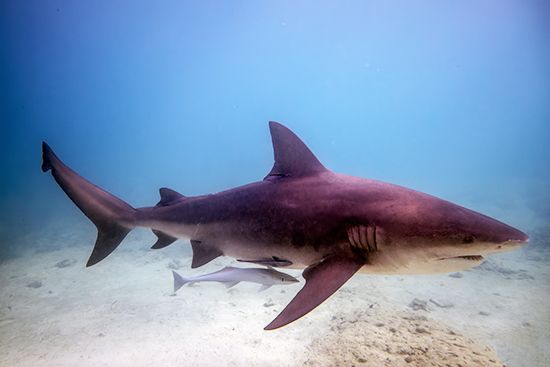
The bull shark (Carcharhinus leucas) derives its common name from its short, blunt snout and its pugnacious, aggressive temperament. While the provided search results do not explicitly detail the historical origin of the name, the species is widely characterized by its stout body and aggressive behavior, which are consistent with the “bull” moniker.41
It is important to distinguish the bull shark from the bullhead shark (genus Heterodontus). Despite the similarity in their names, these are entirely different animals. Unlike the aggressive and potentially dangerous bull shark, bullhead sharks are a group of harmless, bottom-dwelling marine sharks known for their broad heads and crushing teeth, which they use to feed on mollusks and crustaceans.5
The bull shark is sometimes referred to by regional names based on its habitat, such as the Zambezi shark in Africa, though “bull shark” remains the standard common name for the species globally.1
How do bull sharks reproduce, and what is their life cycle like?
Bull sharks (Carcharhinus leucas) exhibit a complex reproductive strategy characterized by internal fertilization and viviparity. During courtship, males may bite the fins and bodies of females to facilitate copulation. Following fertilization, females retain the developing young within their bodies for a gestation period of approximately 10 to 11 months.6
Key aspects of their life cycle and reproduction include:
- Birth: Females typically give birth to between 1 and 13 pups, which are born tail-first and are capable of independent existence immediately.6
- Reproductive Frequency: Females generally reproduce every other year.6
- Maturation: The species is slow to reach sexual maturity. Males typically mature by age 14 or 15, while females reach maturity at age 18.6
- Lifespan: Bull sharks generally live between 23 and 28 years, though some individuals have been recorded living up to 32 years.6
Unlike many other shark species, bull sharks are capable of breeding in both marine and freshwater environments, allowing them to utilize diverse nursery areas.6
What are the unique physical characteristics of bull sharks that distinguish them from other shark species?
The bull shark (Carcharhinus leucas) possesses several distinct physical characteristics that set it apart from other shark species:
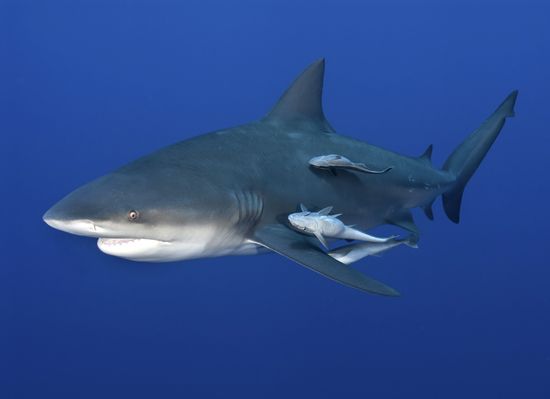
- Snout and Head Shape: The bull shark is easily recognized by its short, blunt snout. This feature, combined with its stout body, contributes to its pugnacious appearance.15
- Coloration: The species typically displays a pale to dark gray dorsal coloration, which contrasts with a white underside.1
- Size and Fins: They are large, active predators; females can reach lengths of up to 4 metres (about 13 feet) and weigh as much as 316.5 kg (about 700 pounds), while males are slightly smaller. They are also characterized by a large dorsal fin.1
- Physiological Adaptations: Perhaps their most unique trait is their ability to tolerate and thrive in freshwater environments. Unlike most sharks, they can live and breed in rivers, estuaries, and lakes, having been documented thousands of kilometers inland in systems like the Amazon and Zambezi rivers.51
- Sensory Systems: Bull sharks have poor vision and rely heavily on electroreception—the ability to detect weak electrostatic fields—and a keen sense of smell to locate prey.1
Sources
- bull shark — Encyclopædia Britannica
- shark - Hazards to humans — Encyclopædia Britannica
- chondrichthyan - Danger to human life — Encyclopædia Britannica
- bull shark — Merriam-Webster
- bullhead shark — Encyclopædia Britannica
- white shark - Reproduction — Encyclopædia Britannica
- shark - Description and habits — Encyclopædia Britannica
Published on · 3 min read