Bullhead
A bullhead is primarily any of several North American freshwater catfishes belonging to the genus Ameiurus (or Ictalurus) and the family Ictaluridae. Unlike…
What is bullhead?
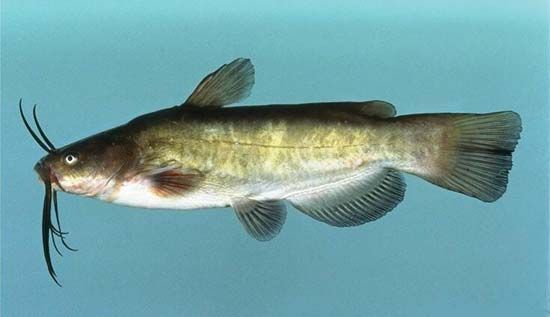
A bullhead is primarily any of several North American freshwater catfishes belonging to the genus Ameiurus (or Ictalurus) and the family Ictaluridae1. Unlike their larger relatives, such as the channel catfish, bullheads typically have squared tails and measure less than 30 centimeters (12 inches) in length. They are widely valued as both food and sport fish.1
Common species include:
- Black bullhead (A. melas): Found in the Mississippi valley.1
- Yellow and brown bullheads (A. natalis and A. nebulosus): Found east of the Rocky Mountains.1
- Flat bullhead (A. platycephalus): Found in coastal streams between North Carolina and Florida.1
The term “bullhead” is also occasionally applied to other large-headed fishes, such as sculpins and sea poachers.12
How do bullhead catfish differ from channel catfish?
Bullhead and channel catfish are both members of the family Ictaluridae, but they exhibit distinct physical and size differences:
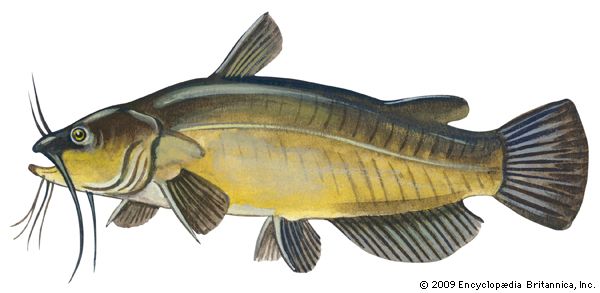
- Tail Shape: The most notable visual difference is the tail. Bullheads possess a squared tail, whereas the channel catfish (I. punctatus) has a distinctly forked tail.1
- Size: Bullheads are generally smaller, typically measuring less than 30 centimeters (12 inches) in length. In contrast, the channel catfish is a larger species that can grow to approximately 1 meter in length and reach weights of up to 12 kilograms.13
Both groups are widely recognized as important food and sport fishes in North America. While they share the characteristic long barbels and lack of scales common to all catfishes, their specific morphological traits allow for easy identification in the field.13
What are the physical characteristics that define a catfish?
Catfish, which belong to the order Siluriformes, are defined by several distinct physical characteristics that set them apart from other fish groups:
- Barbels: The most recognizable feature is the presence of long, whisker-like sensory organs called barbels around the mouth. All species have at least one pair on the upper jaw, and many also possess additional pairs on the snout and chin.3
- Skin and Armor: Catfish are either “naked” (lacking scales) or covered in bony plates. They do not possess true scales.34
- Fins and Spines: Most species have an adipose fin on their back. Additionally, many catfish have sharp spines located in front of their dorsal and pectoral fins, which can sometimes be associated with venom glands, capable of causing painful injuries.3
- Internal Anatomy: As members of the superorder Ostariophysi, they possess a Weberian apparatus, a complex system of bones that connects the swim bladder to the internal ear, enhancing their hearing.34
Why are some catfish species considered dangerous to handle?
Some catfish species are considered dangerous to handle primarily due to their specialized defense mechanisms, which can cause painful injuries to humans.
- Venomous Spines: Many catfish possess hardened fin rays, known as spines, located in front of their dorsal and pectoral fins. In certain groups—including bullheads and madtoms (Ictaluridae), labyrinthic catfishes (Clariidae), and sea catfishes (Ariidae and Plotosidae)—these spines are associated with venom glands at their base. If the skin is punctured, the venom is injected, resulting in significant pain.89
- Electrical Discharge: The electric catfish (Malapterurus electricus) is uniquely dangerous because it can generate a powerful electrical charge of up to 450 volts, which is sufficient to stun humans.89
While these injuries are typically painful rather than fatal, they pose a clear risk to those who handle these fish without proper caution. It is essential to respect these natural defenses when interacting with or studying these species in their environments.89
Sources
- bullhead — Encyclopædia Britannica
- bullhead — Merriam-Webster
- catfish — Encyclopædia Britannica
- ostariophysan - Annotated classification — Encyclopædia Britannica
- ostariophysan - Secondary sexual characteristics — Encyclopædia Britannica
- muscle - Jawed fishes — Encyclopædia Britannica
- fish - Annotated classification — Encyclopædia Britannica
- perciform - Danger to human life — Encyclopædia Britannica
- ostariophysan - Defense — Encyclopædia Britannica
Published on · 3 min read