Brotula
Very little is known about the general biology and reproductive habits of brotulas, which are often grouped with cusk eels in the family Ophidiidae.
How do brotula fish reproduce and what is known about their life cycle?
Very little is known about the general biology and reproductive habits of brotulas, which are often grouped with cusk eels in the family Ophidiidae.12
Regarding their reproduction, it has been established that members of this family are both oviparous (egg-laying) and viviparous (live-bearing). In some of the viviparous species, males are known to produce spermatophores, which are specialized sperm cases. Beyond these basic facts, specific details concerning their life cycles remain largely unstudied due to the deep-sea nature of most species.21
Are there any commercial or ecological significance to brotula fish?
The available information does not provide specific details regarding the commercial or ecological significance of brotula fish. While it is noted that deep-sea members of the family Ophidiidae are among the most abundant groups in the deep sea, their specific roles within those ecosystems or their value in commercial fisheries are not documented in the provided search results.1
Because most brotulas inhabit extreme depths—up to 7,300 meters—they remain poorly studied, and their interactions with human activities or broader ecological networks are not currently well understood.1
What is a brotula and what family of fish does it belong to?
A brotula is a type of marine fish comprising approximately 200 to 220 species. While some authorities classify them within the family Ophidiidae—the same family that includes cusk eels—others categorize them separately as the family Brotulidae.1
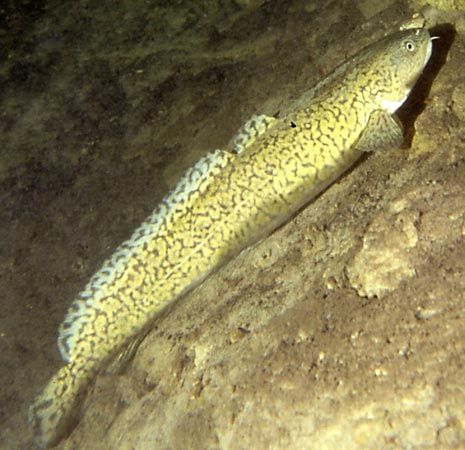
These fish are generally characterized by their elongated bodies, pointed tails, and a single continuous fin formed by the union of the dorsal, anal, and tail fins. They vary significantly in size, ranging from a few centimeters to about 90 cm (3 feet) in length. While most are deep-sea dwellers—some found at depths of up to 7,300 meters—a few species inhabit shallow waters or freshwater caves in tropical America. Depending on the species, they may have functional eyes or be nearly blind.1
Are there any unique behaviors or adaptations that brotula fish exhibit?
Brotula fish exhibit several unique adaptations and behaviors, though much of their biology remains a mystery due to their extreme habitats.
Physical Adaptations
- Body Structure: They possess elongated bodies with pointed tails and a single continuous fin formed by the fusion of the dorsal, anal, and tail fins.1
- Sensory Evolution: While some species retain functional eyes, others—particularly those living in deep-sea environments or freshwater caves—are nearly or completely blind, having adapted to life in total darkness.1
- Habitat Range: They are remarkably resilient, occupying a vast vertical range that extends from shallow waters to depths of approximately 7,300 meters (24,000 feet).1
Reproductive Behaviors
- Diverse Strategies: Brotulas and their relatives in the family Ophidiidae display both oviparous (egg-laying) and viviparous (live-bearing) reproductive strategies.3
- Sperm Transfer: In some viviparous species, males have been observed producing spermatophores, which are specialized sperm cases used during reproduction.3
Sources
- brotula — Encyclopædia Britannica
- echinoderm - Sexual reproduction — Encyclopædia Britannica
- paracanthopterygian - Life cycle and reproduction — Encyclopædia Britannica
- conservation - In the oceans — Encyclopædia Britannica
- Ophidiidae — Merriam-Webster
- cusk eel — Encyclopædia Britannica
Published on · 2 min read