Bruniaceae
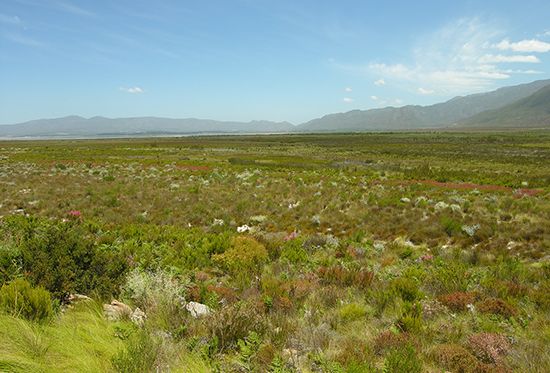
Bruniaceae is a family of shrubby, evergreen plants native to southern Africa. Comprising 12 genera, these plants are characterized by their clusters of thin…
What is Bruniaceae?
Bruniaceae is a family of shrubby, evergreen plants native to southern Africa. Comprising 12 genera, these plants are characterized by their clusters of thin branches and small leaves, often bearing a resemblance to heather.1
Within the broader classification of angiosperms, the family is placed in the order Bruniales, alongside the family Columelliaceae. While many species remain wild, certain members of the genera Brunia and Berzelia are cultivated as ornamentals for their aesthetic appeal. For example, Brunia stokoei is notable for its hairy red and white flowers and can reach heights of up to 5 meters (16 feet).21
What are some other plant families found in southern Africa?
Southern Africa, particularly the Cape floristic region, is home to an extraordinarily diverse array of plant families. Many of these are well-represented in the fynbos scrubland ecosystem.
Key plant families found in this region include:
- Proteaceae: A prominent family of woody shrubs and trees, including well-known genera such as Protea and Leucadendron.34
- Ericaceae: The heath family, which includes the diverse genus Erica. These plants are often adapted to acidic, nutrient-poor soils.356
- Fabaceae: The bean family, represented in the region by genera such as Aspalathus.3
- Asteraceae: The daisy family, which includes the widespread genus Senecio.3
- Aizoaceae: A family of herbs and small shrubs, such as the fig marigolds, often characterized by fleshy leaves.78
- Monocots: The region also hosts a rich variety of herbaceous families, including Iridaceae (irises), Poaceae (grasses), Liliaceae (lilies), and Orchidaceae (orchids)3.
The South African kingdom is unique, containing 11 endemic plant families and hundreds of endemic genera.9
What does it mean for a plant to be an evergreen shrub?
An evergreen shrub is a woody plant characterized by two primary features: its growth habit and its leaf retention.
- Shrub: A shrub is defined as a woody plant that typically has several stems rather than one dominant trunk and is usually less than 3 meters (10 feet) tall. While these distinctions can vary based on environmental conditions, shrubs are generally distinguished from trees, which are taller and possess a single dominant stem.11
- Evergreen: An evergreen is any plant that retains its leaves throughout the year and into the following growing season. Unlike deciduous plants, which shed their leaves annually, evergreens keep their foliage for up to several years. These leaves are often thicker and more leathery than those of deciduous species, which helps the plant resist water loss.1213
Together, these terms describe a perennial plant with durable, woody stems that maintains its foliage year-round.13
How are ornamental plants typically classified?
Ornamental plants are classified using several systems depending on whether the focus is on their biological characteristics, life cycles, or their functional use in landscape design.
Biological and Life Cycle Classification
Plants are frequently categorized by their growth habit and longevity:
- Woody vs. Herbaceous: Woody plants, such as trees and shrubs, possess durable stems that survive over multiple years. Herbaceous plants lack true woody tissue, typically have flexible stems, and are often categorized by their life span.1415
- Life History: In temperate regions, plants are often grouped by how long they take to complete their life cycle:
Landscape and Design Classification
For horticultural and design purposes, plants are organized by their physical properties and environmental needs:
- Design Elements: Landscape architects classify plants by size (trees, shrubs, ground covers), form (vertical, horizontal, round), texture, color, and fragrance.17
- Functional Use: Plants are selected based on their rate of growth, seasonal effects, and environmental requirements, such as soil type, drainage, and light exposure.17
- Industry Categories: The industry often divides ornamentals into floriculture (flowers and pot plants) and landscape horticulture (nursery crops, including woody plants and bulb crops like corms and rhizomes).18
Sources
- Bruniaceae — Encyclopædia Britannica
- angiosperm - Annotated classification — Encyclopædia Britannica
- Fynbos — Encyclopædia Britannica
- Proteales — Encyclopædia Britannica
- Ericales - Ericaceae — Encyclopædia Britannica
- Ericaceae — Encyclopædia Britannica
- Aizoaceae — Merriam-Webster
- Floristic region — Encyclopædia Britannica
- biogeographic region - South African kingdom — Encyclopædia Britannica
- Aizoon — Merriam-Webster
- evergreen — Encyclopædia Britannica
- shrub — Encyclopædia Britannica
- plant - Classification of angiosperms — Encyclopædia Britannica
- horticulture - Herbaceous perennials — Encyclopædia Britannica
- horticulture - Ornamental horticulture — Encyclopædia Britannica
- gardening - Herbaceous plants — Encyclopædia Britannica
- horticulture - Trees — Encyclopædia Britannica
- garden and landscape design - Plants — Encyclopædia Britannica
- herbaceous plant — Encyclopædia Britannica
Published on · 3 min read