Brunonia
Brunonia is a genus of perennial herbs belonging to the family Goodeniaceae. It consists of a single species, Brunonia australis, which is native to…
What is Brunonia?
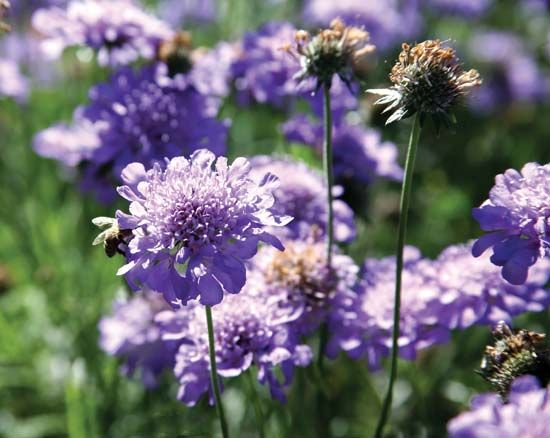
Brunonia is a genus of perennial herbs belonging to the family Goodeniaceae. It consists of a single species, Brunonia australis, which is native to Australia and Tasmania.1
Commonly known as the blue pincushion, this plant typically grows to a height of 30 cm (1 foot) and features spade-shaped leaves arranged in rosettes at the base of the stem. It is characterized by its long-stalked, globular heads of showy, five-lobed blue flowers, with seeds produced singly in small, dry fruits. The genus was named in honor of the Scottish botanist Robert Brown.12
Who was the botanist Robert Brown?
Robert Brown (1773–1858) was a prominent Scottish botanist whose pioneering work significantly advanced the fields of botany and microscopy.
He is perhaps best known for his 1827 observation of the random, oscillatory movement of microscopic particles suspended in fluid, a phenomenon now called Brownian motion in his honor. Additionally, he is credited with identifying the cell nucleus in 1831, a discovery that contributed to the development of cell theory.34
Brown’s botanical career was defined by his extensive research on Australian flora. As a naturalist aboard the Investigator (1801–1805), he collected approximately 3,900 species, most of which were new to science. His work laid the foundations for Australian botany and refined plant classification, including the distinction between gymnosperms and angiosperms. He later served as the keeper of the British Museum’s botanical department.3
(Note: This should not be confused with the British astronomer Robert Hanbury Brown, who was known for his work in radar and radio astronomy.)5
What are some other unique plants native to Australia?
Australia is home to a diverse array of unique flora, many of which have evolved in isolation or adapted to the continent’s specific environmental conditions, such as low soil nutrient levels.6
Some notable examples include:
- Eucalyptus: Represented by over 400 species, these range from small mallees to some of the world’s tallest trees, thriving in environments from rainforests to deserts.6
- Acacia: With approximately 700 species, these include the golden wattle (Acacia pycnantha), which serves as Australia’s national floral emblem.67
- Kangaroo Paw: A sedgelike herb (Anigozanthos manglesii) known for its clustered, woolly flowers; it is the floral emblem of Western Australia.87
- Waratah: A striking plant of the genus Telopea that produces large, showy crimson flower heads and is the floral emblem of New South Wales.97
- Wollemi Pine: Discovered in 1994, this is considered one of the world’s oldest and rarest tree species.10
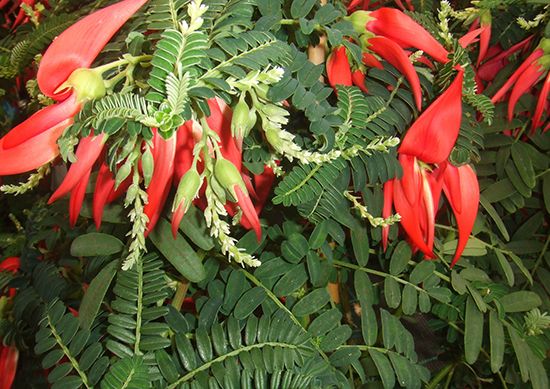
- Sturt’s Desert Pea: A distinctive flowering plant that serves as the floral emblem of South Australia.7
How do perennial herbs survive in different climates?
Perennial herbs survive across diverse climates by utilizing specialized structural modifications that allow them to endure unfavorable conditions, such as extended winters or periods of drought.1314
In temperate regions, the aboveground portions of many herbaceous perennials typically die back at the end of the growing season. To survive the winter, these plants rely on subterranean storage organs that remain dormant underground. These modifications include:1315
- Bulbs and Corms: Short, upright, or fleshy structures that store nutrients and provide resistance to cold and drought.1314
- Rhizomes: Horizontal, underground stems that store food and facilitate vegetative reproduction, allowing the plant to spread and send up new shoots when conditions improve.14
- Tubers: Enlarged, fleshy storage organs derived from stems that support survival and propagation.14
In tropical or arid environments, these survival strategies may differ. Some plants that act as perennials in their native tropical regions may bloom and fruit within their first year, leading them to be cultivated as annuals in temperate zones. Additionally, some plants adapt to arid habitats through shoot system modifications, such as developing water-storing stems or protective structures, to manage extreme heat and water scarcity.1614
Sources
- Brunonia — Encyclopædia Britannica
- Brunonia — Merriam-Webster
- Robert Brown — Encyclopædia Britannica
- Brownian motion — Encyclopædia Britannica
- Robert Hanbury Brown — Encyclopædia Britannica
- Australia - Plant life — Encyclopædia Britannica
- kangaroo paw — Merriam-Webster
- South Australia - Plant and animal life — Encyclopædia Britannica
- waratah — Merriam-Webster
- kangaroo's-foot — Merriam-Webster
- New South Wales - Plant and animal life — Encyclopædia Britannica
- Australia - National and state emblems of Australia — Encyclopædia Britannica
- perennial — Encyclopædia Britannica
- angiosperm - General features — Encyclopædia Britannica
- angiosperm - Shoot system modifications — Encyclopædia Britannica
- life span - Perennials — Encyclopædia Britannica
Published on · 3 min read