Buffalo Gap National Grassland
The Buffalo Gap National Grassland supports a diverse range of wildlife adapted to its semiarid prairie habitat. The species found in the region include:
What wildlife species can be found in Buffalo Gap National Grassland?
The Buffalo Gap National Grassland supports a diverse range of wildlife adapted to its semiarid prairie habitat. The species found in the region include:
- Mammals: Pronghorn, bison, bighorn sheep, coyotes, badgers, deer, jackrabbits, kangaroo rats, and prairie dogs.1
- Endangered Species: The highly endangered black-footed ferret has been successfully reintroduced to the area.1
- Birds: The grassland is home to a wide variety of bird species.1
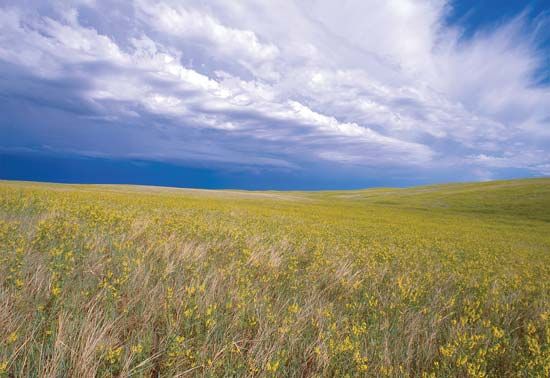
The habitat, which consists of midgrass, tallgrass, and shortgrass prairies, as well as wetlands and woody stream patches, provides the necessary environment for these animals to thrive.1
What is the geographical location and size of Buffalo Gap National Grassland?
The Buffalo Gap National Grassland is located in southwestern South Dakota, U.S., and encompasses approximately 925 square miles (2,400 square km) of scattered land parcels.1
The area is organized into two distinct districts:
- Eastern District: Headquartered in Wall, this section runs along the northern border of the Pine Ridge Reservation and nearly encircles the northern portion of Badlands National Park.Badlands National Park](https://www.britannica.com/place/Badlands-National-Park).1
- Western District: Headquartered in Hot Springs, this area occupies the southwestern corner of the state and extends south along the western border of the Pine Ridge Reservation, adjoining the Oglala National Grassland in Nebraska.1
Established in 1960, the grassland is administered as part of the Nebraska National Forest.1
How was Buffalo Gap National Grassland established, and what is its historical significance?
The Buffalo Gap National Grassland was established in 1960 and is currently administered as part of the Nebraska National Forest.
Regarding its historical significance, the area is notable for its rich paleontological record. The region’s badlands and grasslands frequently yield significant fossil discoveries, which provide insights into the prehistoric life of the Great Plains. A particularly notable find in the broader vicinity is a large cache of bison bones located northwest of Crawford, which highlights the area’s long history of supporting diverse wildlife populations.
Furthermore, the grassland serves as a living record of the region’s ecological and cultural heritage. The National Grasslands Visitor Center in Wall, South Dakota, preserves this history through displays of rocks, minerals, and fossils, while also documenting the environmental evolution of the prairie. Today, the land continues to play a vital role in the regional economy by providing essential grazing land for cattle, maintaining a tradition of land use that has long defined the local communities.
What are the main ecological features and types of vegetation found in Buffalo Gap National Grassland?
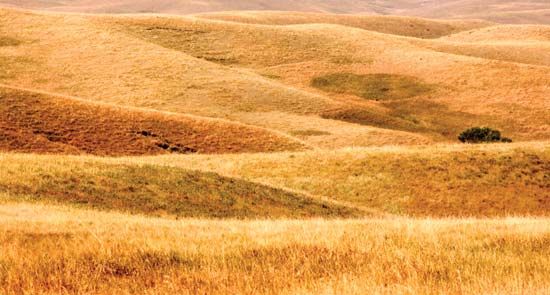
The Buffalo Gap National Grassland is characterized by a semiarid climate with fluctuating precipitation and drought cycles. The landscape is primarily flat, creating expansive, open vistas where constant winds blow across the terrain with little obstruction.1
Ecological Features
The habitat is diverse, consisting of several distinct ecological zones:
- Prairie Types: The area is primarily composed of midgrass prairie, with additional segments of tallgrass and shortgrass prairie.1
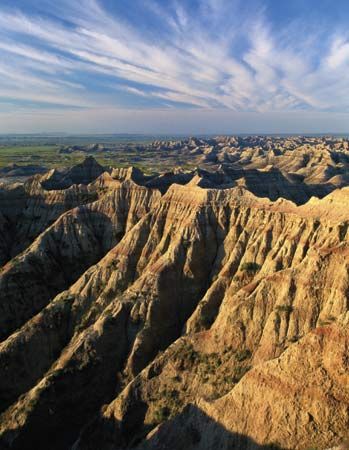
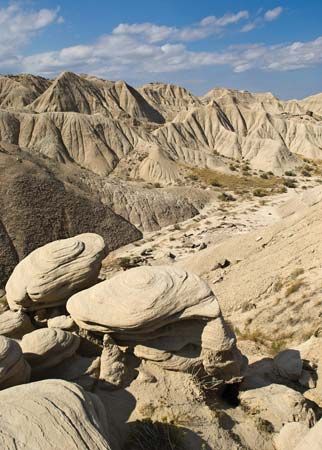
- Badlands: The region features rugged, eroded badlands characterized by peaks, ridges, and valleys formed by wind and water erosion.14
- Wetlands and Streams: While natural water sources are limited, the grassland contains artificial wetlands and woody patches that grow along stream corridors.1
Vegetation
The flora of the Buffalo Gap National Grassland is highly varied, supporting a wide range of plant life:
Sources
- Buffalo Gap National Grassland — Encyclopædia Britannica
- Oglala National Grassland — Encyclopædia Britannica
- Little Missouri National Grassland — Encyclopædia Britannica
- Badlands National Park — Encyclopædia Britannica
Published on · 3 min read