Bunchberry
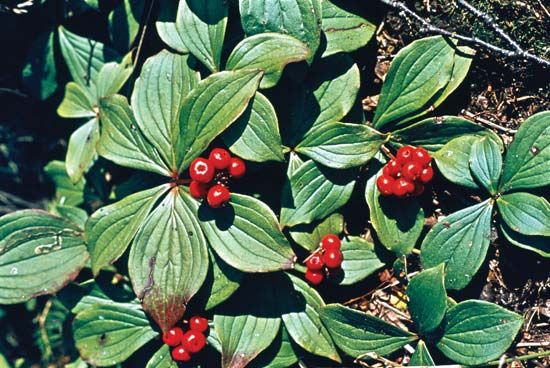
Bunchberry (Cornus canadensis) is a creeping perennial herb belonging to the dogwood family (Cornaceae).
What is bunchberry?
Bunchberry (Cornus canadensis) is a creeping perennial herb belonging to the dogwood family (Cornaceae).12
The plant is characterized by its whorled leaves and small, inconspicuous yellowish flowers. These flowers are surrounded by four large, showy white—or occasionally pink—petallike bracts, which are actually modified leaves. Following the flowering stage, the plant produces clusters of red fruits.12
Bunchberry typically thrives in acid soils, bogs, and on upland slopes. Its natural range is extensive, spanning across Asia and throughout North America, from Greenland to Alaska, and extending south into regions including New Mexico, California, and Maryland.1
How does the bunchberry plant disperse its seeds?
What other plants belong to the dogwood family?
The dogwood family (Cornaceae) consists of various trees, shrubs, and herbs primarily native to temperate regions. The family is defined by its small, clustered flowers, inferior ovaries, and drupaceous fruits.34
The most prominent genus within this family is Cornus, which includes several notable species:
- Flowering dogwood (C. florida): A North American species widely cultivated as an ornamental for its showy, petal-like bracts.3
- Bunchberry (C. canadensis): A creeping perennial herb.3
- Cornelian cherry (C. mas): A European species known for its edible fruit, which is used in preserves and wine.3
- Pacific (or mountain) dogwood (C. nuttallii): A species that shares similarities with the flowering dogwood.3
- Red twig (or red osier) dogwood (C. sericea): A North American species valued for its bright red winter twigs and vibrant fall foliage.3
Why are the white parts of the bunchberry flower called bracts?
The white, petal-like structures on a bunchberry are classified as bracts because they are modified, leaflike structures rather than true petals.5
In many plants, including those in the dogwood family, these specialized leaves are positioned beneath the actual flower or inflorescence. While the bunchberry’s true flowers are small, yellowish, and relatively inconspicuous, these four large, showy bracts serve to attract pollinators, often leading observers to mistake them for the plant’s petals. This evolutionary adaptation is also seen in other plants, such as the poinsettia, where colorful bracts perform a similar visual function.25
Sources
- bunchberry — Encyclopædia Britannica
- bunchberry — Merriam-Webster
- dogwood — Encyclopædia Britannica
- Cornaceae — Merriam-Webster
- Bract — Encyclopædia Britannica
Published on · 2 min read